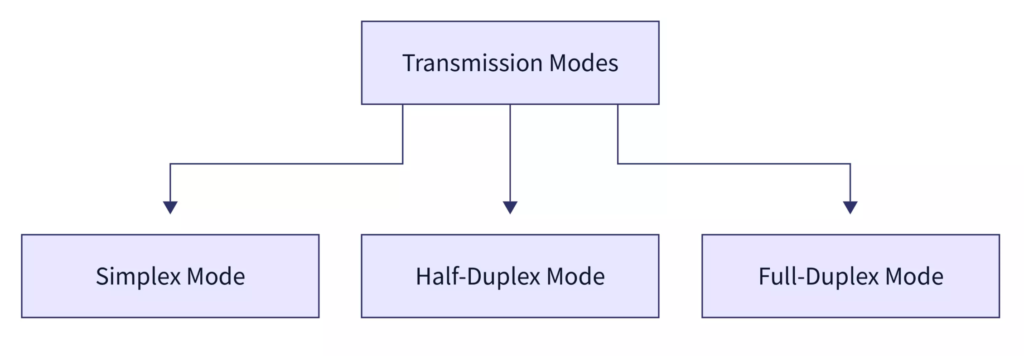
Transmission modes define how data flows between devices in a computer network. They determine the direction of communication and how efficiently devices can exchange information. Understanding these modes is essential for designing reliable and efficient communication systems.
1. Simplex Mode
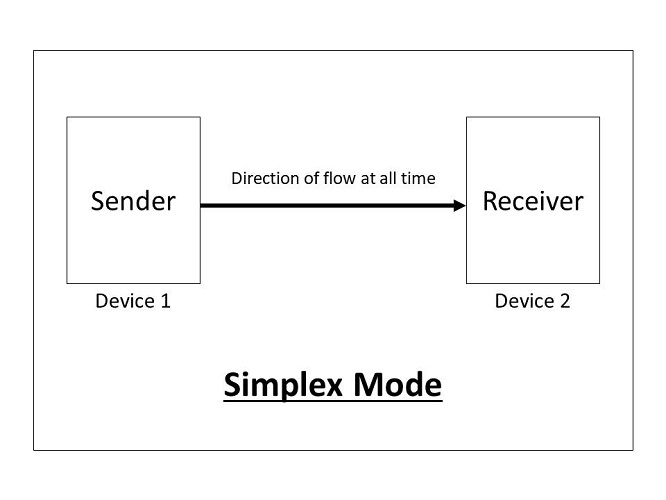
In simplex mode, data flows in only one direction. One device acts as the sender and the other as the receiver. There is no capability for the receiver to send data back.
Examples:
- Keyboard sending input to a computer
- Television broadcasting signals to viewers
Advantages:
- Simple and easy to implement
- No data collision since communication is one-way
Disadvantages:
- No feedback mechanism
- Inefficient for interactive communication
2. Half-Duplex Mode
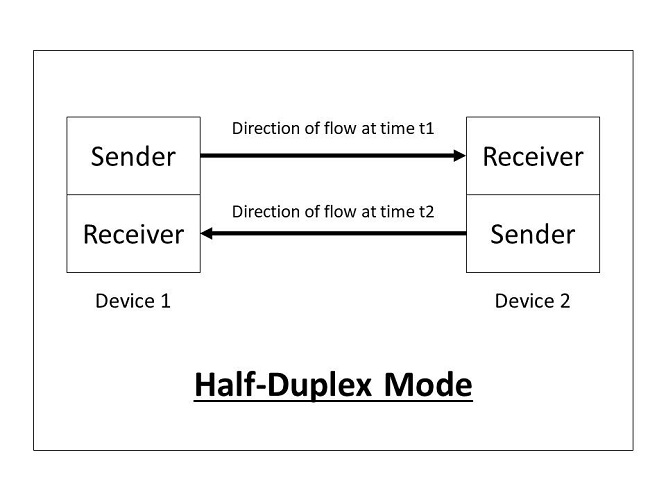
In half-duplex mode, data can flow in both directions, but not at the same time. Devices take turns transmitting and receiving.
Examples:
- Walkie-talkies
- CB radios
Advantages:
- Allows two-way communication
- More efficient than simplex
Disadvantages:
- Communication delay due to turn-taking
- Not suitable for real-time continuous communication
3. Full-Duplex Mode
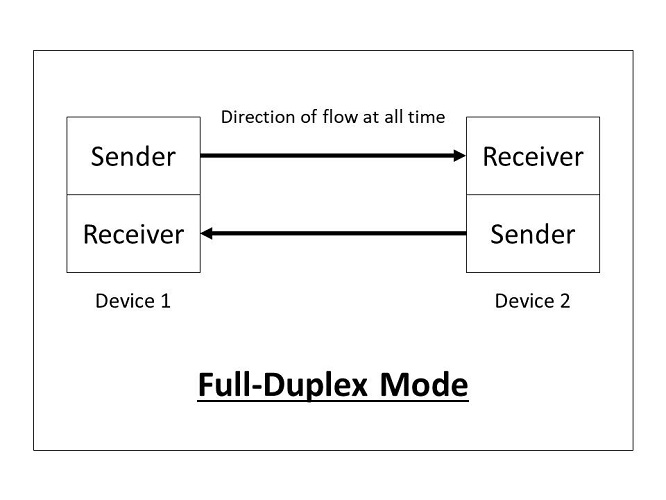
In full-duplex mode, data can be transmitted and received simultaneously. Both devices can communicate at the same time without waiting.
Examples:
- Telephone conversations
- Modern computer networks and Ethernet
Advantages:
- Fast and efficient communication
- No waiting time between transmissions
Disadvantages:
- More complex system design
- Higher cost compared to simplex and half-duplex
Comparison of Transmission Modes
| Feature | Simplex | Half-Duplex | Full-Duplex |
|---|---|---|---|
| Direction | One-way | Two-way (one at a time) | Two-way (simultaneous) |
| Efficiency | Low | Medium | High |
| Complexity | Low | Medium | High |
| Example | Keyboard | Walkie-talkie | Telephone |
Conclusion
Modes of transmission are a fundamental concept in computer networks that directly impact communication performance. Simplex is useful for one-way systems, half-duplex supports basic two-way communication, and full-duplex provides the most efficient and seamless data exchange. Choosing the right mode depends on the application requirements, cost, and desired performance.