What is Switching in Networking ?
Switching is a process of transferring data packets from one device to another in a network using specific devices called switches.
In large networks, there can be multiple paths from sender to receiver. The switching technique will decide the best route for data transmission. Switching technique is used to connect the systems for making one-to-one communication.
Types of Switching Technique
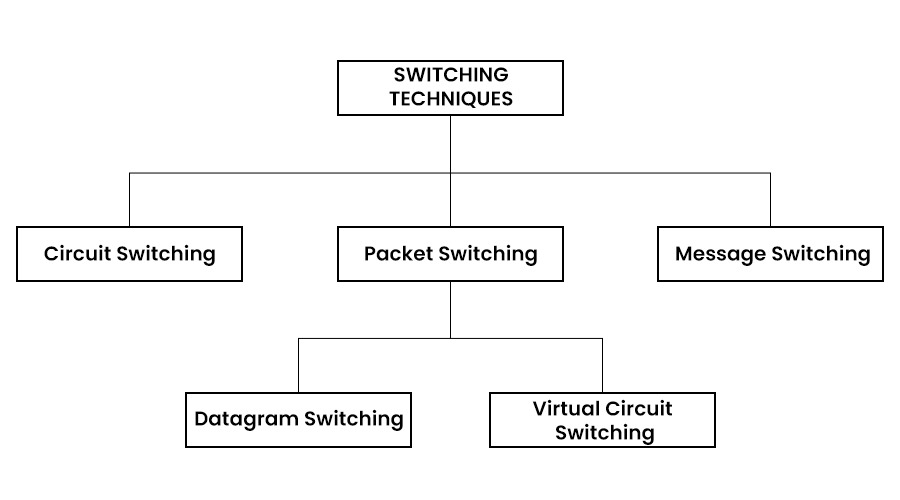
There are three main types of switching in computer networks, which include circuit switching, packet switching, and message switching.
1) Circuit Switching
Circuit switching is a switching method that creates a dedicated path between the transmitter and the receiver it is known as “Circuit Switching”. This type of switching is designed for the “Telephone Netwoking” where the connection between the sender and receivers established before the transmission of the data.
In circuit switching, when a user wants to send data (voice, video), a request signal is sent to the receiver. The receiver sends back an acknowledgement to ensure the availability of the dedicated path. After receiving the acknowledgement, the data is transmitted through the established path.
Phases of Circuit Switching
1. Circuit Termination
2. Circuit Establishment
3. Data Transfer
3) Message Switching
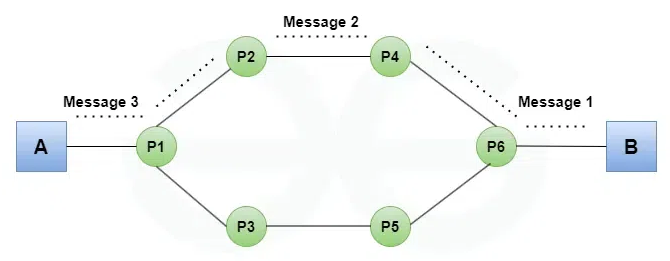
Message switching is a switching mechanism that transfers a message as a full and complete unit and routes it through intermediate nodes which store and forward the message. There is no specific path between the sender and recipient in the Message Switching method.
The message’s destination address is added. Message Switching enables and facilitates dynamic routing by routing the message through intermediary nodes based on the information and data included in the message.
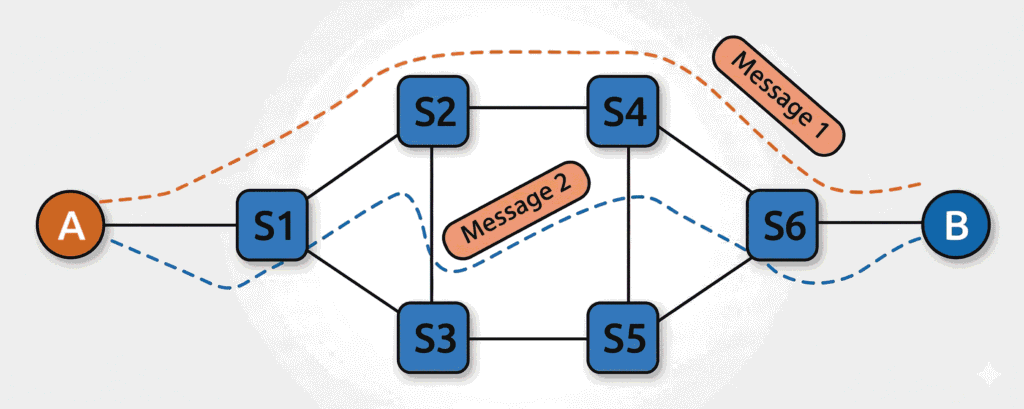
Message switches are configured in such a way that they give the most efficient routes. Every node saves the full message before forwarding it to the next node. This is referred to as a store and forward network.
Message switching handles each message as though it were a separate entity.
2) Packet Switching
Packet switching is a switching technique in which the message is split into smaller bits and delivered separately rather than all at once. The message is broken down into smaller bits known as packets, and each packet is assigned a unique number to indicate its sequence at the receiving end.
The headers of each packet contain information such as the source address, destination address, and sequence number. Packets will go across the network in the quickest possible way. At the receiving end, all packets are reassembled in the right order.
If any packet is missing or corrupted, the message will be resent. If the packets are received in the right order, the acknowledgment message is delivered.
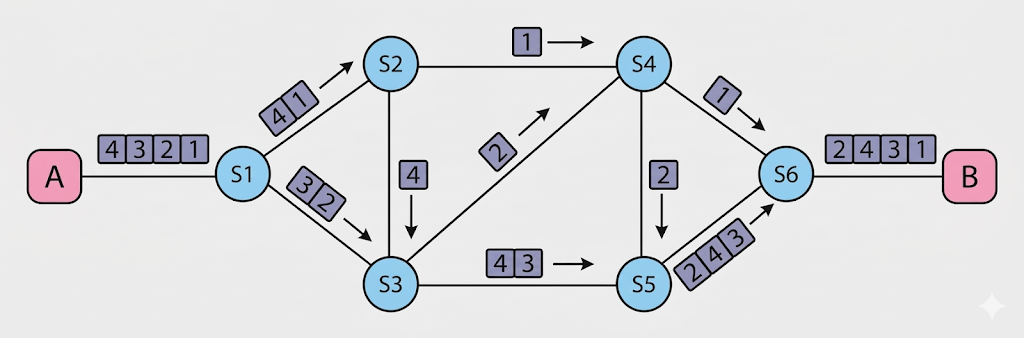
There are two methods to achieve Packet Switching:
1. Datagram Packet Switching:
It is a packet switching approach that treats each packet, known as a datagram, as a distinct entity. Each packet contains information about the destination, which the switch utilises to route the packet to the right location. At the receiving end, the packets are reassembled in the right order.
The route is not set in the Datagram Packet Switching method. To forward packets, intermediate nodes have to make important routing decisions. It is also known as connection-less switching.
2. Virtual Circuit Packet Switching:
Another name for virtual circuit switching is connection-oriented switching. Before messages are transmitted, a preplanned path is established in the case of virtual circuit switching.
The call request and call accept packets are used to connect the sender and recipient. The route is fixed in this situation for the duration of a logical link.
| Datagram Packet Switching | Virtual Circuit Packet Switching |
|---|---|
| To forward packets, the node makes routing decisions. | There is no routing decision made by the nodes. |
| Congestion cannot develop since all packets go in opposite directions. | Congestion occurs when a node is overburdened and does not allow other packets to flow through. |
| It is more adaptable since each packet is considered as an individual entity. | It is not particularly adaptable. |
FAQs on Switching Techniques in Computer Networks
What is switching? Explain Circuit switching and Packet switching in short.
Switching is the process of transferring data from a source device to a destination device through a network by selecting an appropriate path. And Packet switching is a switching technique in which the message is split into smaller bits and delivered separately rather than all at once.
What is the difference between circuit switching and packet switching?
Circuit switching uses a dedicated path for communication, while packet switching sends data in small packets through different paths without reserving a fixed route.
What are the main types of switching techniques?
The three main types are: Circuit Switching, Packet Switching, Message Switching