Vacuum Circuit Breaker (VCB)
A Vacuum Circuit Breaker is a switching device used in medium voltage power systems to protect electrical equipment from faults. It interrupts current by opening its contacts inside a sealed vacuum chamber. Because there is no air or gas inside, the arc that forms during contact separation is quickly extinguished.
Construction of a Vacuum Circuit Breaker
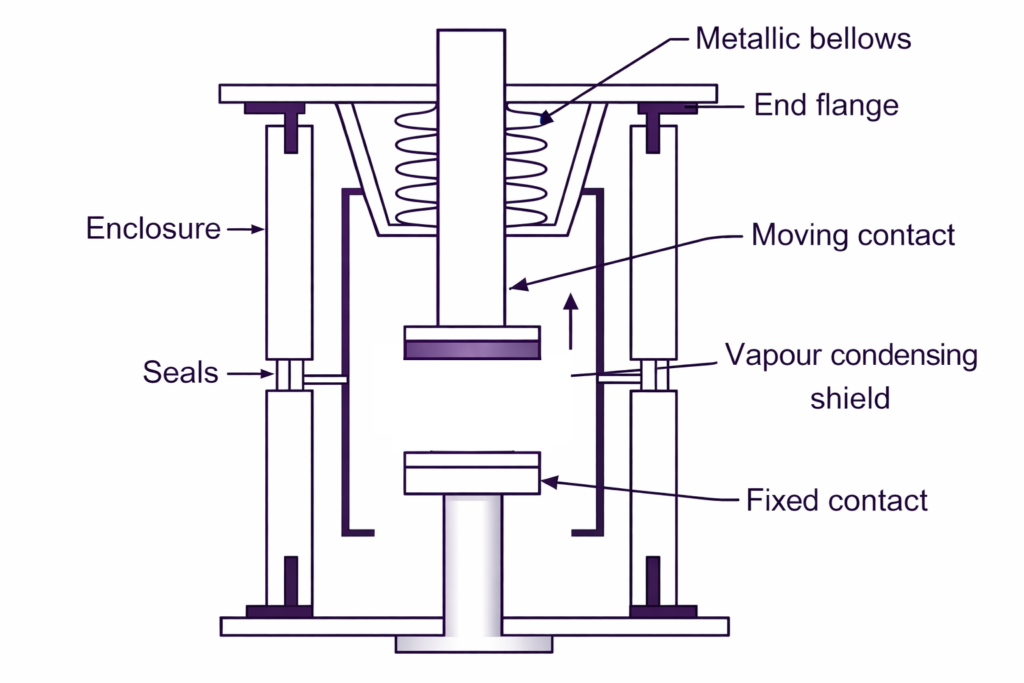
- A vacuum circuit breaker consists of a fixed contact, a moving contact and an arc shield mounted inside a sealed vacuum chamber.
- The moving contact is connected to the operating mechanism through stainless steel bellows.
- These bellows allow contact movement while maintaining a permanent vacuum seal, thereby eliminating the possibility of leakage.
- The outer insulating enclosure of the interrupter is made of a glass or ceramic vessel, which provides mechanical strength and electrical insulation.
- An arc shield is provided inside the interrupter to prevent metallic vapour produced during arcing from depositing on the inner surface of the insulating envelope.
- This helps in maintaining the internal dielectric strength of the vacuum interrupter.
Working of a Vacuum Circuit Breaker
When the breaker operates, the moving contact separates from the fixed contact and an arc is struck between them. This arc is produced due to the ionisation of metal vapour emitted from the contact surfaces, and its formation mainly depends on the material of the contacts. The arc is extinguished very quickly because the metallic vapours, electrons and ions produced during arcing are rapidly diffused and are absorbed by the surfaces of the fixed contact, moving contact and arc shield.
Since vacuum has a very high and fast rate of recovery of dielectric strength, the interruption takes place with a very small contact gap, typically of the order of about 0.625 cm.
Advantages of Vacuum Circuit Breaker (VCB)
- Very fast arc extinction because vacuum has very high dielectric recovery
- Very low maintenance since there is no oil and no gas
- No fire or explosion risk
- Long electrical and mechanical life
- Compact size and light weight
- Suitable for frequent switching operations
- Environment friendly compared to oil and SF₆ breakers
Disadvantages of Vacuum Circuit Breaker
- Not suitable for very high voltage levels (EHV and UHV systems)
- Vacuum interrupter is a sealed unit, it cannot be repaired and must be replaced if it fails
- Initial cost is higher compared to simple air circuit breakers
- Condition of vacuum inside the bottle cannot be checked easily from outside
Applications of Vacuum Circuit Breaker
- Medium voltage distribution systems
- Industrial plants
- Power stations
- Substations
- Railway traction systems
Related Posts: