Introduction
Solar panels are devices that convert sunlight directly into electrical energy using the photovoltaic effect. With the increasing demand for renewable energy, solar technology has evolved into different panel types designed to satisfy requirements such as high efficiency, low cost, flexibility, durability, and performance in different climates.
Each type of solar panel differs in construction, electrical behavior, temperature performance, and lifespan. Understanding these differences is essential for selecting the most suitable panel for residential, commercial, and industrial applications.
Classification of Solar Panels
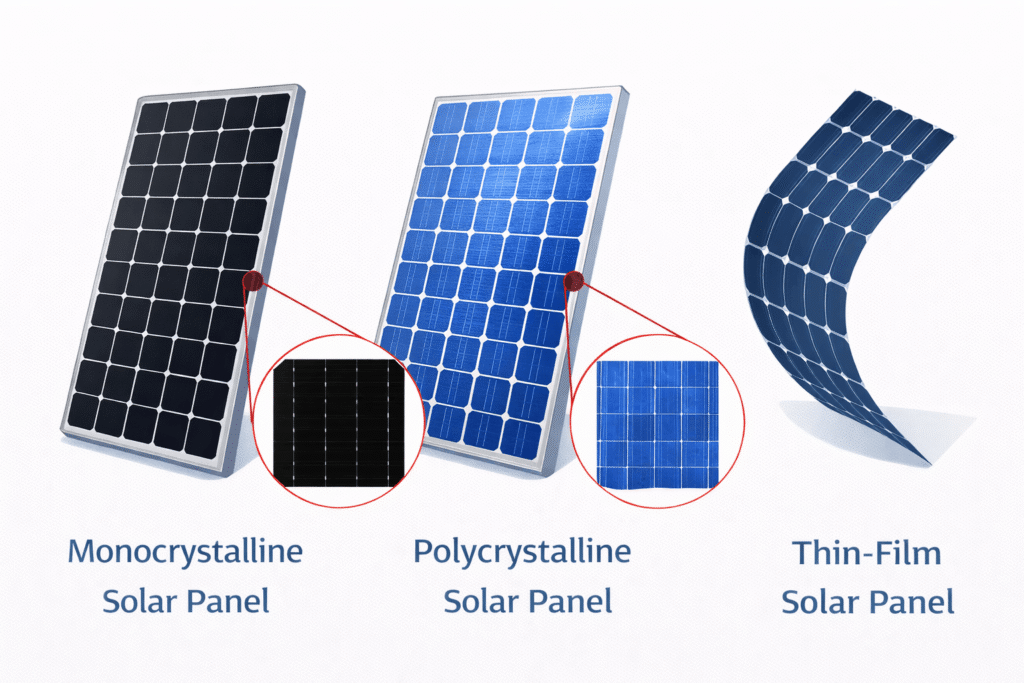
Solar panels are mainly classified into three categories based on manufacturing technology and material used. These include monocrystalline solar panels, polycrystalline solar panels, and thin-film solar panels. In modern systems, advanced technologies such as bifacial panels, PERC panels, and half-cut cell panels are also widely used to improve efficiency and energy yield.
Monocrystalline Solar Panels
Construction and Structure
Monocrystalline solar panels are manufactured from a single continuous crystal of high-purity silicon. The crystal is grown in cylindrical form and sliced into thin wafers to produce solar cells. Because the crystal structure is uniform, electrons flow easily through the material, resulting in high electrical efficiency and low internal resistance.
Performance Characteristics
These panels provide the highest efficiency among commercial panels, typically between 18% and 24%. They generate more power per unit area and maintain good performance even under low-light conditions. Their lower recombination losses result in higher voltage output and stable long-term performance.
Advantages
- High conversion efficiency and power output
- Requires minimum installation space
- Performs well in low-light and cloudy conditions
- Long service life of 25 to 30 years
- Low degradation rate over time
- Attractive uniform black appearance
Disadvantages
- High initial cost compared to other panels
- Energy-intensive manufacturing process
- More silicon wastage during production
- Slightly fragile and requires careful handling
Applications
- Residential rooftop solar systems
- Commercial and industrial buildings
- Urban areas with limited roof space
- High-performance grid-connected systems
- Hybrid solar power systems
Polycrystalline Solar Panels
Construction and Structure
Polycrystalline panels are produced by melting multiple silicon crystals together and casting them into square molds. After cooling, the solid block is sliced into wafers and processed into solar cells. The presence of multiple crystal boundaries restricts electron movement, resulting in slightly lower efficiency.
Performance Characteristics
Polycrystalline panels typically offer efficiency in the range of 15% to 18%. They produce moderate power output and show average performance under low-light conditions. Their electrical output decreases more noticeably when operating at higher temperatures.
Advantages
- Lower cost than monocrystalline panels
- Simpler and faster manufacturing process
- Less silicon wastage
- Environmentally friendly production
- Square shape allows better packing
Disadvantages
- Lower efficiency compared to monocrystalline
- Requires larger installation area
- Higher temperature sensitivity
- Slightly shorter lifespan
- Lower power density
Applications
- Residential rooftops with sufficient space
- Commercial buildings
- Large-scale solar power plants
- Budget-friendly solar installations
- Rural electrification projects
Thin-Film Solar Panels
Construction and Materials
Thin-film solar panels are manufactured by depositing very thin layers of photovoltaic material onto substrates such as glass, plastic, or metal. Common materials include amorphous silicon, cadmium telluride, and copper indium gallium selenide. These layers are much thinner than crystalline silicon wafers.
Performance Characteristics
Thin-film panels generally have efficiency between 10% and 13%. They perform better at high temperatures and under diffuse light conditions. Their output is less affected by partial shading, making them suitable for irregular illumination environments.
Mechanical Properties
These panels are lightweight, flexible, and mechanically robust. They can be mounted on curved surfaces and integrated into building structures. Their flexibility enables innovative architectural and portable applications.
Advantages
- Low manufacturing and material cost
- Lightweight and flexible construction
- Performs well at high temperatures
- Suitable for large-area installations
- Uniform and aesthetically pleasing surface
Disadvantages
- Lowest efficiency among all types
- Requires large installation area
- Shorter operational lifespan
- Higher degradation rate
- Lower power output per unit area
Applications
- Large commercial solar plants
- Building-integrated photovoltaic systems
- Portable solar chargers and devices
- Rooftops with weight limitations
- Facade-mounted solar systems
| Parameter | Monocrystalline | Polycrystalline | Thin-Film |
|---|---|---|---|
| Efficiency | Very high | Medium | Low |
| Cost | High | Medium | Low |
| Space | Least | More | Maximum |
| Lifespan | Long | Medium | Short |
| Heat tolerance | Good | Moderate | Excellent |
| Flexibility | No | No | Yes |
Advanced Solar Panel Technologies
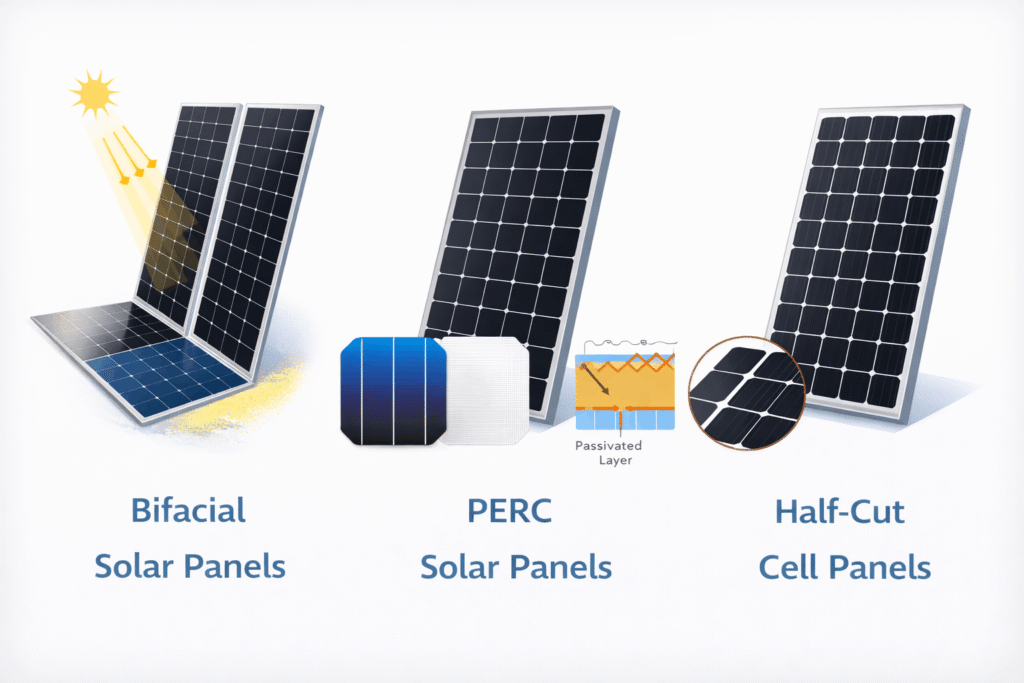
Bifacial Solar Panels
Bifacial panels generate electricity from both front and rear sides by absorbing reflected sunlight from surrounding surfaces. This increases overall energy output and improves system efficiency, especially in ground-mounted installations.
PERC Solar Panels
PERC technology adds a passivation layer on the rear side of the cell to reduce recombination losses and increase light absorption. This improves efficiency without a significant increase in cost.
Half-Cut Cell Panels
Half-cut panels divide solar cells into smaller sections to reduce current flow and resistive losses. This results in higher efficiency, better shade tolerance, and improved reliability.
What Is the Best Type of Solar Panel?
The best type of solar panel depends on application requirements, available space, budget, and performance expectations. Monocrystalline panels are the best choice when maximum efficiency and limited space are critical. Polycrystalline panels are ideal when cost effectiveness and sufficient space are available. Thin-film panels are suitable for lightweight, flexible, or architectural applications. Overall, monocrystalline panels are considered the best option for most modern installations.
Factors to Consider While Selecting Solar Panels
While selecting solar panels, parameters such as efficiency, power rating, available roof area, cost per watt, temperature coefficient, warranty period, degradation rate, climate conditions, and manufacturer reputation should be carefully considered to ensure optimal system performance and long-term reliability.