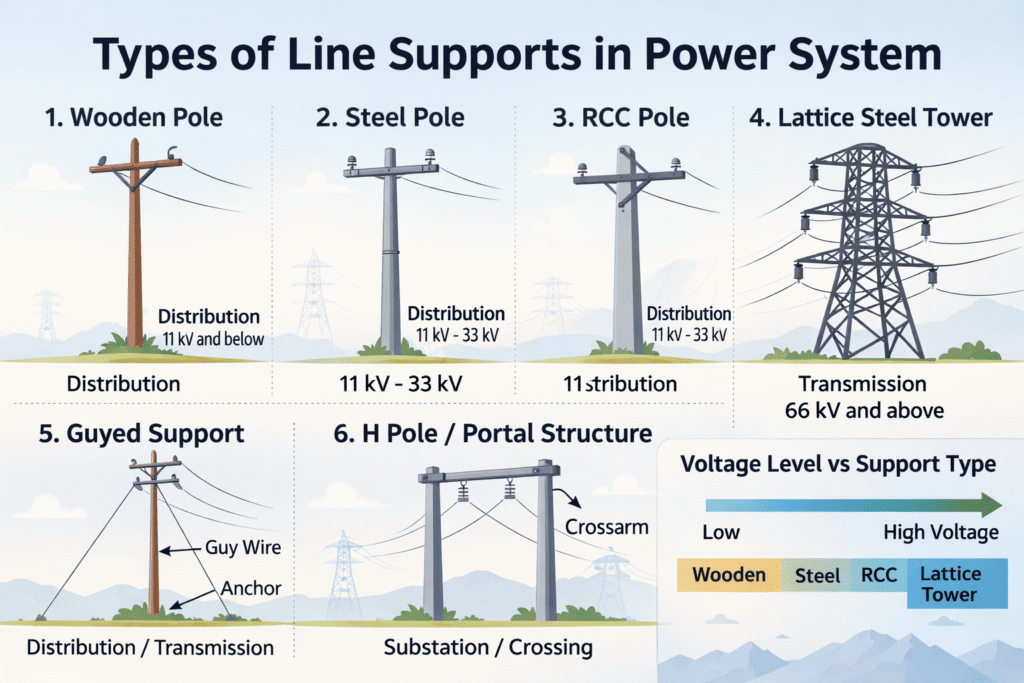
In any power system, line supports play a very important role. They carry the overhead conductors, keep the required ground clearance, maintain proper spacing between phases, and help the line remain mechanically stable under wind, temperature changes, and external loads.
From a practical point of view, a line support is not selected only for strength. It is also selected based on voltage level, span length, location, cost, ease of erection, and long term maintenance.
In this article, we will study the main types of line supports used in overhead power transmission and distribution systems, their construction features, and typical applications.
Line supports
Functions of a line support
- To keep proper spacing between conductors.
- To keep conductors at prescribed distances from grounded parts.
- To maintain the specified ground clearance.
Woooden Poles
Among the various types of supports wood pole is the cheapest. When properly treated with preservative such as creosote a very satisfactory service is obtained. These poles are suitable for lines where spans are short and tensions are low. A wood pole has the limitations of height and diameter.
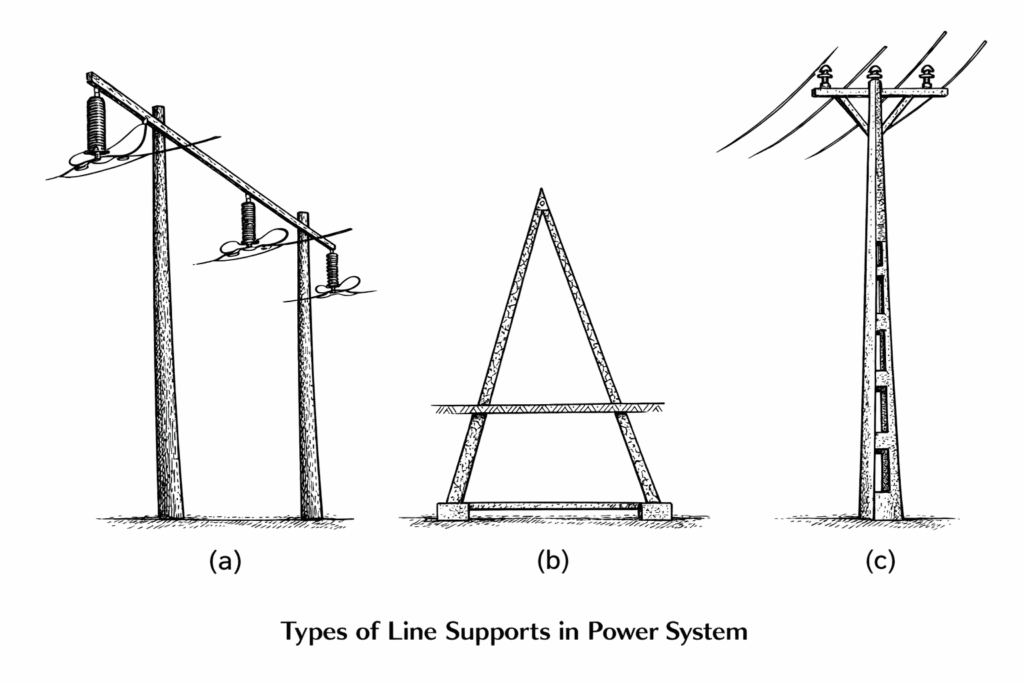
Double pole structures of the ‘A’ or ‘H’ type are used where greater strength is required. The strength of these types of constructions varies from two to four times the strength of the single pole. In practice, it has been found that foundations fail before the pole is stressed to these values. H type of construction is usually employed for terminal poles or those carrying switchgear and transformers.
Wood has got a natural insulating property and, therefore, lesser flashovers are likely to take place due to lightning. The drawbacks with wood poles are that their strength and durability cannot be predicted with certainty. Insects and birds are the problems for such poles. Typical wood pole constructions are shown in Fig. (a) and (b).
Concrete Poles
Concrete pole Fig. (c) is reinforced to give greater strength and is an alternative to a wood pole. It has a longer life than that of wood pole because of little deterioration. The maintenance cost is low. Reinforced concrete poles are very heavy and are liable to damage during loading, unloading, transportation and erection due to their brittle nature.
Handling and transportation difficulties are overcome by the use of pre stressed concrete supports which can be manufactured in pieces and then assembled at the job sites. The weight of pre stressed concrete pole is considerably less than that of reinforced concrete pole. The material used is less. Pre stressed concrete poles are more durable than any other type of pole.
Steel Poles
The use of tubular steel poles or girder steel masts is favoured for low and medium voltage distribution work. Longer spans are possible with steel poles. The poles need to be galvanised or painted periodically to prevent them from corrosion. The maintenance expense is, therefore, more.
Supporting Towers
High voltage and extra high voltage lines require large air and ground clearances. They have large mechanical loadings. Insulation costs are also considerable. Steel towers were developed for such lines where very long spans are essential. The long span construction cuts the insulation costs considerably as fewer supports are to be provided. Moreover, the possibilities of breakdowns are reduced. The towers are either made of steel or aluminium.
They are classified as follows:
- Self supporting towers
- Stayed or guyed towers
Self Supporting Towers
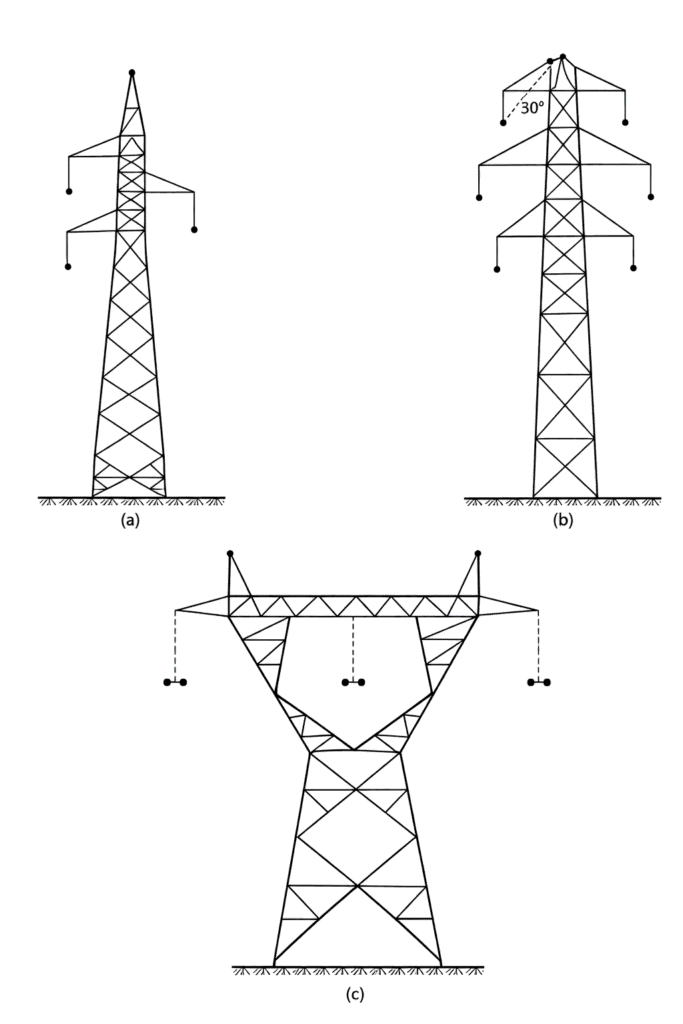
Self supporting towers are divided into two categories, namely, wide base and narrow base towers. In a wide base tower lattice type construction with bolted connections is adopted. Each leg has a separate foundation. The narrow base design uses lattice construction of angle, channel or tubular steel section with bolted or welded connections.
Self supporting towers are also classified as:
(a) tangent towers, and
(b) deviation towers.
Tangent towers are used for straight runs of the line. Suspension insulators are used with these towers.
Deviation towers are used at points where transmission line changes direction. Strain insulators are used with these towers. They have broader base, stronger members, and are costlier as compared to tangent towers. Fig.2 shows some typical self supporting towers.
A narrow base tower requires lesser steel or aluminium in comparison with a wide base tower, but its cost of foundation is more. The selection between the two is to be made on the basis of costs of material, foundations, and right of way requirements.
Guyed or Stayed Towers
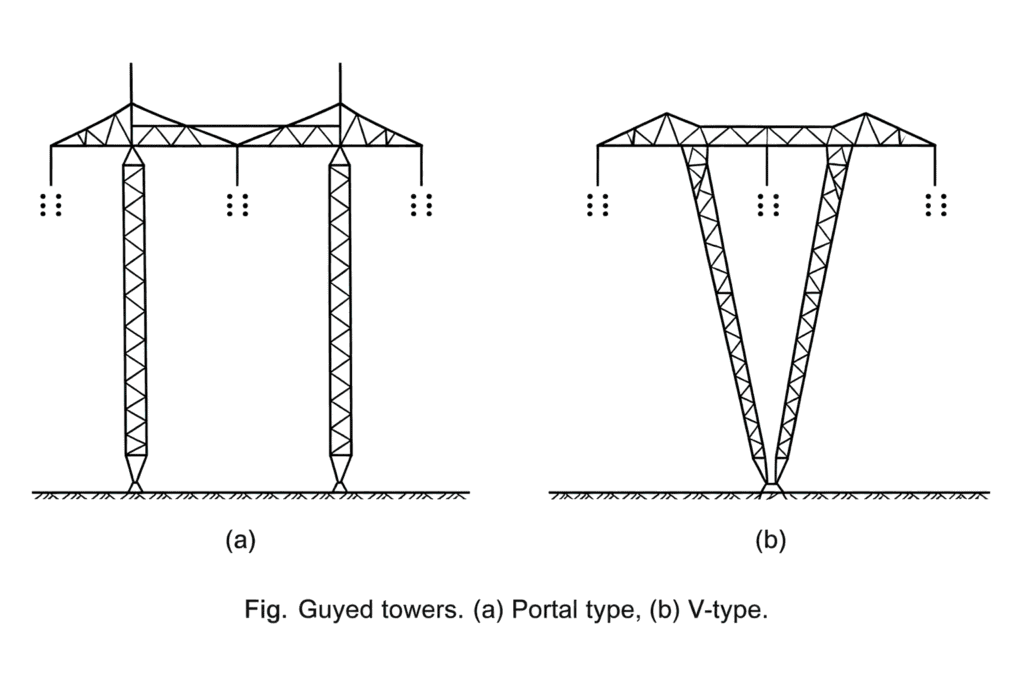
Guyed or stayed towers were adopted with a view to reduce weight and cost. Such towers have many identical members. This affords saving in fabrication and facilitates assembly and erection as complete unit at the job site. Aluminium guyed towers due to their much lighter weight have been favoured for remote areas where transport is a problem. In some countries
like the USA and Canada, use is made of helicopter for transportation of such towers at sites which are not accessible by road or rail.
Guyed towers are either portal type or V-type. Both of them have got two masts connected at the top by a cross arm and provided with four guys. In case of portal type of structure each mast rests on its own foundation. The four guys are anchored to two double acting guy anchors. A V towers has two masts resting at an angle to one another on one thrust footing only which is of heavier type. Separate guy anchorages is to meet varying soil conditions and to take large uplift forces. The two types of guyed towers are shown in Fig. below.
In some of the recent designs pre stressed concrete has been utilized in construction of stayed towers.
Rating and applications
| Line structure type | Typical voltage rating | Main applications |
|---|---|---|
| Wood pole | Up to about 33 kV | Used for short span distribution lines in rural and semi urban areas, where line tension is low and low cost construction is required. |
| Reinforced concrete pole (RCC pole) | Up to about 33 kV to 66 kV | Used for distribution and sub transmission lines in towns and cities where longer life and low maintenance are required. |
| Pre stressed concrete pole (PSC pole) | Up to about 66 kV | Used for distribution and sub transmission lines, especially where transport and handling are difficult and light weight but durable supports are required. |
| Steel pole (tubular or girder pole) | Up to about 66 kV | Used for low and medium voltage distribution and sub transmission lines where longer spans and higher mechanical strength are needed. |
| Self supporting steel tower | 66 kV and above, mainly 132 kV, 220 kV, 400 kV and EHV | Used for high voltage and extra high voltage transmission lines, for long spans, heavy conductor loads and where high ground and air clearances are required. |
| Guyed or stayed tower | Mainly 132 kV and above | Used for high and extra high voltage transmission lines to reduce weight and cost of structure, especially suitable for straight runs and remote areas. |
| Portal type guyed tower | 132 kV and above | Used where two masts with separate foundations are convenient and where soil conditions permit normal foundations. |
| V type guyed tower | 132 kV and above | Used where space is limited and where one common heavy footing is preferable, suitable for high uplift and thrust loads. |
Related Post: