What is Lightning Arrester?
Lightning arresters are protective devices used in electrical power systems to safeguard equipment from high voltage surges caused by lightning strikes or switching operations. These sudden surges can damage transformers, generators, insulators, and other costly components. A lightning arrester provides a low resistance path to ground during overvoltage conditions and safely diverts the surge away from the equipment.
Working Principle of Lightning Arrester
Under normal operating voltage, a lightning arrester behaves like an insulator and does not conduct current. When a high voltage surge appears, its resistance suddenly drops and it provides a low resistance path to earth. After the surge is discharged, it returns to its normal insulating state.
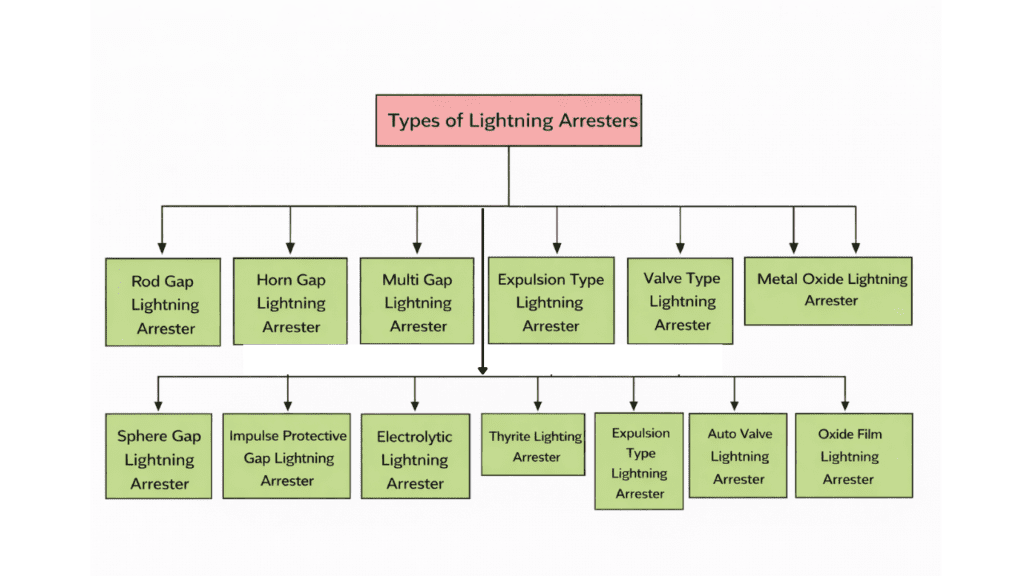
Types of Lightning Arresters
1. Rod Gap Lightning Arrester
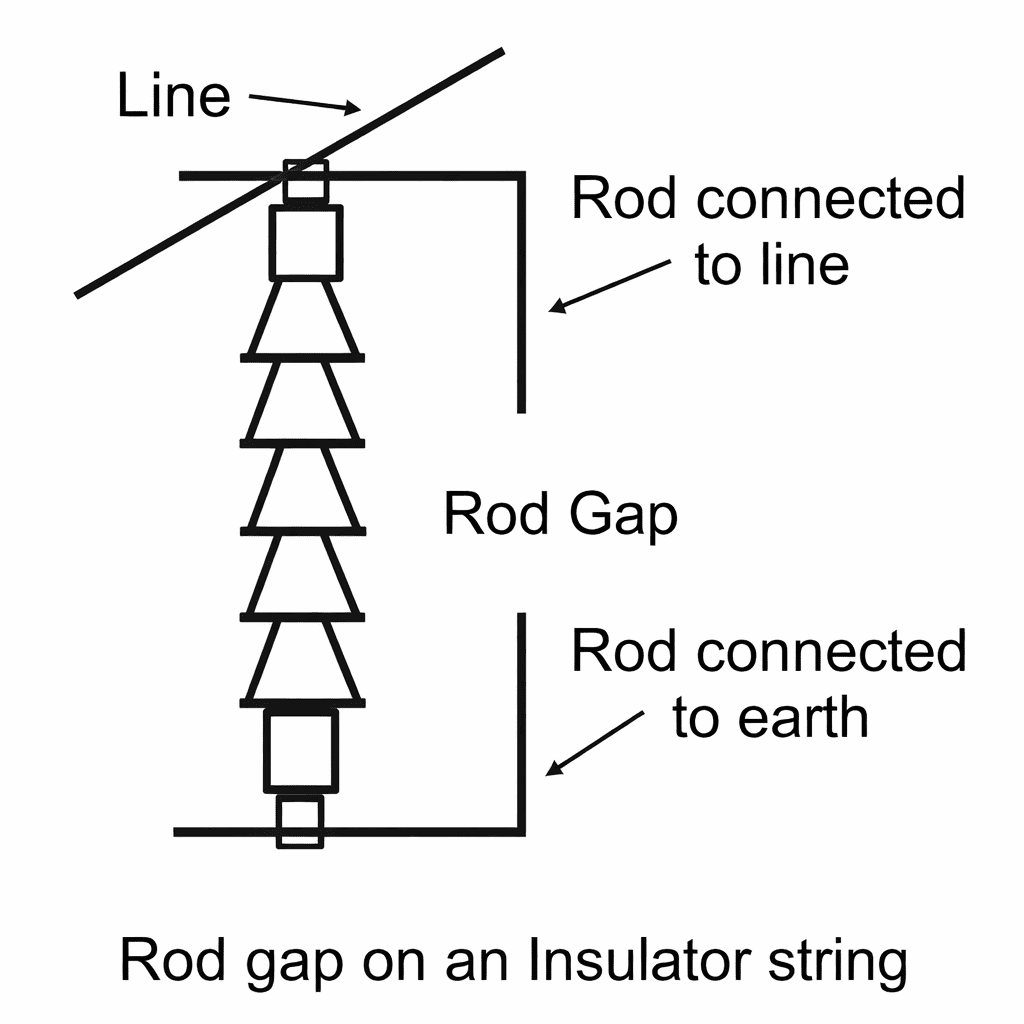
The rod gap arrester is the simplest type of lightning arrester. It consists of two metal rods separated by an air gap. One rod is connected to the line conductor and the other is connected to earth.
Under normal operating voltage, the air gap does not break down. When a lightning surge occurs, the voltage rises sharply and the air gap breaks down, allowing the surge current to flow to earth. This protects the connected equipment.
However, once the arc is formed, it may continue even after the surge has passed. To overcome this, a current limiting reactor or resistance is connected in series. Another disadvantage is that the rods may get damaged due to high arc temperature.
2. Horn Gap Lightning Arrester
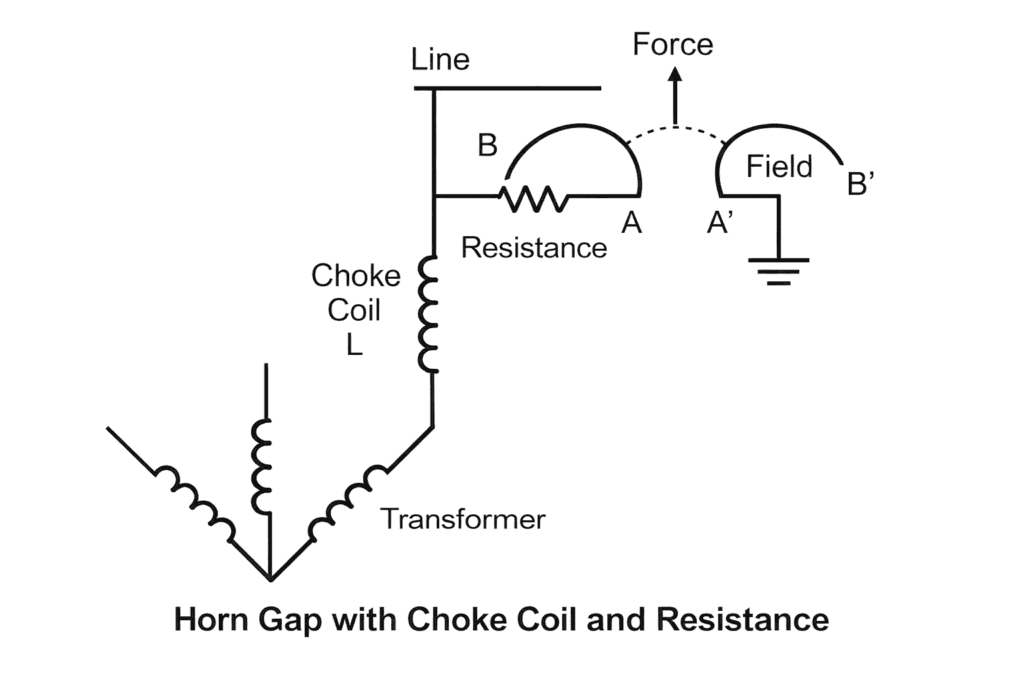
The horn gap arrester consists of two horn shaped metal electrodes separated by a small air gap. The electrodes diverge upwards and are connected between the line and earth.
During normal operation, the voltage is insufficient to bridge the gap. During a surge, the gap breaks down and an arc is formed. The arc rises upward along the diverging horns due to thermal convection, increasing the arc length. Eventually, the arc extinguishes due to cooling and increased length.
This type is simple and widely used but may allow power frequency follow current.
3. Multi Gap Lightning Arrester
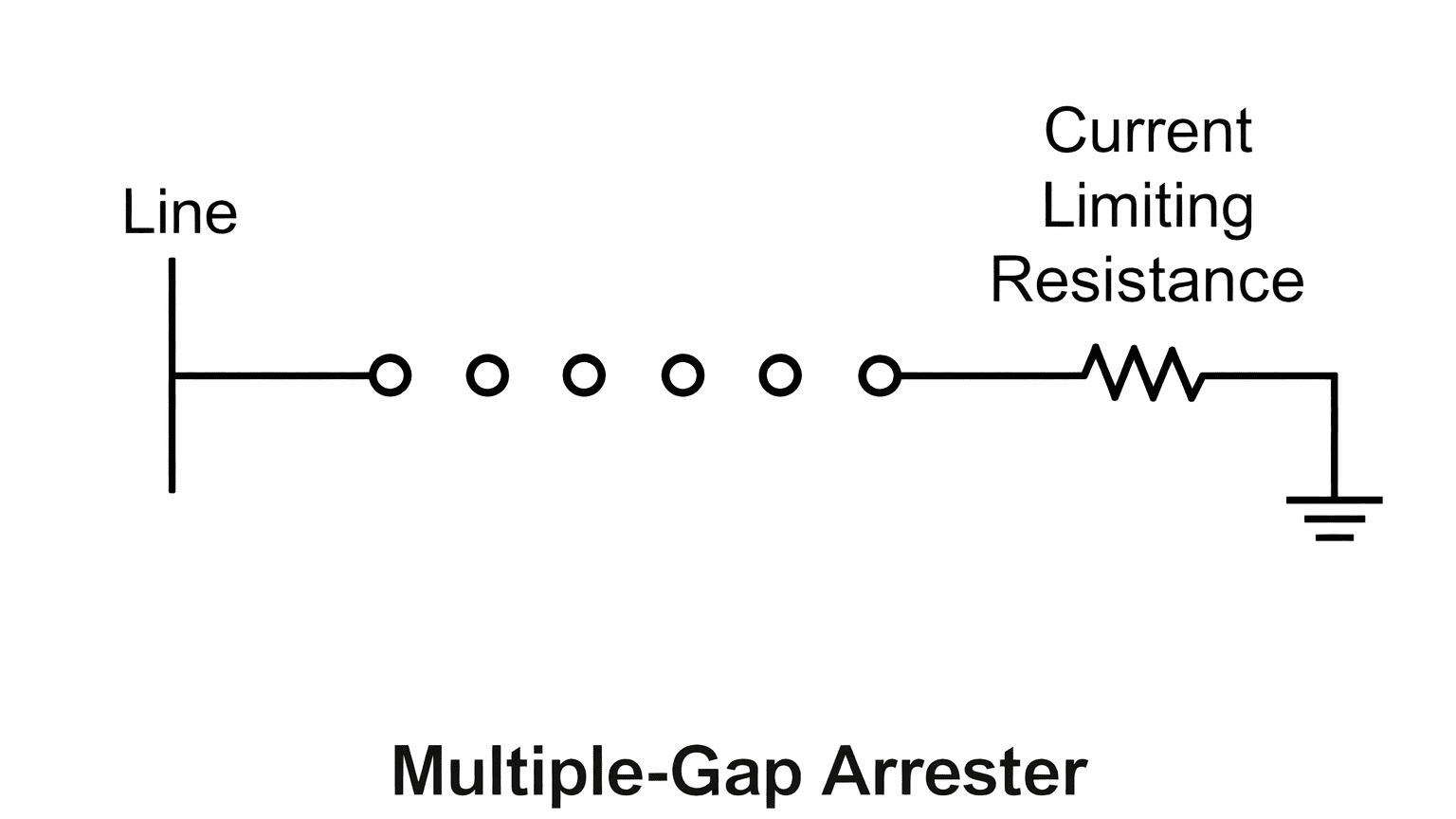
The multiple gap arrester consists of a number of small metal cylinders separated by air gaps. The cylinders are insulated from each other and arranged in series.
The first cylinder is connected to the line and the last to earth. When a surge occurs, the voltage across each gap adds up, causing breakdown and discharge to earth. The number of gaps depends on the system voltage.
Multiple gaps improve voltage distribution and arc extinction but increase construction complexity.
4. Expulsion Type Lightning Arrester
The expulsion type arrester is an improved form of the rod gap arrester. It consists of a fibre tube containing an arc gap.
When a surge occurs, an arc forms inside the tube. The heat causes the fibre material to decompose, producing gases that are expelled through a vent. This gas blast extinguishes the arc, similar to the operation of a circuit breaker.
This arrester effectively suppresses power frequency follow current.
5. Valve Type Lightning Arrester
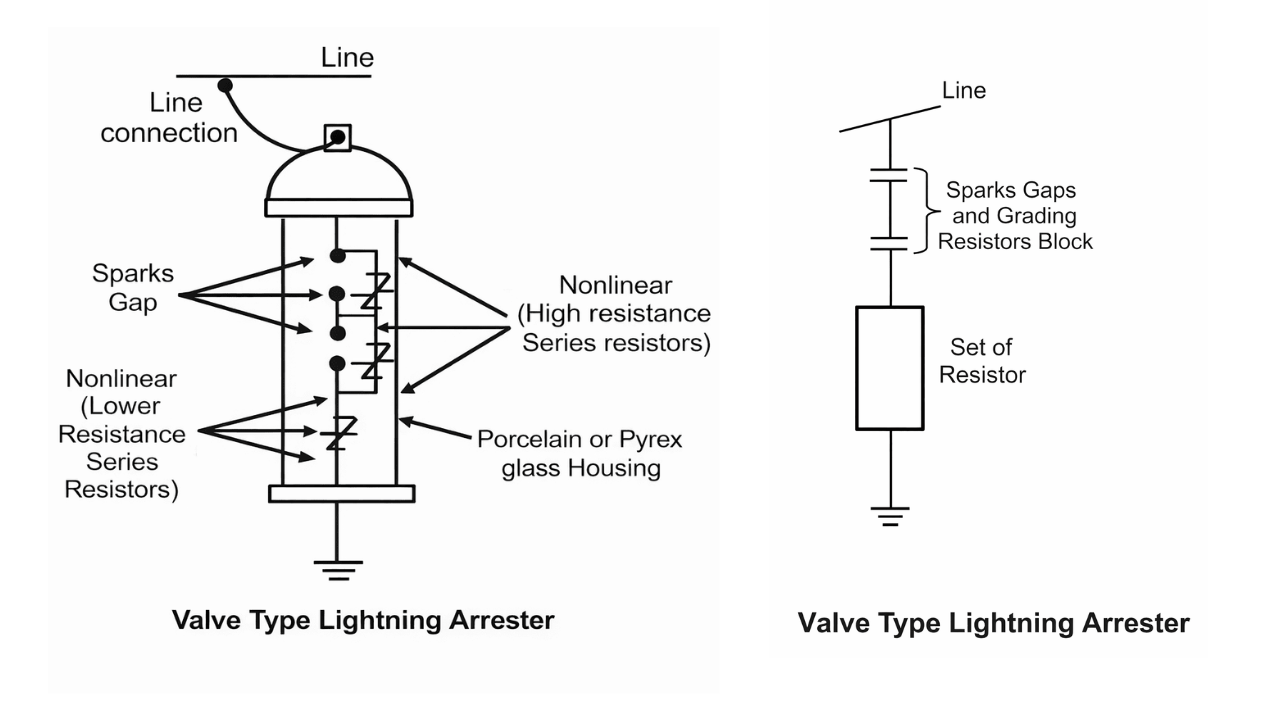
Valve type arresters use nonlinear resistors in series with spark gaps. The spark gaps are divided into several sections, each having grading resistors connected in parallel.
During normal voltage, no spark occurs. During a surge, uneven voltage distribution causes the upper gap to break down first, followed by the remaining gaps. The nonlinear resistor then limits the surge current and diverts it to earth.
This type provides good protection but requires careful design.
6. Metal Oxide Lightning Arrester
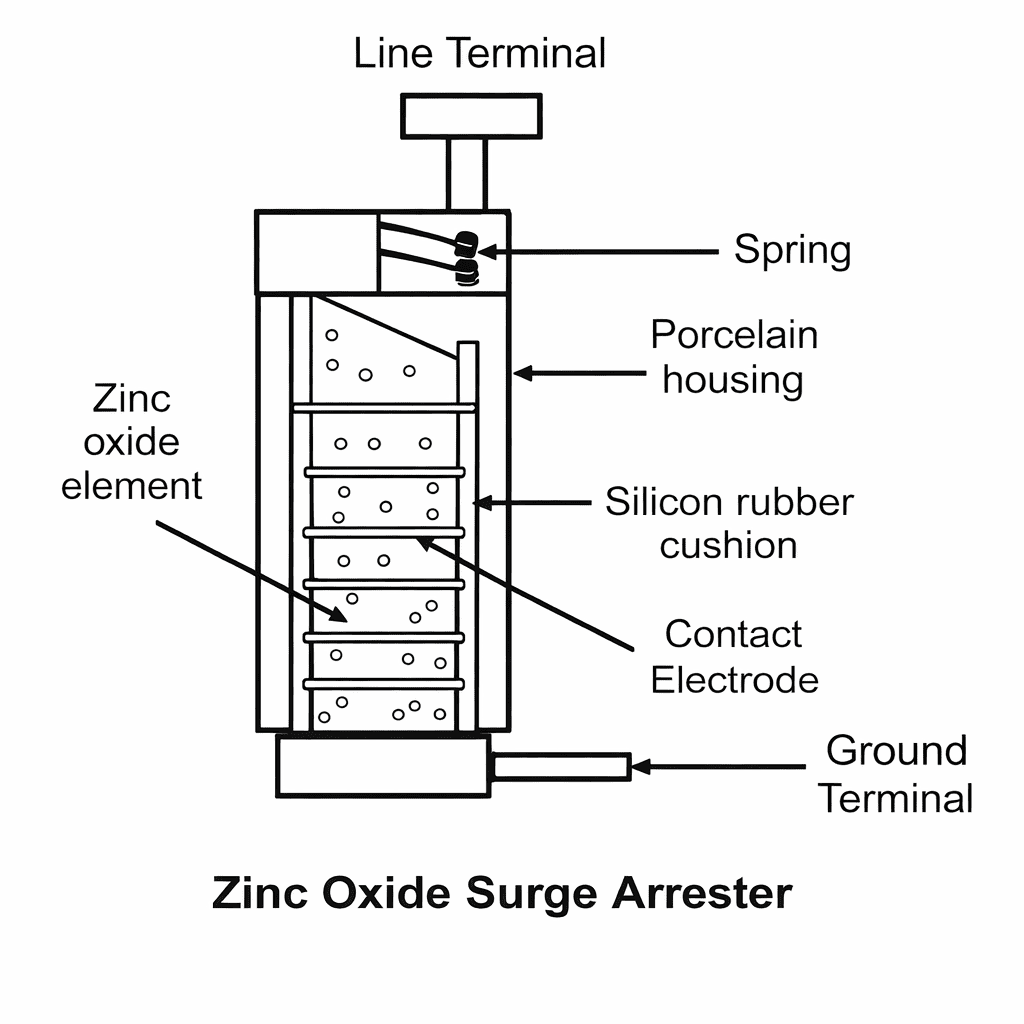
Metal oxide arresters are the most widely used modern arresters. They use zinc oxide discs enclosed in a porcelain or polymer housing filled with nitrogen or SF₆ gas.
At normal voltage, potential barriers between zinc oxide grains prevent current flow. During overvoltage, these barriers collapse, causing a sharp drop in resistance and allowing surge current to flow to earth. After the surge, the barriers reform and current stops automatically.
These arresters are gapless, fast acting, highly reliable, and require minimal maintenance.
7. Sphere Gap Lightning Arrester
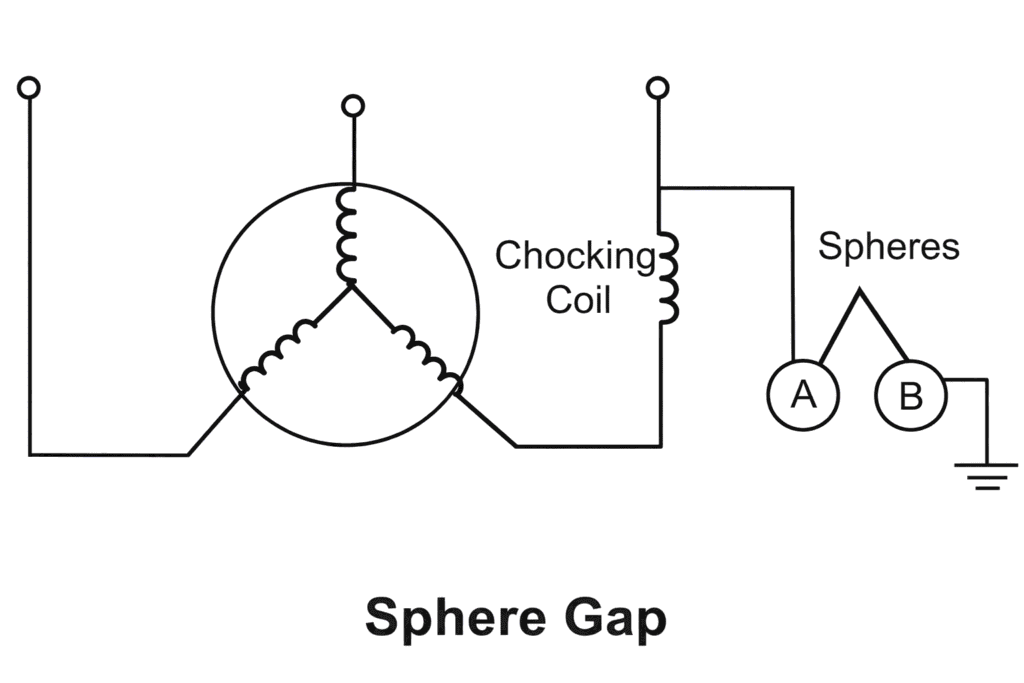
In this type, the air gap is formed between two metallic spheres. One sphere is connected to the line and the other to earth. The spherical shape provides uniform electric field distribution and accurate gap spacing.
A choking coil is connected between the transformer winding and the line sphere. When a surge occurs, the air gap breaks down and the arc forms. The heated air around the arc rises upward, increasing the arc length until it extinguishes naturally.
Sphere gap arresters are reliable but require accurate spacing and regular maintenance.
8. Impulse Protective Gap Lightning Arrester
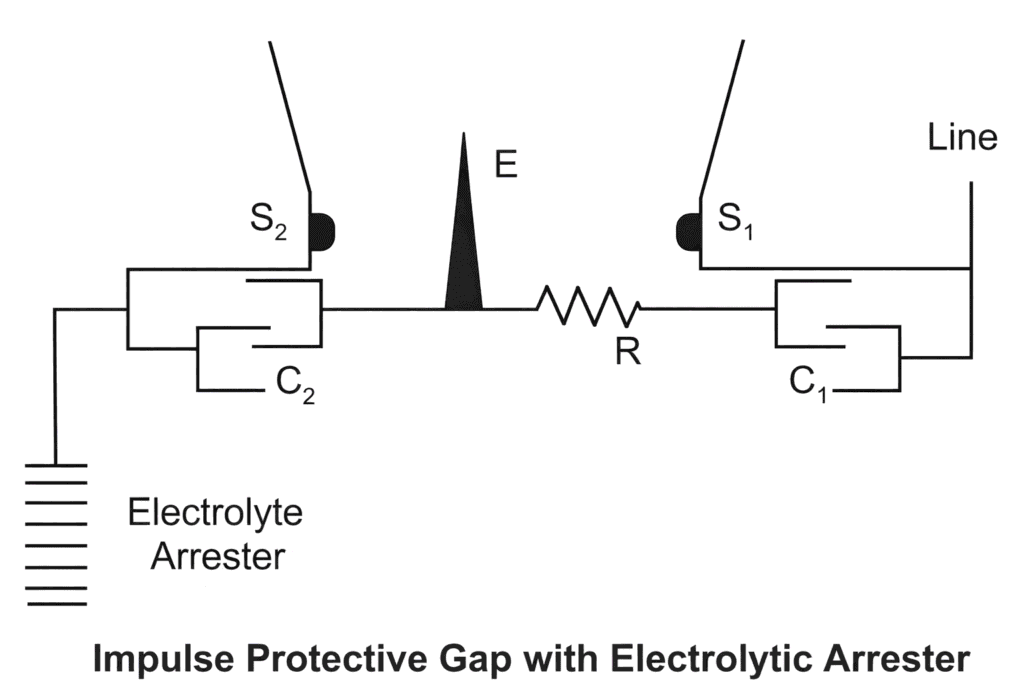
The impulse protective gap is designed to operate efficiently under steep lightning impulses. It consists of two main sphere electrodes S₁ and S₂, an auxiliary electrode, capacitors C₁ and C₂, and a resistor R.
At normal frequency, the capacitive reactance is high and voltage is evenly distributed, so no discharge occurs. During a lightning surge, the capacitive reactance decreases, causing voltage concentration across one gap. This leads to rapid breakdown and discharge to earth.
This arrester has a low impulse ratio and fast response.
9. Electrolytic Lightning Arrester
Electrolytic arresters operate on the principle of aluminium hydroxide film formation. Aluminium plates are immersed in an electrolyte solution.
At normal voltage, a thin film of aluminium hydroxide forms on the plates, offering high resistance. When voltage exceeds a critical value, the film breaks down, allowing current to flow to earth. After the surge, the film reforms and resistance increases again.
These arresters have high discharge capacity but are now largely obsolete due to maintenance issues.
10. Thyrite Lightning Arrester
Thyrite arresters use thyrite, a ceramic nonlinear resistor material. Its resistance decreases rapidly as voltage increases.
Under normal conditions, resistance is high and current flow is negligible. During a surge, resistance drops sharply, allowing the surge current to pass to earth. After the surge, resistance returns to its original high value.
These arresters are reliable and were widely used before metal oxide arresters became common.
11. Expulsion Type Lightning Arrester
It contains a spark gap inside a fibrous tube. The arc produced during operation expels burnt material from the gap, achieving self-quenching. The expulsion-type arrester is an improvement over the rod gap as it seals the flow of power frequency following current. This arrester consists of a tube made of fiber, which is highly effective. It contains an isolating spark gap and an interrupting spark gap inside the fiber tube.
During operation, the arc caused by the impulse spark inside the fibrous tube causes some of the tube’s fibrous material to volatilize into gas. This gas is expelled through a vent at the bottom of the tube, extinguishing the arc similarly to how circuit breakers operate.
12. Auto valve Lightning Arrester
The autovalve arrester consists of porous discs stacked together and separated by thin mica rings. Conducting materials are added to the discs.
When voltage rises, glow discharge occurs within the pores of the discs, limiting voltage to about 350 volts per unit. Under normal voltage, no discharge occurs.
Autovalve arresters provide controlled conduction and effective surge suppression.
13. Oxide Film Lightning Arrester
This arrester consists of lead peroxide pellets coated with litharge, arranged in a column inside a tube with series spark gaps.
During overvoltage, spark gaps conduct and apply voltage across the pellet column, causing discharge. After the surge, resistance increases and current reduces to a very small value, which is finally interrupted by the spark gaps.
This type provides good surge protection but is not commonly used today.