What is a Synchronous Motor?
A synchronous motor is an AC motor that runs at a constant speed, exactly equal to the speed of the rotating magnetic field produced by the stator. This speed is called synchronous speed.
Construction
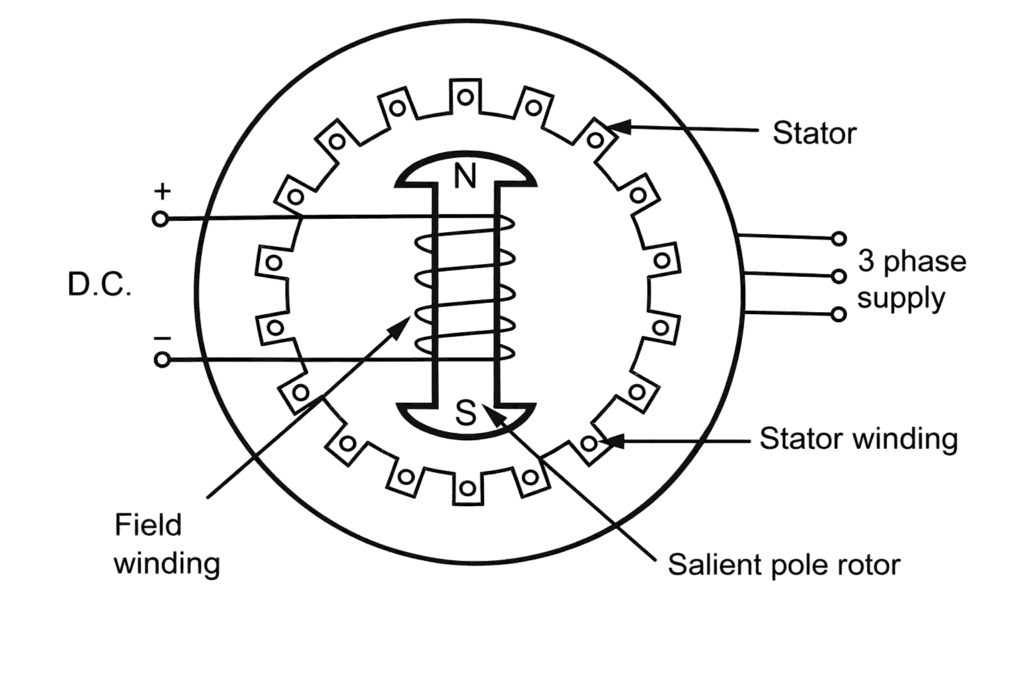
Synchronous motors feature a stator with three-phase windings that create a rotating magnetic field when powered by AC supply. The rotor, typically salient-pole type, uses DC excitation via slip rings to produce a constant magnetic field, or permanent magnets in smaller units.
This diagram shows the stator windings, rotor poles, DC field supply, and three-phase AC connections typical in synchronous motor construction.
The stator core has slots for windings, while the rotor includes field windings or magnets, often with damper windings for starting.
Working Principle
When three-phase AC energizes the stator, it generates a rotating magnetic field (RMF) at synchronous speed , where ( f ) is frequency in Hz and ( P ) is poles. DC excitation creates fixed north-south poles on the rotor that lock with the RMF poles, causing rotation at exact synchronous speed with zero slip.
Under load, the rotor poles pull ahead slightly (load angle), producing torque via field interaction. Excitation level determines power factor: under-excited for lagging, normal for unity, over-excited for leading.
The illustration depicts stator RMF interacting with the DC-excited rotor to achieve synchronism.
Starting Methods
Synchronous motors are not self-starting due to high rotor inertia. Common methods include damper windings acting as a squirrel cage for induction start until near synchronous speed, then applying DC excitation; or using pony motors/auxiliary drives.
Variable frequency drives (VFDs) ramp up frequency gradually for smooth synchronization in modern applications.
Phasor Diagrams
Phasor diagrams visualize voltage (V), induced EMF (E), and armature current (I) relationships. For under-excited conditions, E lags V (lagging PF); normal excitation aligns them (unity PF); over-excitation leads E ahead (leading PF).
These diagrams account for armature resistance (Ra) and synchronous reactance (Xs) drops:
.
Applications
Synchronous motors excel in constant-speed drives like pumps, compressors, and power factor correction in industries. Their ability to operate at leading PF improves system efficiency.