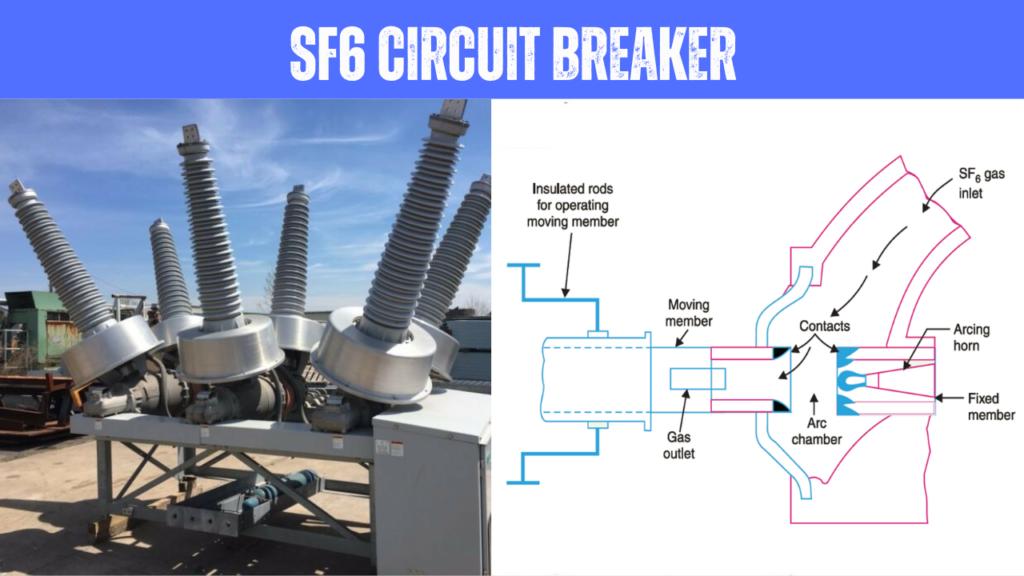
A sulphur hexafluoride (SF₆) circuit breaker is a modern high-voltage circuit breaker in which SF₆ gas is used both as the arc-quenching and insulating medium. SF₆ is an electronegative gas with a very strong ability to absorb free electrons, which enables rapid de-ionisation of the arc and fast recovery of dielectric strength after current zero. Because of these properties, SF₆ circuit breakers provide high interrupting capability, compact construction and reliable performance.
SF₆ circuit breakers are commonly manufactured for voltage ratings ranging from 6.6 kV up to 800 kV and higher, with short-circuit breaking capacities typically up to 20 kA to 60 kA (up to 800 kV) and suitable for 50 Hz and 60 Hz power systems. They are designed for both indoor and outdoor installations, and are widely used in high-voltage and extra-high-voltage substations, including gas-insulated substations (GIS).
In addition to excellent arc-quenching performance, SF₆ circuit breakers offer low maintenance requirements, long service life, high operating reliability and fast dielectric recovery, which make them the preferred choice for modern transmission and sub-transmission networks. However, careful gas handling and monitoring are required because SF₆ is a potent greenhouse gas.
Properties of SF₆ (Sulfur Hexafluoride) Gas
- SF₆ has very high dielectric strength (about 2–3 times that of air).
- SF₆ is a strongly electronegative gas that absorbs free electrons.
- SF₆ provides excellent arc-quenching capability.
- SF₆ has high thermal conductivity for effective arc cooling.
- SF₆ is chemically stable under normal operating conditions.
- SF₆ is non-flammable and non-explosive.
- SF₆ has high density, which improves insulation performance.
- SF₆ shows very fast dielectric recovery after current interruption.
- Pure SF₆ is colourless, odourless and non-toxic.
| Property | Value |
|---|---|
| Density at 20 °C | 6.14 kg/m³ |
| Colour of gas | Colourless |
| Molecular weight | 146.06 g/mol |
| Thermal conductivity | 0.0136 W/m·K |
| Critical temperature | 45.55 °C |
| Critical density | 730 kg/m³ |
| Critical pressure | 3.78 MPa |
| Sound velocity in SF₆ | 136 m/s (about three times lower than in air) |
| Refractive index | 1.000783 |
| Heat of formation | −1221.66 kJ/mol |
| Specific heat (Cp) | 96.6 J/mol·K |
| Breakdown field relative to pressure | 89 V/(m·Pa) |
| Relative dielectric constant (25 °C, 1 bar) | 1.00204 |
Related Posts: Vaccum Circuit Breaker
Types of SF₆ Circuit Breakers
From a construction and operating principle point of view, SF₆ circuit breakers are commonly classified into the following types.
- Non puffer type
- Single pressure puffer type
- Double pressure puffer type
Non puffer type (SF₆) circuit breaker
In the non puffer type SF₆ circuit breaker, the gas used for arc extinction is supplied from an external high pressure reservoir.
The breaker consists of two pressure systems, namely
- a high pressure SF₆ chamber, and
- a low pressure SF₆ chamber.
During the opening operation, a valve opens and allows high pressure SF₆ gas to flow into the contact region.
The gas passes through the arc zone and cools the arc, thereby extinguishing it at the next current zero. In this type of circuit breaker, the gas pressure is not produced by the mechanical motion of the contacts.
Instead, it is already stored in a separate high pressure chamber.
This design is therefore known as the non puffer type SF₆ circuit breaker.
Construction of Non puffer type
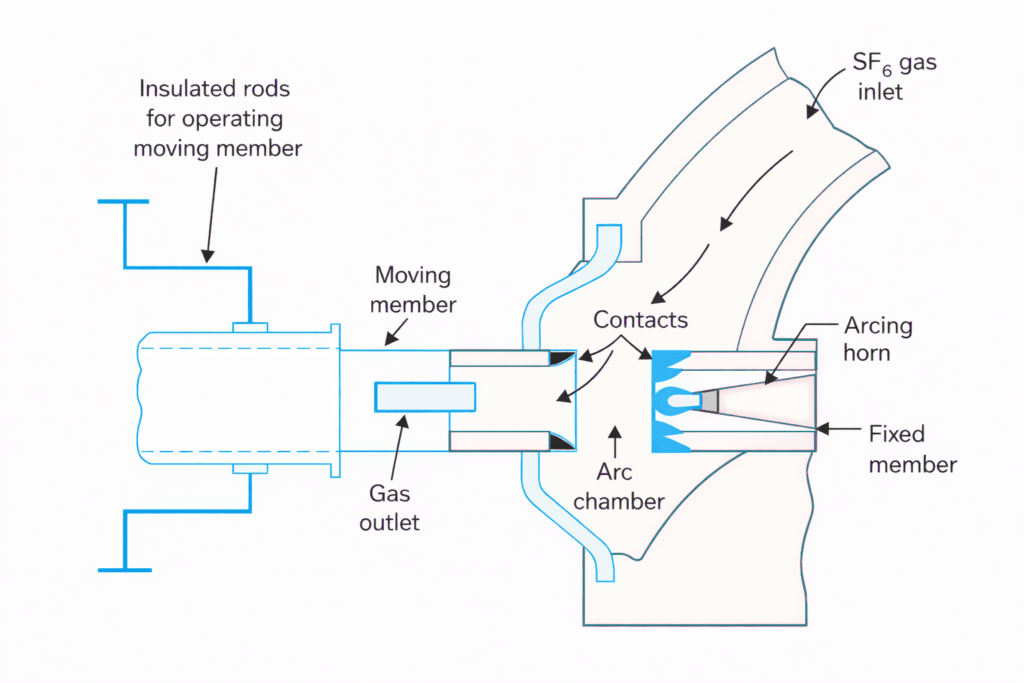
An SF₆ circuit breaker consists of a fixed contact and a moving contact enclosed inside an arc-interruption chamber filled with sulphur hexafluoride (SF₆) gas. This interrupter chamber is connected to an SF₆ gas reservoir.
When the breaker operates, a valve mechanism allows high-pressure SF₆ gas from the reservoir to flow into the arc-interruption chamber.
The fixed contact is made in the form of a hollow cylindrical current-carrying contact and is provided with an arcing horn. The moving contact is also hollow and is provided with rectangular slots on its sides. After the gas passes along and across the arc, it is discharged through these slots.
The tips of the fixed contact, moving contact and arcing horn are coated with copper–tungsten arc-resistant material in order to withstand high temperature and erosion caused by repeated arcing.
Since SF₆ gas is expensive, the gas used during interruption is collected, reconditioned and reclaimed by a suitable auxiliary gas-handling system after each operation of the circuit breaker.
Working of Non puffer type
During normal operation, the contacts of the SF₆ circuit breaker remain closed inside an enclosure filled with SF₆ gas at a pressure of approximately 2.8 kg/cm². When a fault is detected and a trip command is issued, the operating mechanism separates the moving contact from the fixed contact, and an electric arc is produced between them.
At the same time, a control valve connected to the operating mechanism opens and allows high-pressure SF₆ gas (around 14 kg/cm²) from the gas reservoir to enter the arc-interruption chamber. The pressurised SF₆ gas is directed across the arc zone through the nozzle.
Because SF₆ is a strongly electronegative gas, it rapidly captures the free electrons present in the arc plasma and converts them into heavy negative ions. This sharply reduces the electrical conductivity of the arc path and causes a rapid increase in the dielectric strength of the contact gap.
Consequently, the arc is extinguished at the next current zero. After successful interruption, the gas valve is closed automatically by spring action, and the interrupter chamber returns to its normal operating pressure.
Single pressure puffer type
A single-pressure puffer type SF₆ circuit breaker is a type of gas circuit breaker in which the same SF₆ gas system is used for both insulation and arc interruption.
The gas pressure required for extinguishing the arc is produced mechanically by a puffer mechanism during the opening operation.
In this design, no separate high-pressure reservoir is used. The gas is compressed only at the time of contact separation. Hence, the construction is simpler than double-pressure and non-puffer designs.
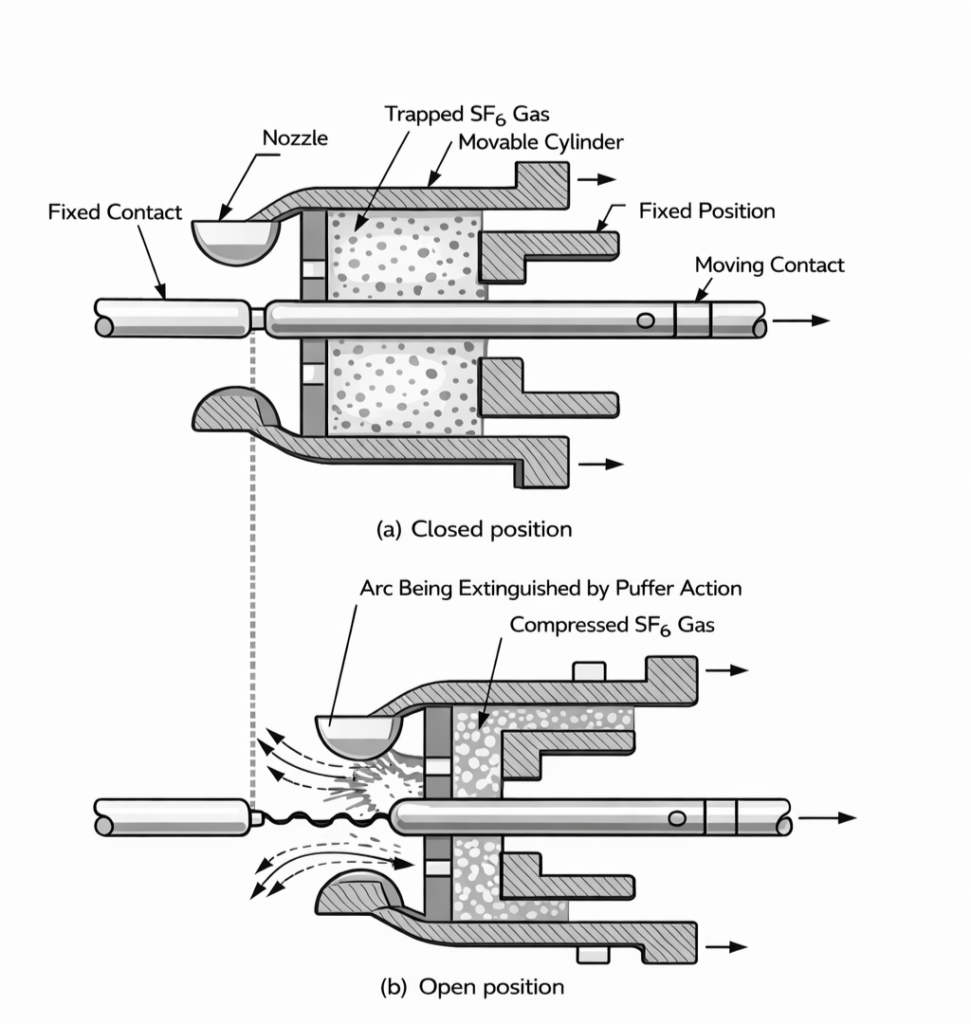
Construction of Single pressure puffer type
The main parts of a single-pressure puffer type SF₆ circuit breaker are
- fixed contact,
- moving contact,
- arcing contacts,
- movable puffer cylinder,
- fixed piston,
- insulating nozzle, and
- sealed interrupter chamber filled with SF₆ gas.
The moving contact is mechanically connected to a movable puffer cylinder. A fixed piston is mounted inside the interrupter unit. During the opening operation, the relative motion between the puffer cylinder and the fixed piston produces compression of SF₆ gas.
The nozzle is located around the arcing contacts to direct the compressed gas towards the arc. In this type of breaker, only one normal pressure system of SF₆ gas is provided. Therefore, it is known as the single-pressure puffer type.
Working of Single pressure puffer type
Under normal operating conditions, the fixed and moving contacts remain closed and the interrupter chamber is filled with SF₆ gas at rated pressure. When a tripping command is given, the operating mechanism moves the moving contact away from the fixed contact. An arc is formed between the arcing contacts. At the same time, the puffer cylinder moves over the fixed piston. This movement compresses the SF₆ gas in the compression chamber.
The compressed SF₆ gas is forced through the insulating nozzle and is directed across the arc zone.
The flowing gas performs the following actions.
- It cools the arc column.
- It removes free electrons because of the strong electronegative nature of SF₆ gas.
- It increases the resistance of the arc path.
As the alternating current reaches its natural current zero, the arc is extinguished.
Immediately after current zero, the dielectric strength of the gas in the contact gap increases rapidly and prevents re-ignition of the arc. Thus, in a single-pressure puffer type SF₆ circuit breaker, the arc is extinguished mainly by the mechanically produced gas blast generated by the puffer action.
Double pressure puffer type
A double-pressure puffer type SF₆ circuit breaker uses two different gas pressure levels inside the interrupter and a moving puffer cylinder to blow high pressure SF₆ gas across the contacts so that the arc is cooled and extinguished quickly during opening.
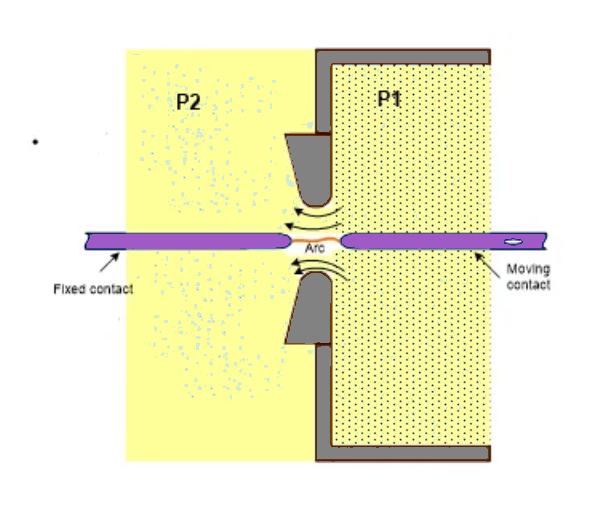
Construction of Double pressure puffer type
The main parts are:
- Fixed contact and moving contact inside an insulating nozzle.
- Puffer cylinder connected to the moving contact.
- High-pressure gas chamber.
- Low-pressure gas chamber.
- Gas passage and control valves between the chambers and the nozzle.
- Operating mechanism to move the contact and the puffer piston.
In this design, the interrupter always maintains two pressure zones, one high and one low.
Working of Double pressure puffer type
Under normal condition, the contacts are closed and the high-pressure and low-pressure chambers remain separated. When a trip command is given, the moving contact starts opening and an arc is formed between the contacts. At the same time, the puffer piston moves and connects the high-pressure chamber to the nozzle region.
High-pressure SF₆ gas is forced through the nozzle and blown directly across the arc. The gas absorbs heat and captures free electrons, so the arc is rapidly cooled and de-ionised. At current zero, the insulating strength recovers very fast and the arc is completely extinguished. The gas finally flows to the low-pressure chamber, restoring the pressure difference for the next operation.
Advantages of SF₆ circuit breaker
- SF₆ gas has very high dielectric strength, therefore the contact gap required for insulation is small.
- It possesses excellent arc quenching capability, which enables the breaker to interrupt very high short circuit currents.
- The dielectric strength of SF₆ gas recovers very rapidly after current zero, hence the probability of re striking of arc is very low.
- The size and weight of the breaker are considerably smaller as compared to oil and air blast circuit breakers of the same rating.
- Maintenance requirement is very low because there is no carbonisation or oil deterioration.
- Operation of the breaker is quiet and does not produce fire or explosion hazards.
- It is highly suitable for high voltage and extra high voltage systems.
Disadvantages of SF₆ circuit breaker
- SF₆ gas has a very high global warming potential and is harmful to the environment if released into the atmosphere.
- Special gas handling and monitoring equipment are required for filling, recovery and maintenance.
- Leakage of gas must be continuously monitored, otherwise the dielectric strength of the breaker may reduce.
- Skilled and trained personnel are required for maintenance and servicing.
- The initial cost of an SF₆ circuit breaker is higher compared to conventional circuit breakers.
Applications of SF₆ circuit breaker
SF₆ circuit breakers are widely used in the following areas.
- High voltage and extra high voltage transmission substations.
- Generating station switchyards.
- Gas insulated substations installed in urban and space constrained locations.
- Industrial power systems having high fault levels.
- Interconnection points of large power networks and grid substations.