What is Single Phase Induction Motor?
A single-phase induction motor is a type of AC electric motor that operates on a single-phase power supply to convert electrical energy into mechanical energy. Commonly used in low-power residential and commercial applications (e.g., fans, pumps), these motors are not self-starting, requiring an auxiliary winding or capacitor to initiate rotation.
Why is single phase induction motor not self-starting?
Single-phase induction motors are not self-starting because the single-phase AC supply produces a pulsating magnetic field in the stator, which does not create net torque on a stationary rotor. This pulsating field, fixed in direction but varying in magnitude, resolves into two equal counter-rotating fields (per double revolving field theory) whose forward and backward torques cancel each other out at standstill. Once rotating, however, the rotor speed makes the forward field dominant, enabling sustained operation.
Construction of 1-Phase Induction Motor
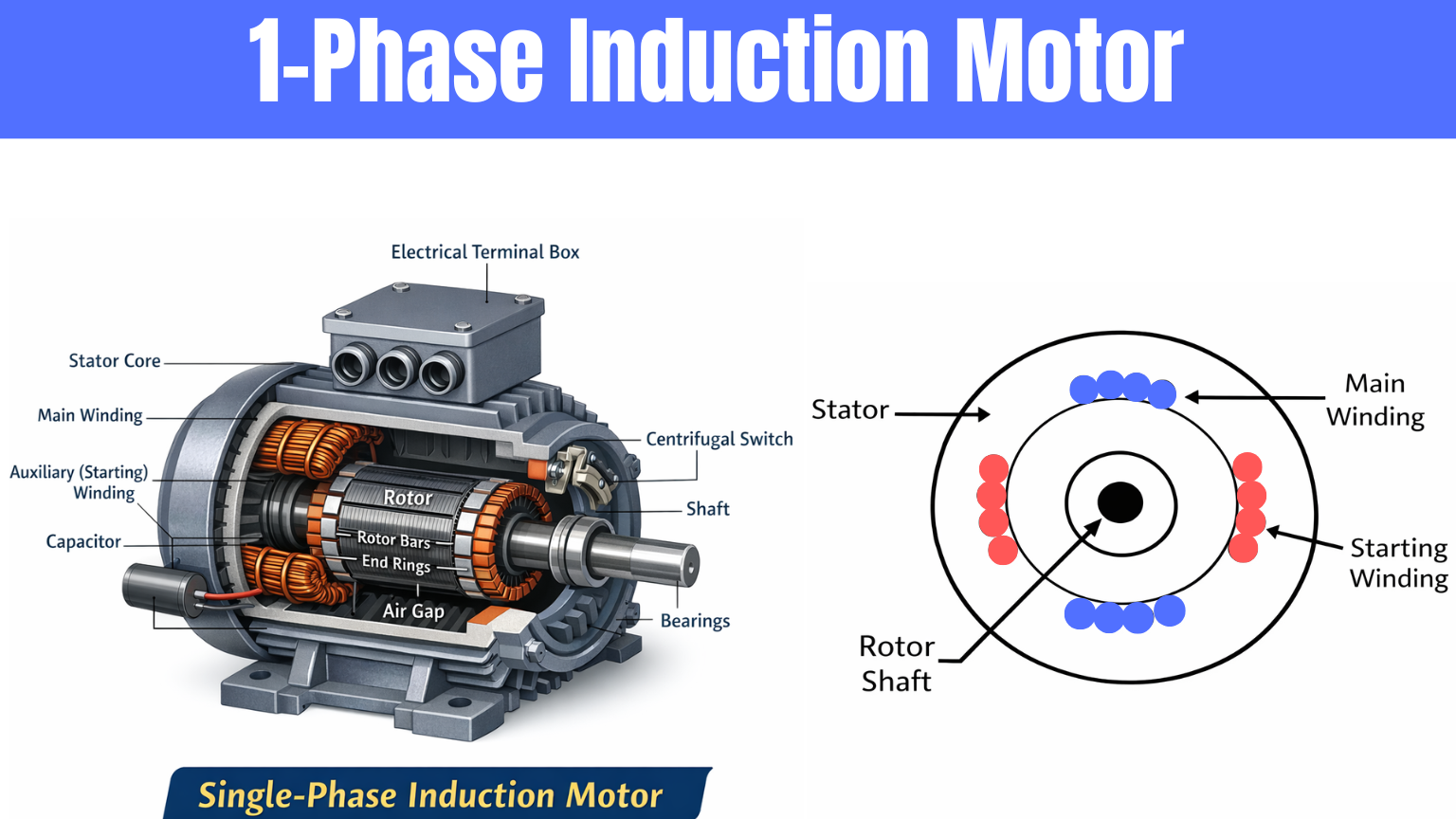
The construction of a single phase induction motor is quite simple and similar to a three phase induction motor. It mainly consists of two main parts, stator and rotor.
Stator
The stator is the stationary outer part of the motor and is made up of laminated silicon steel stampings. These laminations reduce eddy current losses and improve magnetic efficiency. The stator core construction is almost identical to that of a three phase induction motor.
Stator Windings: The stator contains two separate windings placed in slots and distributed spatially 90 electrical degrees apart. In most types of single phase motors, two windings are provided in the stator:
Main winding: The main winding is directly connected to the single phase supply. It is designed for continuous operation and carries the load current during normal running conditions.
Auxiliary or starting winding: The auxiliary winding is placed spatially 90 electrical degrees apart from the main winding. It is used only for starting to create a phase difference and produce starting torque. In shaded pole motors, this auxiliary winding is not present. The stator slots accommodate these windings and are designed to provide proper flux distribution and magnetic balance.
Rotor
The rotor used in a single phase induction motor is generally of the squirrel cage type, similar to that used in a three phase induction motor. Instead of a wound rotor, aluminum or copper bars are placed in the rotor slots. These bars are permanently short circuited at both ends by conducting end rings, forming a closed circuit. The rotor bars are rigidly connected or braced to the end rings to provide mechanical strength and structural stability during operation.
Skewed Rotor Slots: The rotor slots are skewed at a small angle with respect to the shaft axis. This skewing serves several important purposes:
- It reduces magnetic locking between stator and rotor teeth.
- It minimizes cogging and torque pulsations.
- It ensures smooth, quiet, and vibration free operation of the motor.
Working of 1- Phase Induction Motor
A 1-phase induction motor works on the principle of electromagnetic induction. When a single phase AC supply is applied to the stator winding, it produces an alternating current that creates a pulsating magnetic field. This magnetic field increases in one direction, decreases to zero, and then increases in the opposite direction during each cycle.
The changing stator flux cuts the rotor conductors and induces an electromotive force in them. Since the rotor bars are short circuited by end rings, a current flows in the rotor circuit. This rotor current produces rotor flux. The interaction between stator flux and rotor flux develops electromagnetic torque.
However, at standstill, the pulsating magnetic field can be resolved into two rotating magnetic fields of equal magnitude but opposite directions. These two fields produce equal and opposite torques on the rotor. Therefore, the net starting torque is zero, and the motor cannot start on its own. It may only produce a humming sound.
If the rotor is given an initial push in any direction, the balance between the opposing torques is disturbed. One field becomes dominant, producing greater torque in that direction. The motor then accelerates and continues to rotate near synchronous speed.
Hence, a 1-phase induction motor is not self starting and requires auxiliary starting methods such as split phase, capacitor start, or shaded pole arrangement.
Double Revolving Field Theory
According to Double Revolving Field Theory, the alternating magnetic field produced by a single phase stator winding can be resolved into two rotating magnetic fields of equal magnitude rotating in opposite directions at synchronous speed. If the maximum value of the alternating stator flux is , then each rotating component has a magnitude of
where is the forward field rotating in the anticlockwise direction and is the backward field rotating in the clockwise direction.
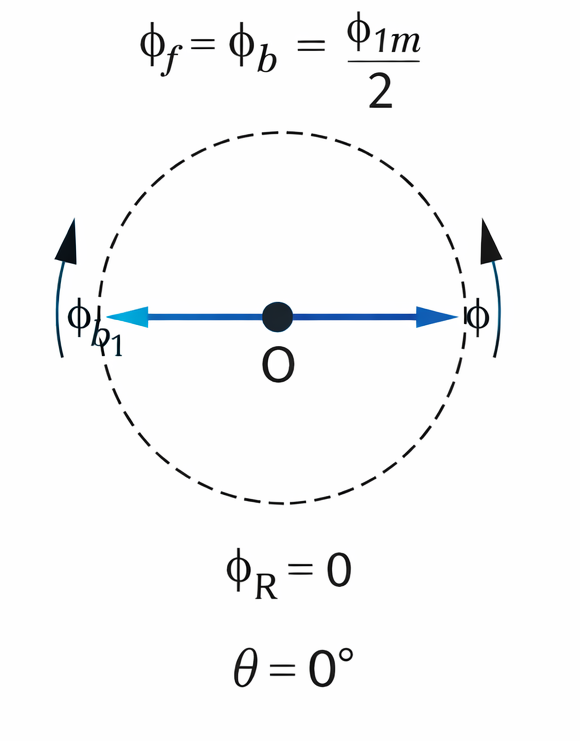
At any instant, the resultant stator flux is the algebraic sum of the two components:
At start, the two components are opposite in direction, therefore
After 90 electrical degrees, both components act in the same direction and
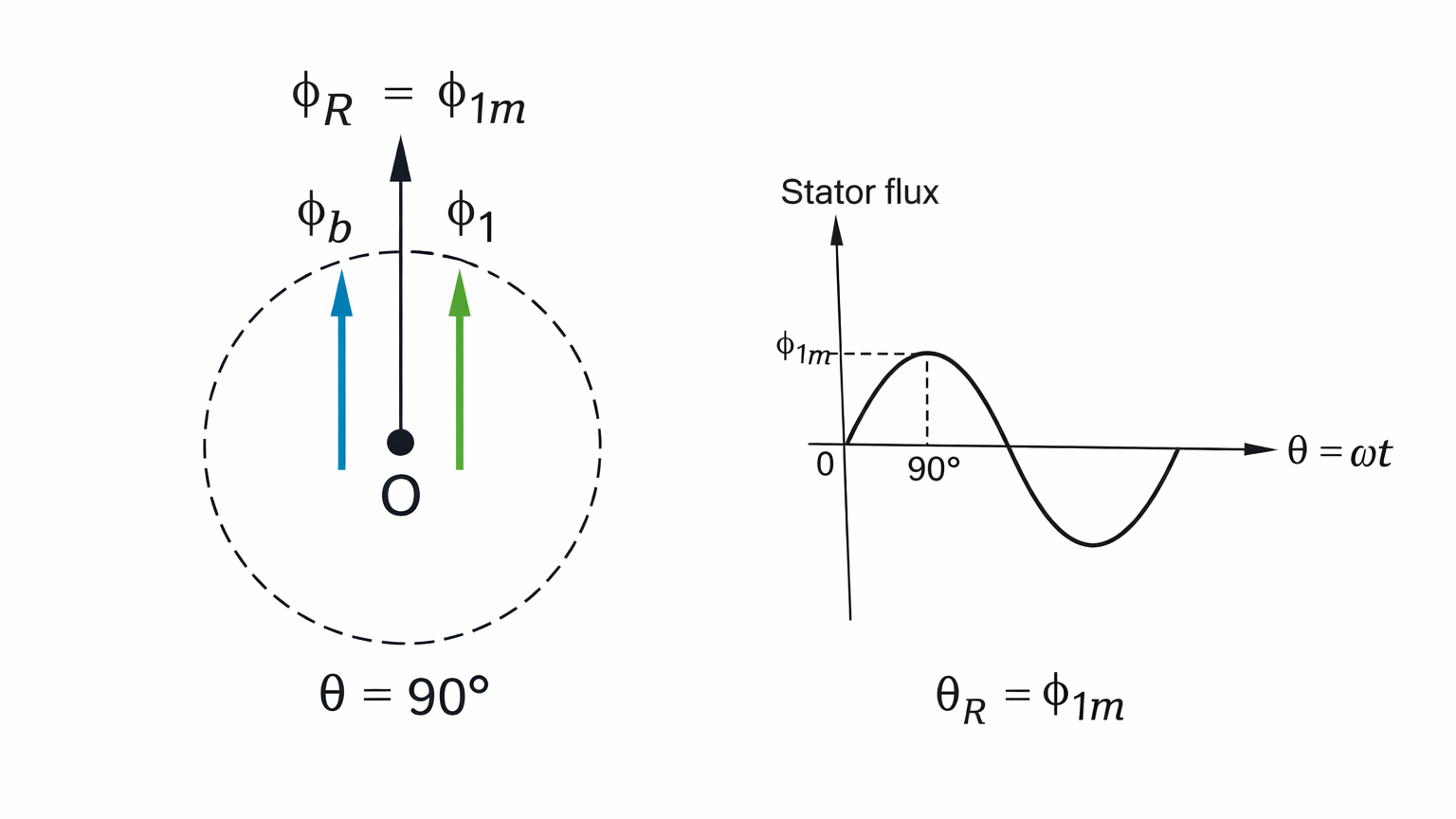
Thus, continuous rotation of these two components reproduces the original alternating flux.
Both rotating fields cut the rotor conductors and induce EMF, causing rotor current to flow. The rotor flux interacts with the forward field producing torque , and with the backward field producing torque . At standstill,
Since the net starting torque is zero, a single phase induction motor is not self starting.
Related Post:
Types of Single-phase Induction Motors
The single-phase induction motors are classified as:
- Split Phase Induction Motor
- Shaded Pole Induction Motor
- Capacitor Start Induction Motor
- Permanent Capacitor Induction Motor
- Capacitor Start Capacitor Run Induction Motor
Split Phase Motor
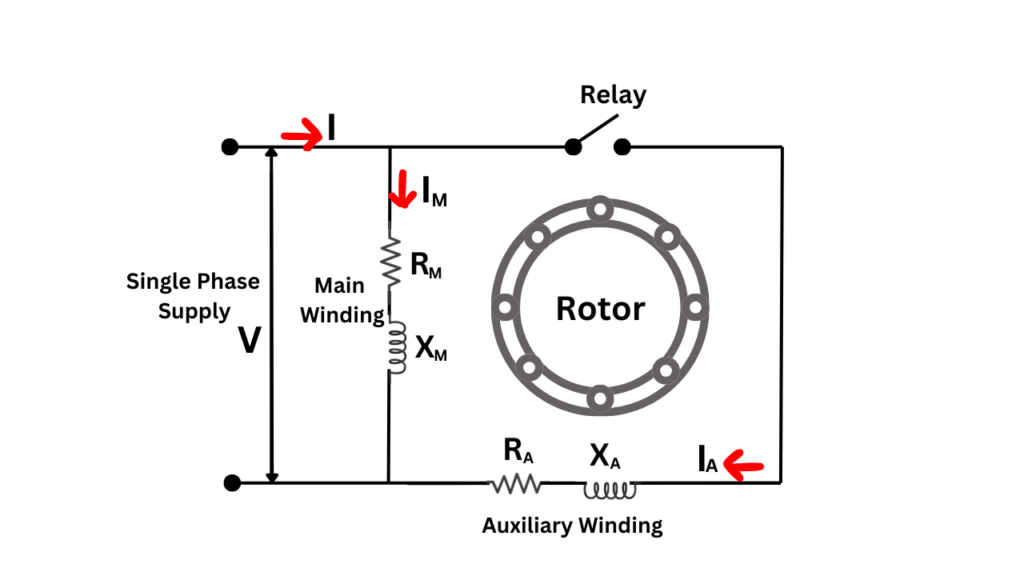
A split phase motor uses two stator windings, main and auxiliary, having different resistance and reactance values to create a phase difference during starting. This phase difference produces the required starting torque for light mechanical loads. These motors are simple in construction, economical, and widely used in fans, small pumps, grinders, and washing machines.
Shaded Pole Motor
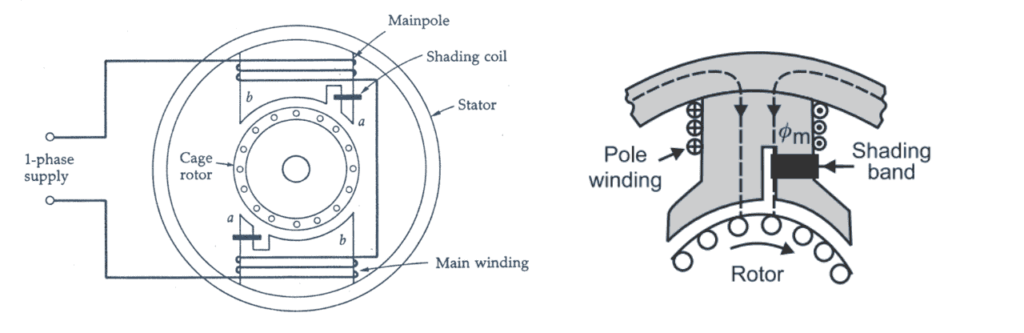
A shaded pole motor has a copper shading ring placed on a part of each stator pole. This shading coil delays the magnetic flux in that portion, producing a weak rotating magnetic field for starting. It has very simple construction, low starting torque, and is commonly used in low power devices such as table fans, hair dryers, and small exhaust fans.
Capacitor Start Motor
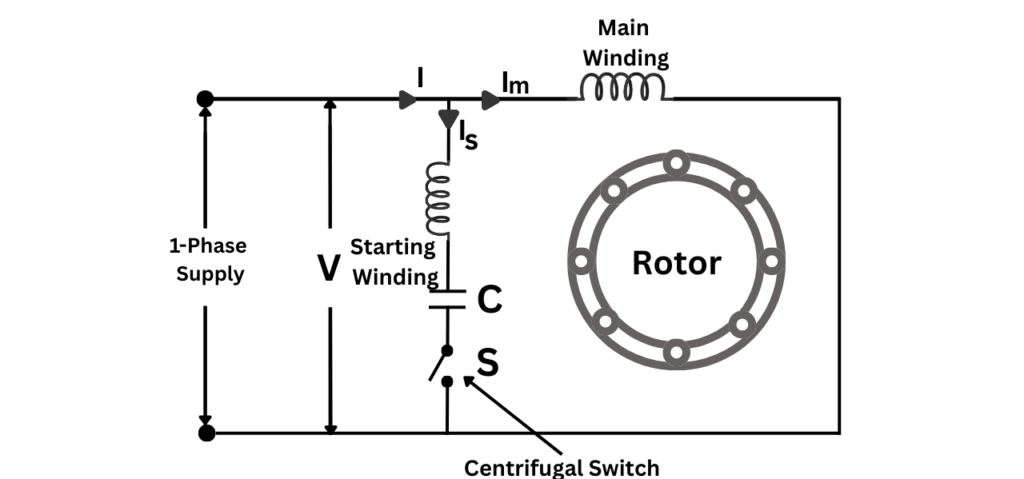
A capacitor start motor uses a high value capacitor connected in series with the auxiliary winding during starting. The capacitor creates a large phase shift between main and auxiliary currents, resulting in high starting torque. The auxiliary winding and starting capacitor are disconnected at about 70 to 80 percent of rated speed, and these motors are used in compressors, pumps, and refrigeration equipment.
Permanent Split Capacitor Motor
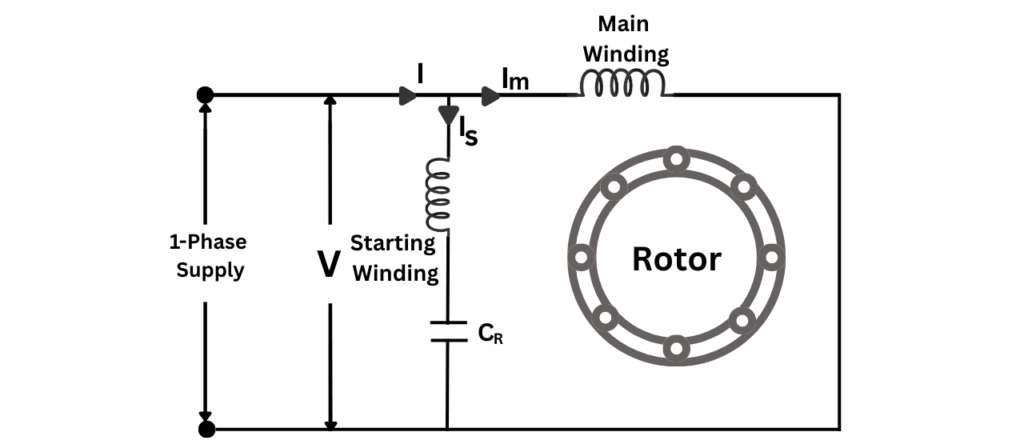
A permanent split capacitor motor has a capacitor permanently connected in series with the auxiliary winding for both starting and running. It provides smooth, quiet operation with moderate starting torque and improved power factor. Since there is no centrifugal switch, maintenance is low, and these motors are commonly used in ceiling fans, air conditioners, and blowers.
Capacitor Start Capacitor Run Motor
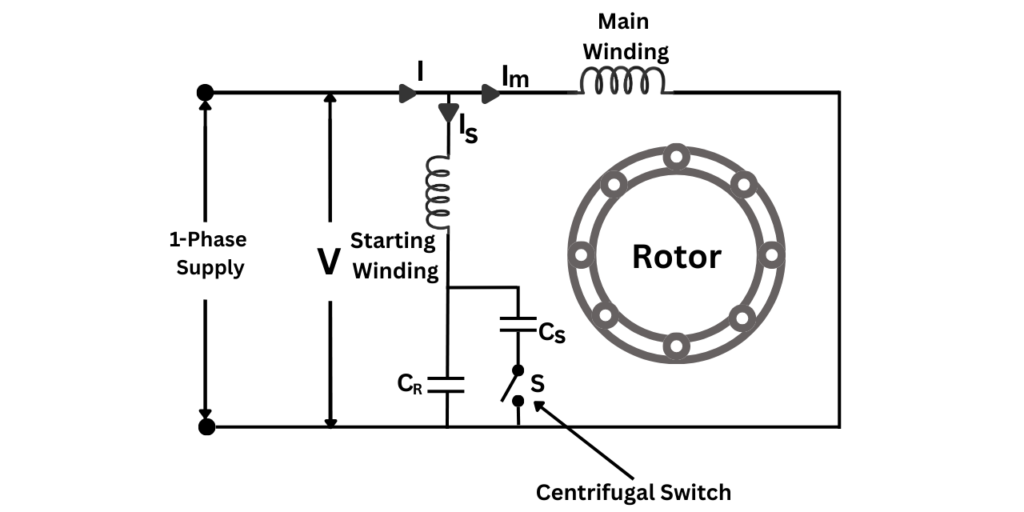
A capacitor start capacitor run motor uses two capacitors, one large capacitor for starting and one smaller capacitor for running. The starting capacitor is disconnected after the motor reaches rated speed, while the running capacitor remains in the circuit. This arrangement gives high starting torque and efficient performance, making it suitable for air compressors, pumps, and heavy duty applications.
Applications of 1 Phase Induction Motors
| Type of Motor | Applications |
|---|---|
| Split Phase Motor | • Fans • Washing machines • Small water pumps • Grinders |
| Capacitor Start Motor | • Air compressors • Refrigerators • Water pumps • Conveyors |
| Permanent Split Capacitor Motor | • Ceiling fans • Air conditioners • Blowers • Air coolers |
| Capacitor Start Capacitor Run Motor | • Heavy duty pumps • Air compressors • Refrigeration systems • Industrial machinery |
| Shaded Pole Motor | • Table fans • Hair dryers • Exhaust fans • Small household appliances |