Point-to-point Protocol (PPP) is a communication protocol of the data link layer that is used to transmit multiprotocol data between two directly connected (point-to-point) computers. It is a byte – oriented protocol that is widely used in broadband communications having heavy loads and high speeds. Since it is a data link layer protocol, data is transmitted in frames. It is also known as RFC 1661.
Frame Format
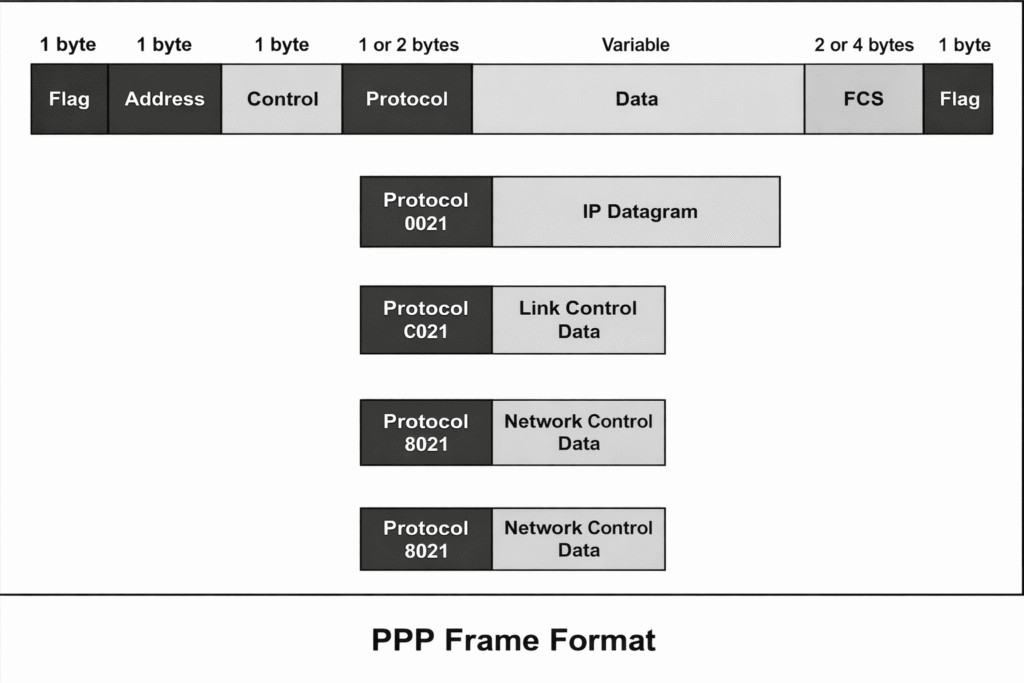
Flag field:
The flag field indicates the beginning and end of a PPP frame. It helps in proper frame synchronization during transmission. This field is always 1 byte in size and has a fixed binary value of 01111110, similar to the HDLC protocol.
Address field:
The address field is used to represent a broadcast address, meaning the frame is intended for all stations on the link. It is always set to 11111111 (all bits 1). PPP does not use this field for individual addressing, but it is kept for compatibility with HDLC.
Control field:
The control field follows the unnumbered frame format of HDLC. However, in PPP, this field is not used for flow or error control and remains fixed at 00000011. It supports simple, connectionless communication between devices.
Protocol field:
The protocol field identifies the type of data being carried in the frame. It tells the receiver what kind of protocol data unit is encapsulated in the data field, such as IP, Link Control Protocol, or Network Control Protocol. Its size can be either 1 or 2 bytes depending on the protocol.
Data field:
The data field contains the actual information or payload that needs to be transmitted. Typically, it carries network layer data such as an IP datagram. The size of this field is not fixed and can vary depending on the amount of data being sent.
FCS field:
The Frame Check Sequence field is used for error detection. It contains a checksum that is calculated over the address, control, protocol, and data fields. This helps the receiver detect any errors that may have occurred during transmission. It can be either 16 bits or 32 bits in size depending on the level of error checking required.