Large synchronous generators produce a significant amount of heat during operation due to copper losses, iron losses, and mechanical friction. If this heat is not removed properly, the insulation of the windings can get damaged and the machine efficiency may drop.
To maintain safe operating temperature, different ventilation methods are used in synchronous generators.
1. Open Circuit Ventilation System
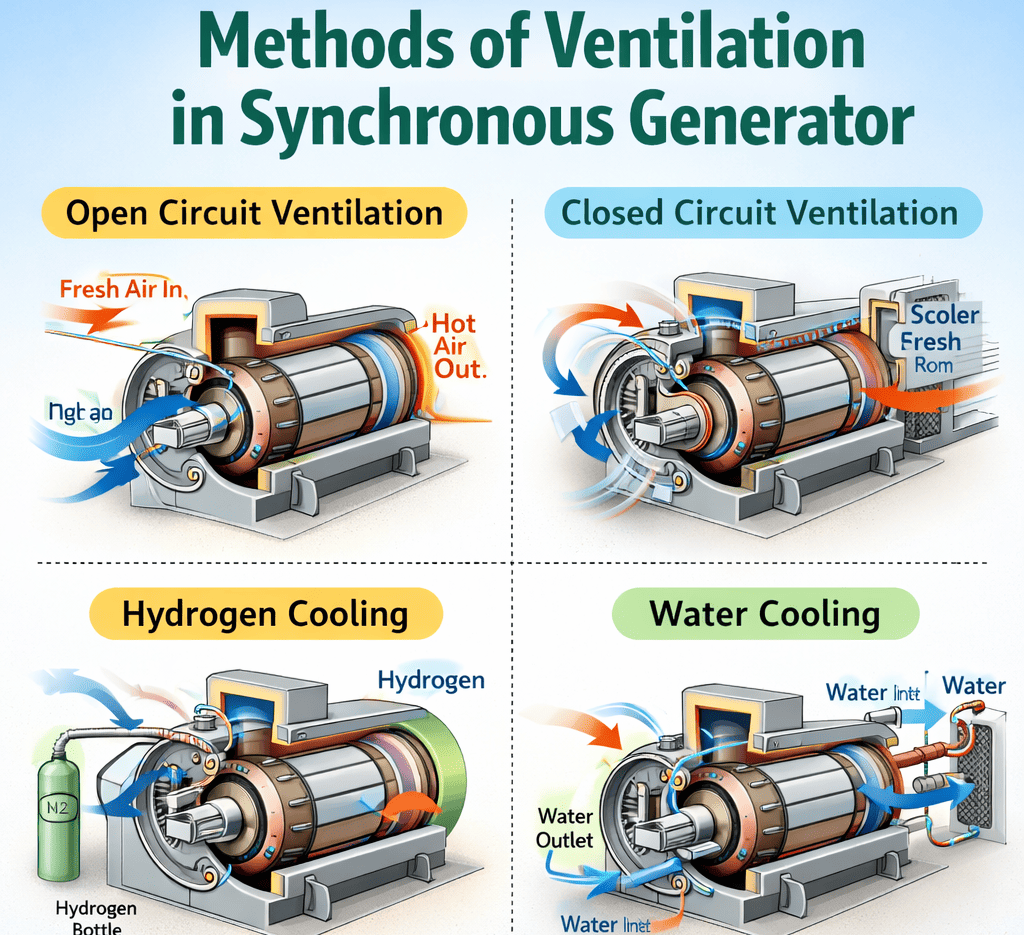
In this method, fresh air from the atmosphere is taken directly into the generator with the help of fans. The air flows through the stator and rotor parts, absorbs heat, and then it is discharged back into the atmosphere.
The air does not circulate again inside the machine.
Features
- Simple design
- Used in small and medium generators
- Requires clean surrounding air
Disadvantage
Dust and moisture from outside air may enter the machine.
2. Closed Circuit Ventilation System
In this system, the same air is circulated repeatedly inside the generator in a closed path. The hot air from the generator passes through coolers or heat exchangers, where it is cooled and then sent back into the generator again.
Only a small amount of fresh air may be added when required.
Advantages
- Prevents entry of dust and moisture
- Better temperature control
- Suitable for large power generators
3. Hydrogen Cooling System
For very large synchronous generators used in power stations, hydrogen gas is used as the cooling medium instead of air.
Hydrogen has better cooling properties and lower density, which reduces windage losses.
Advantages
- High cooling efficiency
- Reduced friction losses
- Higher generator output possible
Disadvantages
- Requires special sealing system
- Hydrogen handling needs safety precautions
4. Water Cooling System
In extremely large generators, water cooling is used along with air or hydrogen cooling. Water flows through hollow conductors or cooling tubes to remove heat from the stator windings.
Advantages
1. Suitable for high capacity generators
2. Very effective heat removal