Introduction
A transformer is a static electrical device that transfers electrical energy from one circuit to another at the same frequency by electromagnetic induction.
Although transformers are highly efficient machines, they are not completely lossless. During operation, a part of the input power is dissipated in different forms known as transformer losses. These losses reduce the efficiency and cause heating of the transformer.
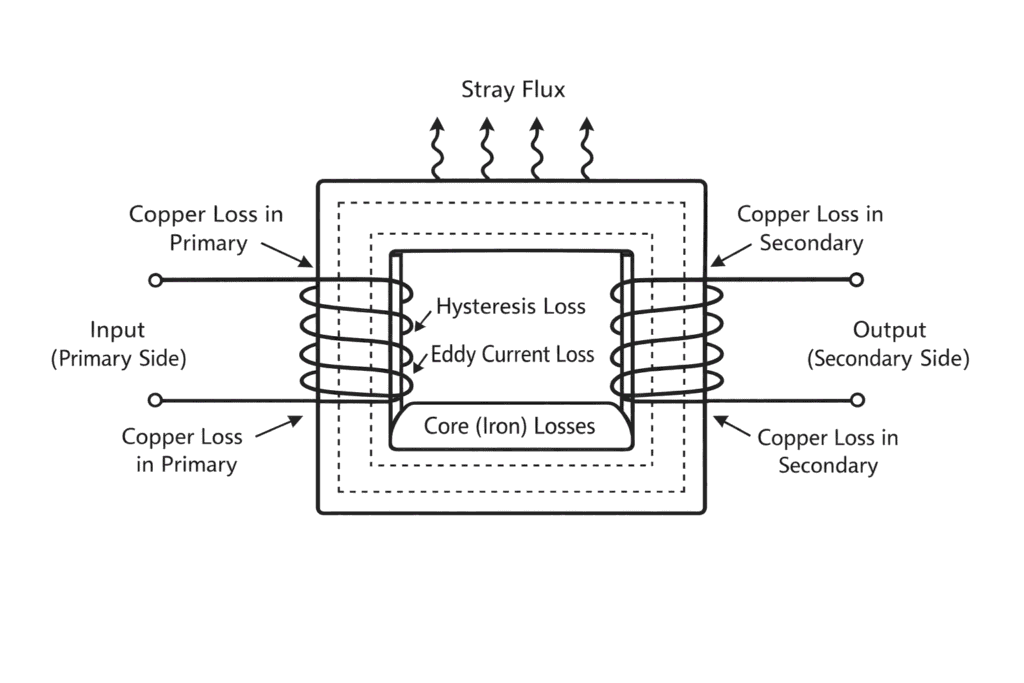
Transformer losses are mainly classified into:
- Core (Iron) Losses
- Copper Losses
- Stray Load Losses
- Dielectric Losses
1. Core (Iron) Losses
Core losses occur in the magnetic core of the transformer due to alternating magnetic flux. These losses depend mainly on supply voltage and frequency and remain almost constant irrespective of the load.
Core losses are of two types:
(a) Hysteresis Loss
Hysteresis loss is produced when the magnetic domains in the core repeatedly reverse their direction during each AC cycle. Energy is consumed in magnetizing and demagnetizing the core material, and this energy is dissipated as heat. The magnitude of hysteresis loss depends on the frequency, flux density, and the type of core material used.
Reduction:
Hysteresis loss is reduced by using silicon steel or CRGO steel having a narrow hysteresis loop.
(b) Eddy Current Loss
Eddy current loss occurs when circulating currents are induced in the iron core due to changing magnetic flux. These currents flow in closed paths inside the core and produce heat because of the resistance of the core material. Eddy current loss increases with the square of frequency and flux density.
Reduction:
This loss is minimized by laminating the core into thin sheets and using high-resistivity materials.
2. Copper Losses
Copper losses occur in the primary and secondary windings due to the electrical resistance of the conductors when current flows through them. These losses are proportional to the square of the load current and hence vary with load. At no-load condition, copper loss is zero, and it becomes maximum at full load.
Reduction:
Copper losses are reduced by using conductors of proper cross-section, high conductivity materials, and effective cooling to limit temperature rise.
3. Stray Load Losses
Stray losses are caused by leakage magnetic flux produced by the windings. This leakage flux induces eddy currents in the transformer tank, clamps, bolts, and other metallic parts, resulting in additional heating. These losses increase with load and are generally small compared to copper losses.
Reduction:
Stray losses are minimized by proper magnetic design, shielding of metallic parts, and reducing leakage flux.
4. Dielectric Losses
Dielectric losses occur in the insulating materials due to the alternating electric field. A small amount of energy is absorbed by the insulation and converted into heat. Although these losses are very small, they become significant in high-voltage transformers.
Reduction:
Dielectric losses are reduced by using high-quality insulation and maintaining proper drying and impregnation.
Classification of Transformer Losses
| Type of Loss | Dependence on Load | Nature |
|---|---|---|
| Core Loss | Constant | Voltage and frequency dependent |
| Copper Loss | Varies with load | Current dependent |
| Stray Load Loss | Varies with load | Leakage flux dependent |
| Dielectric Loss | Almost constant | Insulation dependent |
Efficiency of Transformer
Transformer efficiency is defined as:
Since transformer losses are small, the efficiency of a transformer is very high, usually between 95% and 99%.
Maximum efficiency occurs when:
Conclusion
Losses in a transformer are unavoidable but can be minimized by proper design, good quality materials, and effective cooling. A clear understanding of transformer losses helps in improving efficiency, reducing heating, and ensuring reliable operation of power systems.