Short-Duration Voltage Variations
Short-duration voltage variations are deviations in the RMS voltage magnitude that last for a period of time ranging from 0.5 cycles to 1 minute. These variations are a core part of power quality (PQ) and are typically caused by fault conditions (like short circuits), the energization of large loads (motors), or intermittent loose connections. Each type of variation can be designated as instantaneous, momentary, or temporary, depending on its duration as defined in Short-duration voltage variations are caused by fault conditions, the energization of large loads which require high starting currents, or intermittent loose connections in power wiring. Depending on the fault location and the system conditions, the fault can cause either temporary voltage drops (sags), voltage rises (swells), or a complete loss of voltage (interruptions). The fault condition can be close to or remote from the point of interest. In either case, the impact on the voltage during the actual fault condition is of the short-duration variation until protective devices operate to clear the fault.
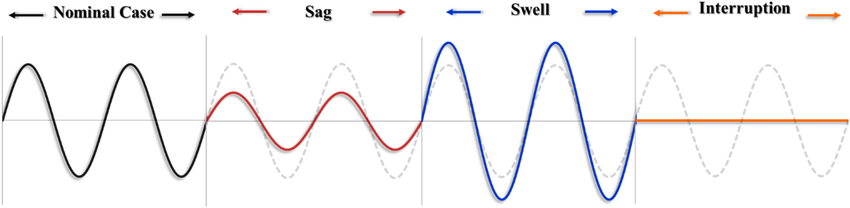
Interruption:- An interruption occurs when the supply voltage or load current decreases to less than 0.1 pu for a period of time not exceeding 1 min. Interruptions can be the result of power system faults, equipment failures, and control malfunctions. The interruptions are measured by their duration since the voltage magnitude is always less than 10 per cent of nominal. The duration of an interruption due to a fault on the utility system is determined by the operating time of utility protective devices.
A complete loss or a reduction below 10% of the nominal RMS voltage.
Types (based on duration):
- Instantaneous: < 0.5 cycles to 30 cycles (up to 0.5 seconds)
- Momentary: 30 cycles to 3 seconds
- Temporary: >3 seconds to 1 minute
Causes:
- Power system faults
- Operation of protection devices (like circuit breakers)
- Faulty equipment or connections
Impact:
- Total loss of power to equipment
- May require manual or automatic restart
- Can stop industrial processes or cause data loss
Sags (dips):- A sag is a decrease to between 0.1 and 0.9 pu in rms voltage or current at the power frequency for durations from 0.5 cycle to 1 min. The power quality community has used the term sag for many years to
describe a short-duration voltage decrease. The IEC definition for this phenomenon is dip. A decrease in RMS voltage to 10%–90% of nominal voltage.
Duration: From 0.5 cycles (about 8 ms at 60 Hz) up to 1 minute.
Causes:
- Starting of large motors
- Electrical faults (e.g., line-to-ground fault)
- Sudden increase in load
Impact:
- Computers may reboot
- Industrial equipment may malfunction
- Lights may flicker or dim
Swell :- A swell is defined as an increase to between 1.1 and 1.8 pu in rms voltage or current at the power frequency for durations from 0.5 cycle to 1 min. As with sags, swells are usually associated with system fault
conditions, but they are not as common as voltage sags. One way that a swell can occur is from the temporary voltage rise on the unfaulted phases during an SLG fault. A short-term increase in RMS voltage level to 110% to
180% of the nominal voltage.
Duration: From 0.5 cycles to 1 minute.
Causes:
Switching off large loads
Poor voltage regulation
Faults involving a floating or open neutral
Impact:
- Overvoltage stress on equipment
- Flickering or brightening of lights
- Premature failure of electrical components