Introduction
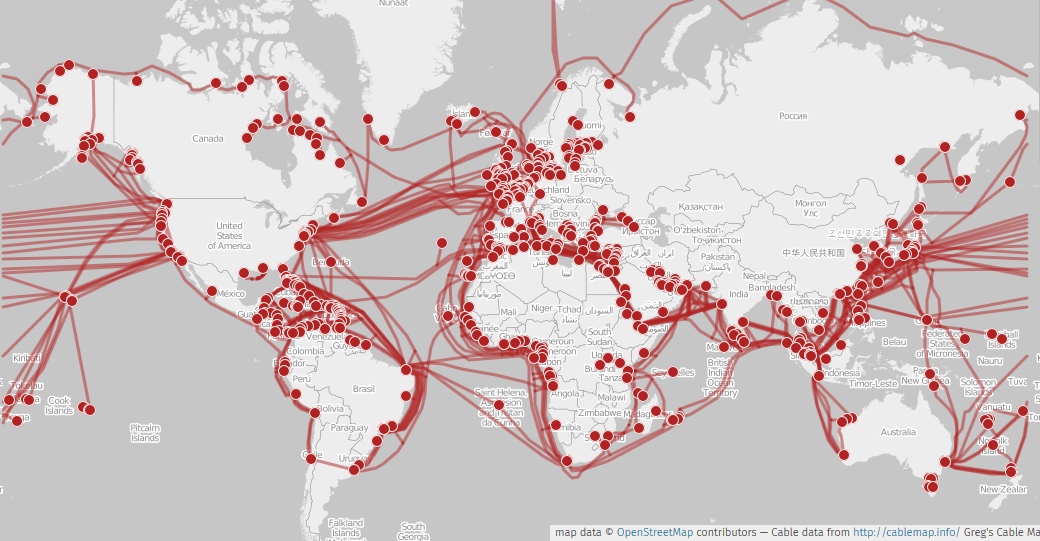
In modern power systems, underground cables are widely used for transmission and distribution of electrical energy, especially in urban areas, industrial zones, substations, and densely populated regions. Compared to overhead lines, underground cables offer better safety, improved appearance, and higher reliability under adverse weather conditions.
The performance, reliability, and life of an underground cable mainly depend on its construction and insulation system. Therefore, understanding the construction of underground cables is essential for proper selection, installation, and maintenance.
What is an Underground Cable?
An underground cable is an insulated conductor system laid below the earth’s surface to transmit electrical energy safely and reliably.
It consists of a conductor surrounded by insulation, metallic sheath, armouring, and outer protective layers to withstand electrical, mechanical, and environmental stresses.
Basic Structure of an Underground Cable
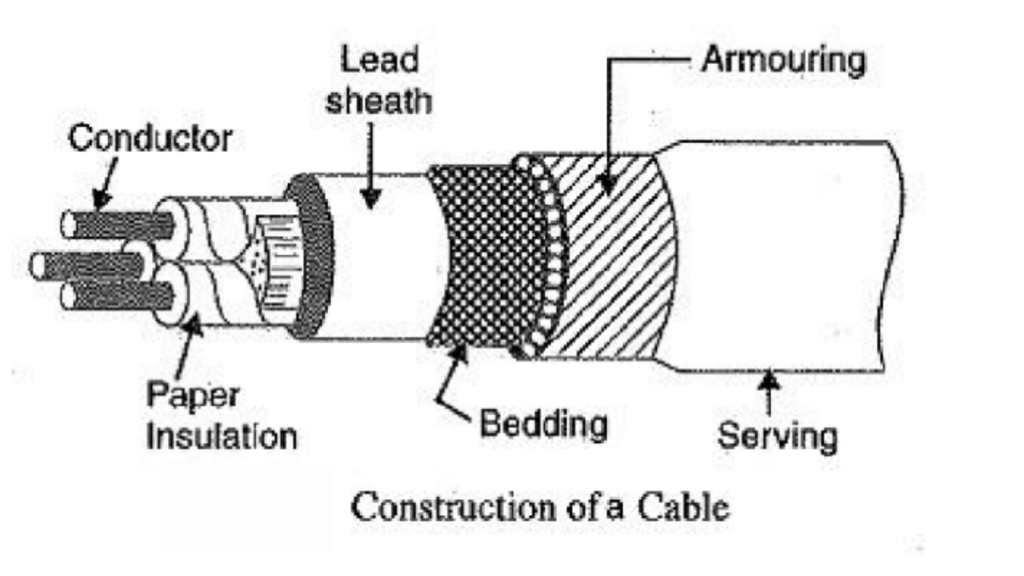
An underground cable generally consists of the following main parts:
- Conductor
- Insulation
- Metallic Sheath
- Bedding
- Armouring
- Outer Serving (Outer Sheath)
Each layer performs a specific electrical or mechanical function.
1. Conductor
The conductor is the innermost part of the cable and is responsible for carrying the electric current from source to load. It must have low resistance and high conductivity to minimize power loss. Conductors are usually solid or stranded depending on current capacity and flexibility required.
Material used: Copper, Aluminium
2. Insulation
The insulation surrounds the conductor and electrically isolates it from other conductors and earth. It prevents leakage current and withstands the operating voltage without breakdown. Good insulation must have high dielectric strength and high insulation resistance.
Material used: Impregnated paper, PVC, XLPE, Rubber
3. Metallic Sheath
The metallic sheath is provided over the insulation to protect it from moisture and chemical action of soil. It also carries leakage and fault currents and provides electrostatic shielding. This layer ensures long life of the insulation system.
Material used: Lead, Aluminium, Copper
4. Bedding
Bedding is a protective layer placed over the metallic sheath to prevent mechanical damage during armouring. It also provides a smooth surface for laying armouring wires and cushions the inner layers.
Material used: Jute, PVC, Bituminous compound
5. Armouring
Armouring gives strong mechanical protection to the cable against soil pressure, impact, crushing and pulling stress during installation. It also serves as an earth path for fault current, improving safety of the system.
Material used: Steel wires, Steel tapes
6. Outer Serving (Outer Sheath)
The outer serving is the outermost layer and protects the cable from moisture, corrosion, chemicals in soil and mechanical wear. It ensures durability and safe operation under underground conditions.
Material used: PVC, Polyethylene, Bitumen compound
Functions of Layers
| Layer | Main Function |
|---|---|
| Conductor | Carries electric current |
| Insulation | Prevents leakage and short circuit |
| Metallic Sheath | Moisture protection and shielding |
| Bedding | Protects sheath and supports armouring |
| Armouring | Mechanical protection and earthing |
| Outer Serving | Environmental and corrosion protection |