OSI Reference Model
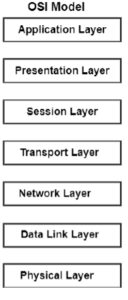
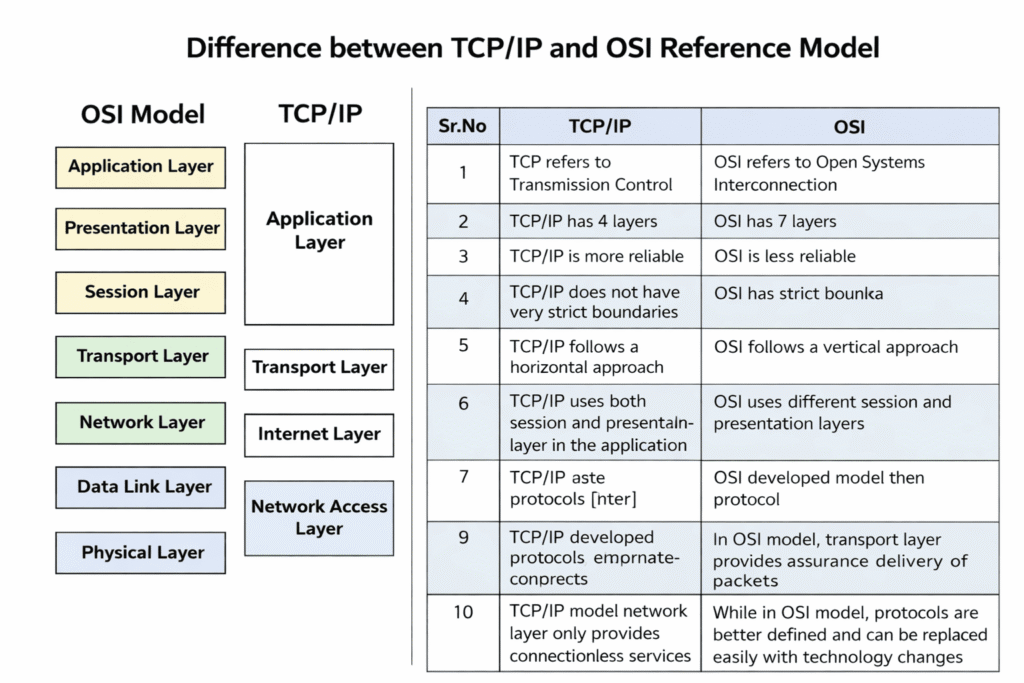
The OSI Reference Model (Open Systems Interconnection Model) is a conceptual framework developed by ISO that standardizes how data is transmitted over a network by dividing the communication process into seven distinct layers, each performing a specific function.
OSI Model Layers
Layer 1 – Physical Layer: This layer handles data transmission through cables, radio waves, etc.
Layer 2 – Data Link Layer: This layer makes sure the data transfer between adjacent nodes is error-free.
Layer 3 – Network Layer: This layer is responsible for routing data packets between different networks.
Layer 4 – Transport Layer: It makes sure the data is transferred with protocols like TCP and UDP.
Layer 5 – Session Layer: It manages sessions and connections between network devices.
Layer 6 – Presentation Layer: This layer handles data formatting, encryption, and compression.
Layer 7 – Application Layer: This layer supports application services like email and browsing.
These are seven of the OSI Model Layers.
TCP/IP Reference Model
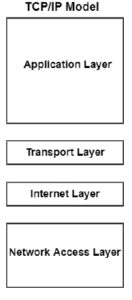
The TCP/IP Reference Model (Transmission Control Protocol/Internet Protocol Model) is a practical networking model developed by DARPA that defines how data is transmitted over the internet using a four-layer architecture, focusing on real-world communication protocols.
TCP/IP Model Layers
Layer 1 – Network Interface: This layer combines the Physical and Data Link layers of the OSI Model for hardware communication.
Layer 2 – Internet Layer: It focuses on addressing and routing via IP.
Layer 3 – Transport Layer: This layer is responsible for reliable data delivery, and it does that with the help of protocols like TCP.
Layer 4 – Application Layer: This layer is a combination of the top three layers of OSI Model and handles user interaction.
So, there are 7 layers in the OSI Model whereas in TCP/IP, we only have 4 layers.
Comparison of OSI Reference Model and TCP/IP Reference Model
| Sr.No | TCP/IP | OSI |
|---|---|---|
| 1 | TCP refers to Transmission Control Protocol | OSI refers to Open Systems Interconnection |
| 2 |
TCP/IP has 4 layers |
OSI has 7 layers |
| 3 | TCP/IP is more reliable | OSI is less reliable |
| 4 | TCP/IP does not have very strict boundaries | OSI has strict boundaries |
| 5 | TCP/IP follows a horizontal approach | OSI follows a vertical approach |
| 6 | TCP/IP uses both session and presentation layer in the application layer itself | OSI uses different session and presentation layers |
| 7 | TCP/IP developed protocols then model | OSI developed model then protocol |
| 8 | Transport layer in TCP/IP does not provide assurance delivery of packets | In OSI model, transport layer provides assurance delivery of packets |
| 9 | TCP/IP model network layer only provides connectionless services | In OSI model, network layer provides both connectionless and connection-oriented services |
| 10 | Protocols cannot be replaced easily in TCP/IP model | In OSI model, protocols are better defined and can be replaced easily with technology changes |