Type of Loads/ Classification of Load Torques
There are two types of loads or load torques, they are as follows:
1) Active Load Torques: Load torques which has the potential to drive the motor under equilibrium conditions are called active load torques. Load torques usually retains sign when the drive rotation is changed. For Example, Torque due to force of gravity, Torque due to tension, Torque due to compression and torsion etc.
2) Passive Torque: Load torques which always oppose the motion and change their sign on the reversal of motion are called passive load torques. For Example, Torque due to friction, cutting etc.
Components of Load Torques
The components of load torque are as follows:
1) Friction Torque (TF): The friction torque (TF) is the equivalent value of various friction torques referred to the motor shaft. Value of friction torque with speed is shown in figure 1 below:
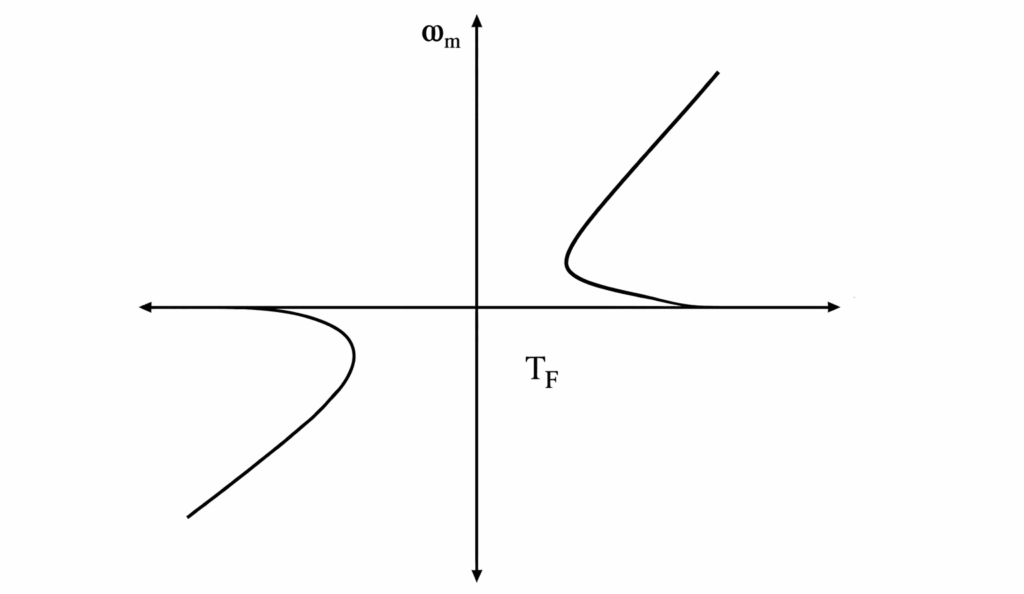
Its value at stand still is much higher than its value slightly above zero speed. Friction at zero speed is called stiction or static friction. In order to start the drive the motor should at least exceed stiction.
Friction torque can also be resolved into three components i.e.
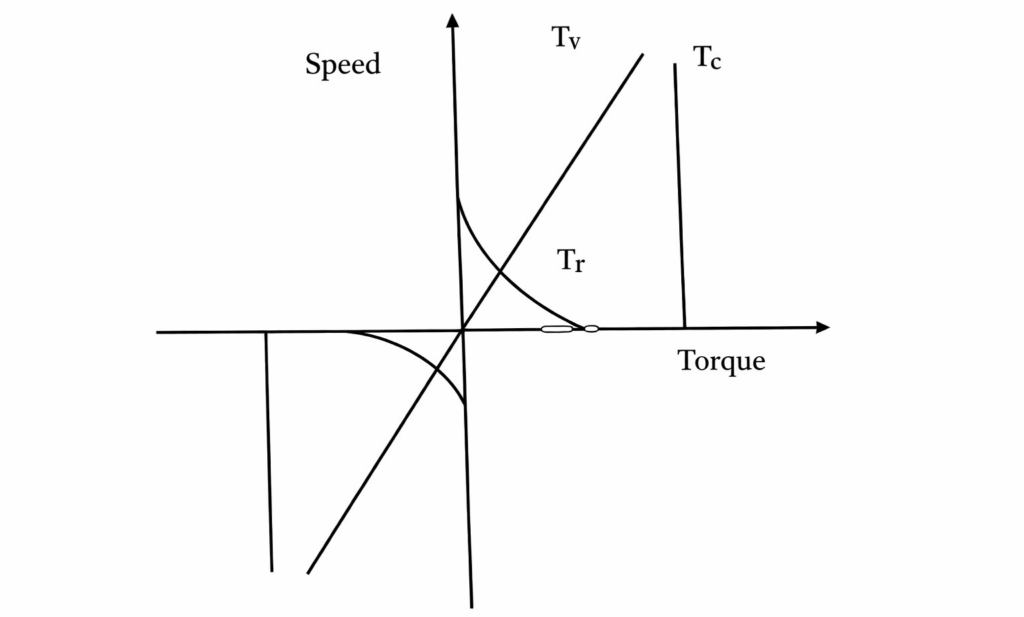
Component varies linearly with speed and is called viscous friction and is given by
Where,
= viscous friction coefficient
Another component , which is independent of speed, is known as coulomb friction.
Third component accounts for additional torque present at stand still.
Since is present only at stand still it is not taken into account in the dynamic analysis.
Windage torque , which is proportional to speed squared is given by
Thus from the above, for finite speed
2) Windage Torque (Tw):
When a motor runs, the wind generates a torque opposing the motion. This is known as the windage torque.
3) Torque Required Doing Useful Mechanical Work (Tm):
Nature of the torque depends of type of load. It may be constant and independent of speed, some function of speed, may be time invariant or time variant. The nature of the torque may change with the change in the loads mode of operation.