What is BMS (Battery Management System)?
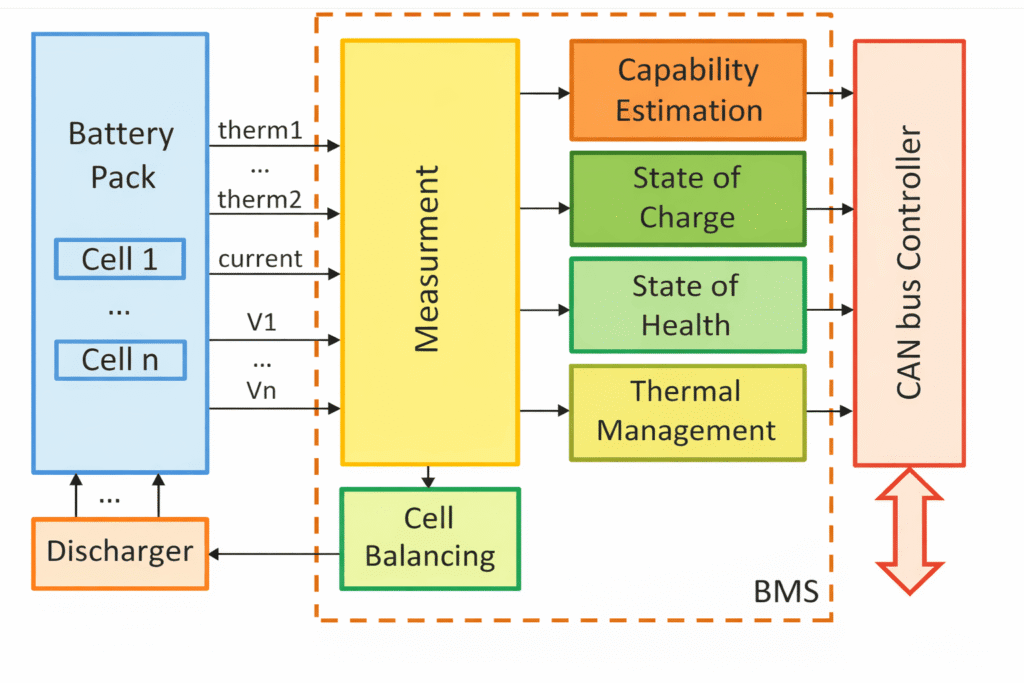
A Battery Management System (BMS) is an electronic system that monitors and manages a rechargeable battery pack. It ensures optimal performance, prevents overcharging and deep discharging, balances cell voltages, and enhances battery life. Without a BMS, an EV battery could suffer from degradation, overheating, or even failure.
Purpose of a BMS
The main purpose of a BMS is to:
- protect the battery from unsafe operating conditions,
- improve performance, and
- increase the overall lifetime of the battery pack.
Key Functions of an BMS
- Cell monitoring
- State estimation
- Protection and safety control
- Cell balancing
- Thermal management support
- Charge and discharge control
- Fault detection and diagnosis
- Communication with vehicle systems
Types of BMS Architectures
Centralized BMS Architecture
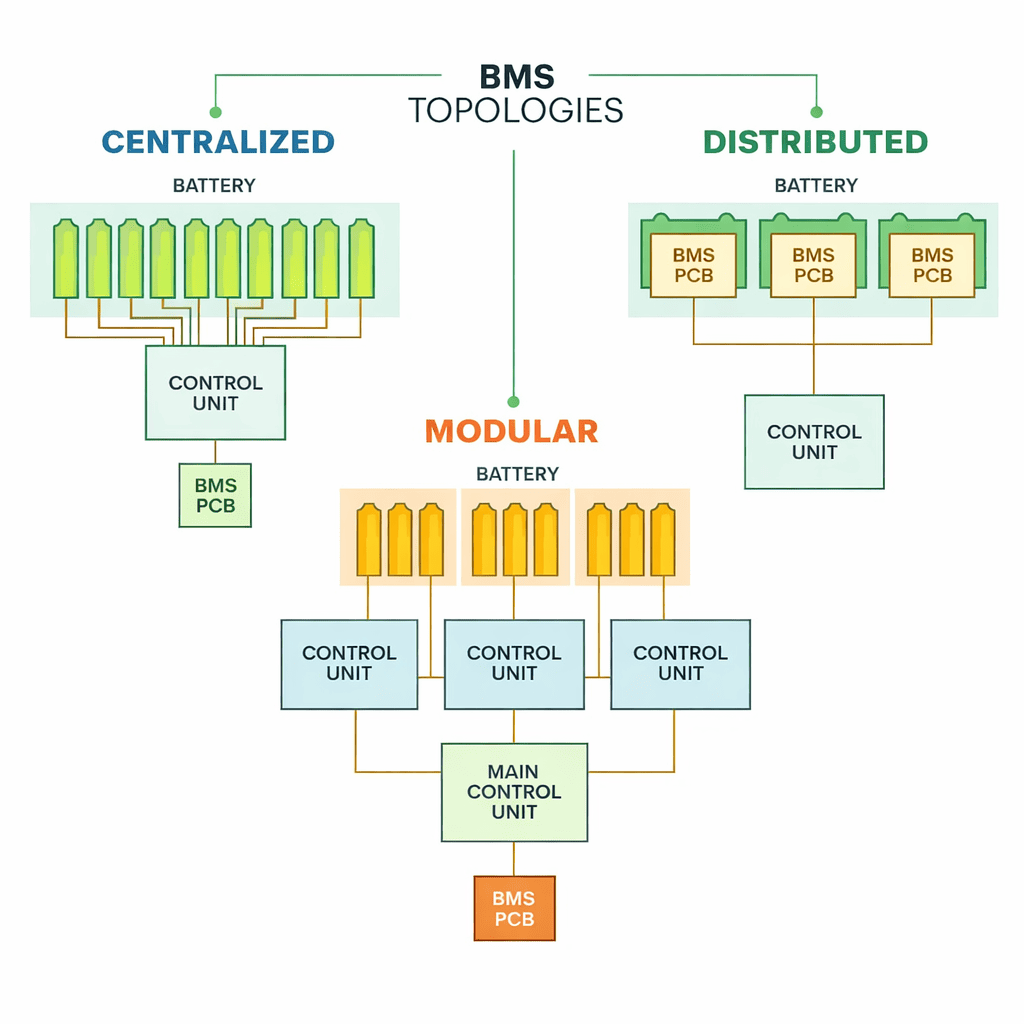
Centralized BMS architecture is a battery management structure in which one single BMS control board monitors and controls all the cells of the battery pack. The voltage of every cell and the temperature signals are connected directly to this single board through sensing wires. The same board performs cell monitoring, protection and balancing, and controls the main contactors.
Distributed BMS Architecture
Distributed BMS architecture is a battery management structure in which each cell (or a very small group of cells) has its own local BMS board placed close to the battery. These local boards measure the cell voltage and temperature and send the data to a main controller through a communication bus. The main controller performs protection, balancing control and pack-level decisions.
Modular BMS Architecture
Modular BMS architecture is a battery management structure in which the entire battery pack is divided into several modules, and each module has its own slave BMS board to monitor the cell voltages and temperatures inside that module. A single master BMS collects data from all slave boards through a communication bus and performs pack-level protection, balancing control, and contactor operation.
Important Terms related to BMS
State of Charge (SOC)
SOC (State of Charge) is the percentage that shows how much usable energy is left in a battery compared to its full capacity.
In simple words, SOC tells how full the battery is (just like a fuel gauge).
A BMS estimates SOC using measured current, voltage and temperature of the battery.
Formula (Coulomb counting)
Example:
- SOC = 100% → battery fully charged
- SOC = 50% → battery is half charged
- SOC = 0% → battery is fully discharged
State of Health (SOH)
SOH (State of Health) indicates how healthy a battery is compared to a new one. It is usually defined as the ratio of the current usable capacity of the battery to its original rated capacity, expressed in percentage. In short, SOH tells how much the battery has aged and degraded over time.
formula (capacity-based)
Where,
- = current available capacity (Ah)
- = rated capacity when battery was new (Ah)
Example:
If,
- Rated capacity = 100 Ah
- Present measured capacity = 85 Ah
So the battery SOH is 85%.
Cell Balancing
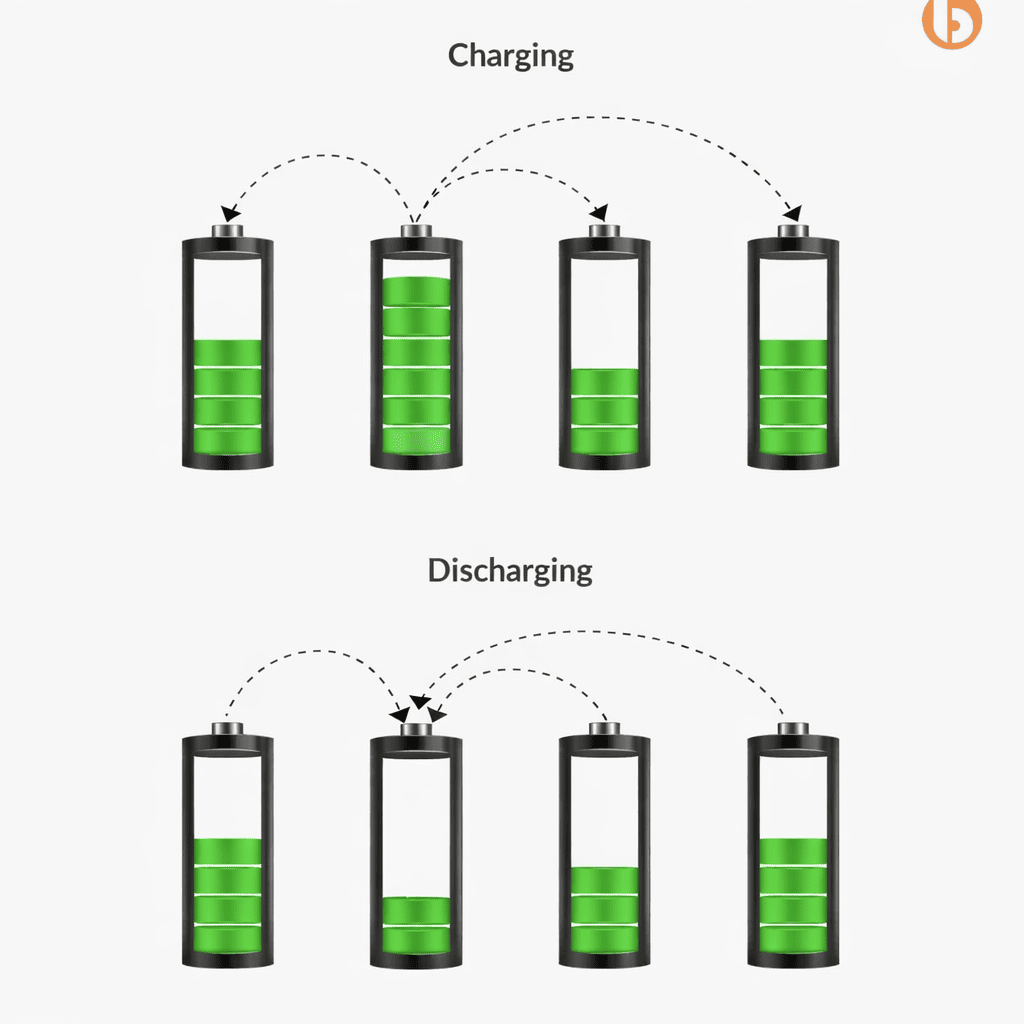
Cell balancing in a Battery Management System (BMS) is the process of equalizing the voltage and state of charge (SOC) among individual cells in a battery pack. It prevents overcharging or deep discharging of weaker cells, maximizing usable capacity, improving efficiency, and extending the lifespan of the battery pack.
Types of Cell Balancing
Passive cell balancing
In passive balancing, the BMS detects the cell with higher voltage and connects a small resistor across that cell.
The extra energy of that cell is dissipated as heat, so its voltage slowly drops and becomes equal to the other cells.
Simply:
- high-voltage cell → resistor ON
- extra charge → burned as heat
- cells become equal
Active cell balancing
In active balancing, the BMS moves energy from a higher-charged cell to a lower-charged cell using electronic circuits (capacitors or inductors).
Simply:
- high-voltage cell → gives energy
- low-voltage cell → receives energy
- very little energy is wasted
Thermal management
Thermal management is the system used to keep the battery cells within a safe temperature range during charging, discharging, and operation.
In a BMS, thermal management works by:
- measuring cell temperatures using sensors, and
- controlling cooling or heating devices (fans, liquid cooling, heaters, pumps, etc.)
So that the battery:
- does not overheat
- does not become too cold
Applications of BMS
A Battery Management System is widely used in:
- electric vehicles,
- energy storage systems,
- uninterruptible power supplies,
- portable and industrial battery packs.