
What is an Electric Arc?
An electric arc is a continuous electrical discharge that occurs when current flows through a normally non-conducting medium (such as air or gas) between two separated conductors due to ionization of the medium.
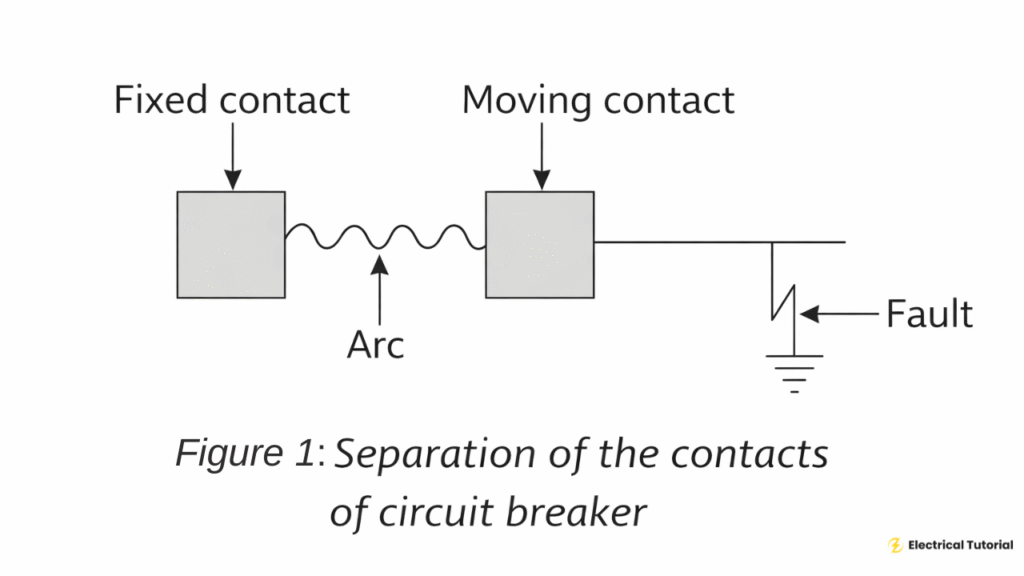
In a circuit breaker, an electric arc is formed when the breaker opens its contacts to interrupt the flow of current under load or fault conditions.
When the contacts separate, the current does not stop immediately. Instead, it continues to flow through the ionized air or medium between the contacts in the form of an arc.
What is a Circuit Breaker?
A circuit breaker is a mechanical switching device capable of making, carrying, and breaking currents under normal circuit conditions, and also capable of making, carrying for a specified time, and automatically breaking currents under abnormal conditions, such as short-circuits or faults.
The main function of a circuit breaker is to isolate the faulty part of the power system whenever abnormal conditions like faults occur, so that the healthy part of the system continues to operate safely.
There are two methods of arc interruption:
- High Resistance Interruption
- Current Zero Interruption
High Resistance Interruption
In this method of arc interruption, its resistance is increased so as to reduce the current to a value insufficient to maintain the arc. The arc resistance can be increased by cooling, lengthening, constraining and splitting the arc. When current is interrupted the energy associated with its magnetic field appears in the form of electrostatic energy.
A high voltage appears across the contacts of the circuit breaker. If this voltage is very high and more than the withstanding capacity of the gap between the contacts, the arc will strike again. Therefore, this method is not suitable for a large-current interruption. This can be employed for low power ac and dc circuit breakers.
The following are the reasons which can increase the resistance of the arc.
- Cooling of arc
- Increasing the length of the arc
- Reducing the cross section of the arc
- Splitting of arc
Current Zero Interruption
This method is applicable only in case of ac circuit breakers. In case of ac supply, the current wave passes through a zero point, 100 times per second at the supply frequency of 50 Hz.
This feature of ac is utilised for arc interruption. The current is not interrupted at any point other than the zero current instant, otherwise a high transient voltage will occur across the contact gap. The current is not allowed to rise again after a zero current occurs. There are two theories to explain the zero current interruption of the arc.
- Recovery rate theory (Slepain’s Theory)
- Energy balance theory (Cassie’s Theory)
Recovery Rate Theory
The arc is a column of ionised gases. To extinguish the arc, the electrons and ions are to be removed from the gap immediately after the current reaches a natural zero. Ions and electrons can be removed either by recombining them into neutral molecules or by sweeping them away by inserting insulating medium (gas or liquid) into the
gap.
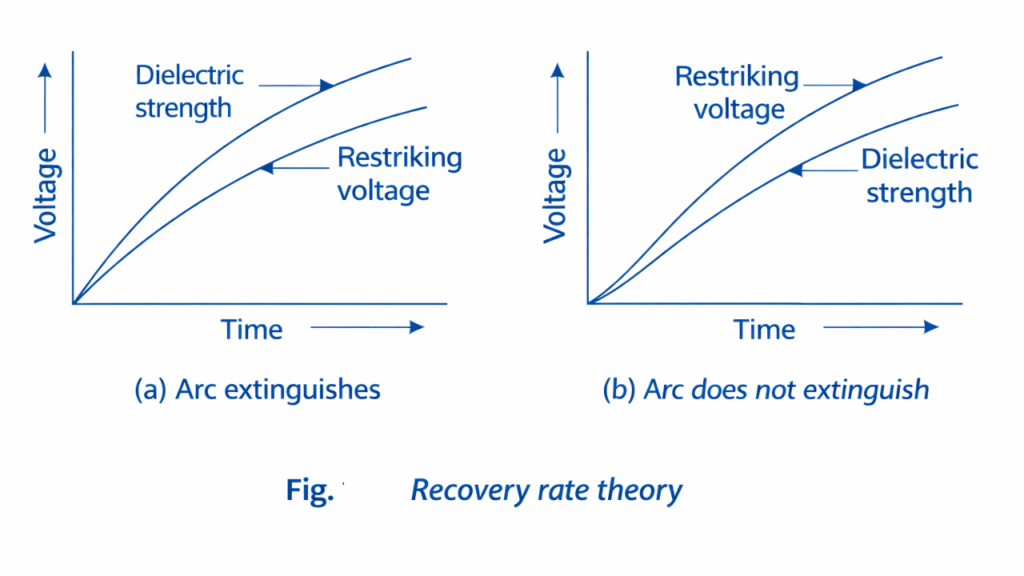
The arc is interrupted if ions are removed from the gap at a rate faster than the rate of ionisation. In this method, the rate at which the gap recovers its dielectric strength is compared with the rate at which the gap recovers its dielectric strength is compared with the rate at which the restriking voltage (transient voltage) across the
gap rises.
If the dielectric strength increases more rapidly than the restriking voltage, the arc is extinguished. If the restriking voltage rises more rapidly than the dielectric strength, the ionisation persists and breakdown of the gap occurs, resulting in an arc for another half cycle.
Energy Balance Theory
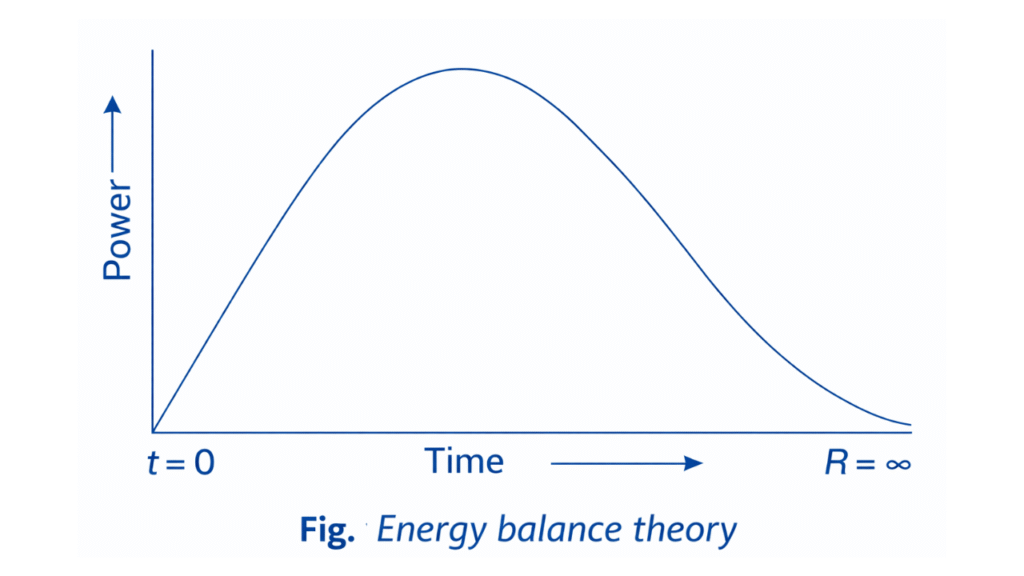
The space between the contacts contains some ionised gas immediately after current zero and hence, it has a finite post-zero resistance. At the current zero moment, power is zero because restricking voltage is zero. When the arc is finally extinguished, the power again becomes zero, the gap is fully de-ionised and its resistance is infinitely high.
In between these two limits, first the power increases, reaches a maximum value, then decreases and finally reaches zero value as shown in Fig. Due to the rise of restriking voltage and associated current, energy is generated in the space between the contacts. The energy appears in the form of heat.
The circuit breaker is designed to remove this generated heat as early as possible by cooling the gap, giving a blast of air or flow of oil at high velocity and pressure. If the rate of removal of heat is faster than the rate of heat generation the arc is extinguished. If the rate of heat generation is more than the rate of heat dissipation, the space breaks down again resulting in an arc for another half cycle.


1 thought on “Arc Interruption Methods in Circuit Breakers”
Well explained