What is ALOHA in Computer Network?
ALOHA in computer networks is a random access protocol used to control how multiple devices share a common communication channel.
It was developed at the University of Hawaii and is one of the earliest methods for wireless data communication.
What ALOHA Does
ALOHA allows any device to send data whenever it has data to transmit, without checking whether the channel is free.
- If only one device transmits → data is received successfully
- If multiple devices transmit at the same time → collision occurs and data is lost
- After collision → devices wait for a random time and retransmit
Types of ALOHA
- Pure ALOHA
- Slotted ALOHA
Pure ALOHA
Pure ALOHA is a method where any station can send data whenever it has data to transmit, without checking whether the channel is free or not.
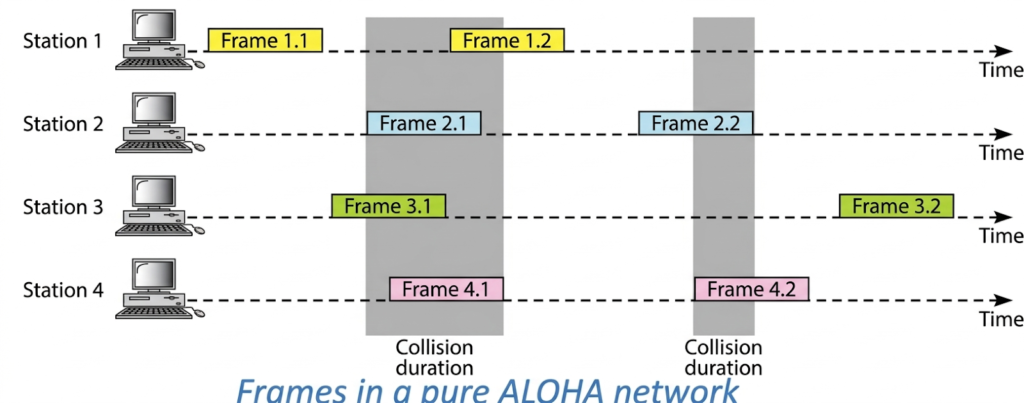
When two or more stations transmit simultaneously, there is collision and the frames are destroyed.
● In pure ALOHA, whenever any station transmits a frame, it expects the acknowledgement from the receiver.
● If acknowledgement is not received within specified time, the station assumes that the frame (or acknowledgement) has been destroyed.
● If the frame is destroyed because of collision the station waits for a random amount of time and sends it again. This waiting time must be random otherwise same frames will collide again and again.
● If the frame is destroyed because of collision the station waits for a random amount of time and sends it again. This waiting time must be random otherwise same frames will collide again and again.
● If the frame is destroyed because of collision the station waits for a random amount of time and sends it again. This waiting time must be random otherwise same frames will collide again and again.
● Therefore pure ALOHA dictates that when time-out period passes, each station must wait for a random amount of time before resending its frame. This randomness will help avoid more collisions.
🔹 Vulnerable Time
The time during which collision can occur is:
Where is the transmission time of one frame.
🔹 Efficiency
Maximum efficiency of Pure ALOHA is:
Slotted ALOHA
Slotted ALOHA is an improved version of Pure ALOHA where time is divided into equal slots, and stations are allowed to transmit only at the beginning of a time slot.
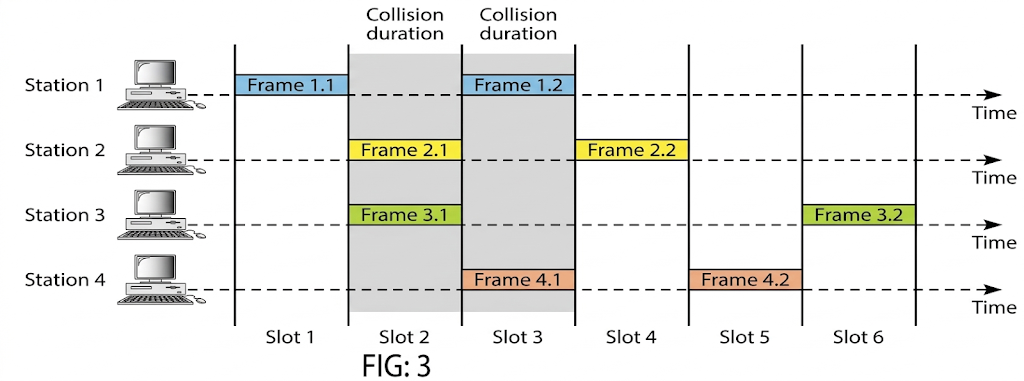
Slotted ALOHA improves upon Pure ALOHA by introducing time synchronization across all stations. In this method, time is divided into equal slots, and each station is only allowed to transmit at the beginning of a slot, as illustrated in the diagram. This restriction ensures that frames either fully collide or do not collide at all, eliminating partial overlaps. As a result, the vulnerable time is reduced to a single frame duration, which significantly lowers the probability of collisions.
However, collisions can still occur if multiple stations choose the same time slot. While this method improves efficiency and doubles the throughput compared to Pure ALOHA, it requires precise synchronization and may lead to some idle slots when no station transmits.
🔹 Vulnerable Time
Only one time slot is vulnerable, unlike Pure ALOHA (2Tt)
🔹 Efficiency
Which is double that of Pure ALOHA.
Comparison of Pure Aloha and Slotted Aloha
| No. | Pure Aloha | Slotted Aloha |
|---|---|---|
| 1 | Introduced by University of Hawaii in 1972 | Introduced by Robert in 1972 |
| 2 | Any station can transmit data at any time | Any station can transmit data at beginning of time slot |
| 3 | Time is not synchronized | Time is globally synchronized |
| 4 | Does not decrease number of collisions | It decreases the number of collision |
| 5 | Vulnerable time = 2 × Tt | Vulnerable time = Tt |
| 6 | Maximum efficiency or throughput is 18% | Maximum efficiency or throughput is 37% |
| 7 | Probability of successful transmission of frame is less | Probability of successful transmission of frame is high |