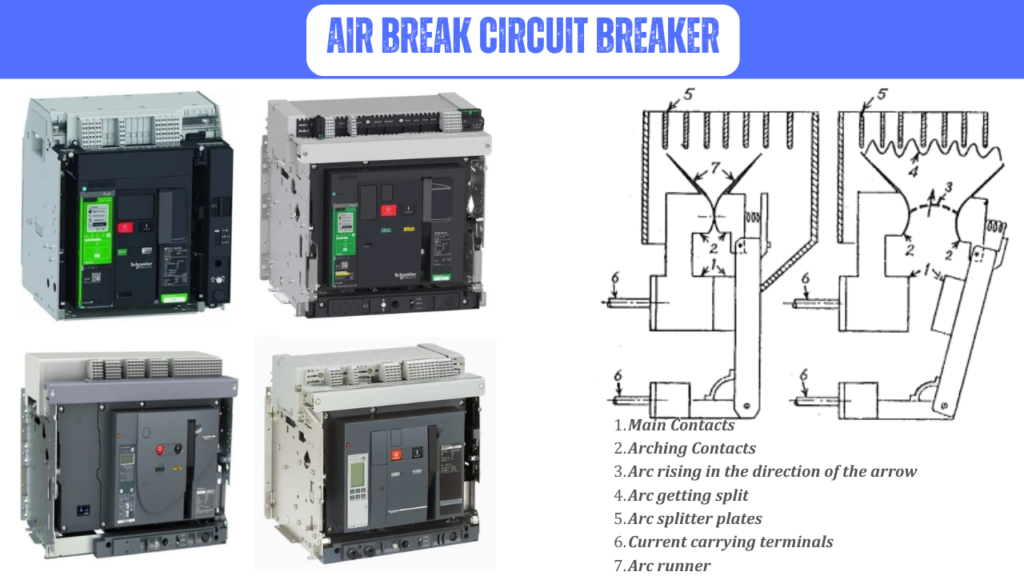
The air at atmosphere pressure is used as an arc extinguishing medium in Air-Break Circuit-Breakers. These circuit-breakers employ the high resistance interruption principle. The arc is rapidly lengthened by means of arc runners and arc chutes and the resistance of the arc is increased by cooling, lengthening and splitting the arc. The arc resistance increases to such an extent that the voltage drop across the arc becomes more than the supply voltage and the arc extinguishes.
Air-break circuit-breakers are used in d.c. circuits and a.c. circuits up to 12 kV. The air-break circuit-breakers are generally indoor type and installed on vertical panels or in indoor draw-out type switchgear.A.C. air-break circuit-breakers are widely used in indoor medium voltage and low voltage switchgear.
Typical reference values of ratings of air-break circuit-breakers are:
| Rated Voltage | Rated Current Range | Short-Circuit Breaking Capacity |
|---|---|---|
| 460 V | 400 – 3500 A | 40 – 75 kA |
| 3.3 kV | 400 – 3500 A | 13.1 – 31.5 kA |
| 6.6 kV | 400 – 2400 A | 13.1 – 20 kA |
Magnetic field is utilised for lengthening the arc in high voltage air-break circuit-breakers.
Construction of Air Break Circuit Breaker
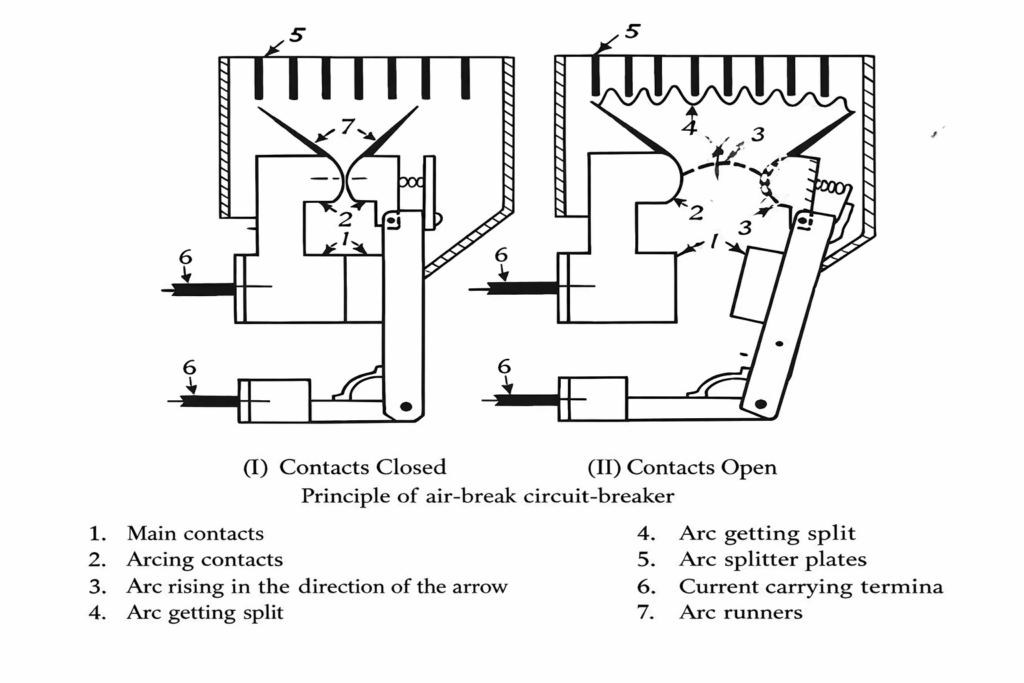
An air-break circuit breaker is constructed so that the contacts and arc-extinguishing parts operate in air at atmospheric pressure. Its main constructional parts are:
- Main contacts
These carry the load current during normal operation. They are made with low contact resistance material and are usually silver-plated. - Arcing contacts
These contacts carry the current during opening and closing. They are made of hard and heat-resistant copper alloy and are designed to withstand arc erosion. - Arc runners (arcing horns)
They guide the arc away from the contacts and force it to move upward towards the arc chute. - Arc chute (arc chamber)
It is an insulated enclosure provided above the contacts to control and extinguish the arc. - Arc splitter plates
A set of metallic plates arranged inside the arc chute. These plates split the arc into a number of smaller arcs, increase the arc length and help in rapid cooling. - Operating mechanism and moving contact system
This mechanical arrangement opens and closes the contacts when the breaker is operated manually or by a trip unit. - Current-carrying terminals
These provide the external electrical connections to the circuit.
In construction, the main contacts open first and the arcing contacts open later.
The arc formed between arcing contacts is driven along the arc runners into the arc chute, where it is split and extinguished.
Related Posts: Sulphur Hexafluoride (SF₆) Circuit Breaker
Working Principle of Air-Break Circuit Breaker (ACB)
The working principle of an air-break circuit breaker is based on the high-resistance method of arc extinction in air at atmospheric pressure. During normal operation, current flows through the main contacts. When a fault occurs, the breaker operates and the main contacts open first, transferring the current to the arcing contacts. Immediately after this, the arcing contacts separate and an arc is formed between them. This arc is driven upward by the combined effect of electromagnetic forces and the thermal buoyancy of hot ionized air.
The arc ends move along the arc runners and enter the arc chute, where a set of arc splitter plates divides the arc into several smaller arcs. As a result, the arc length increases and the arc is cooled rapidly, which greatly increases the arc resistance. When the arc resistance becomes sufficiently high, the system voltage is unable to maintain the arc and, in AC systems, the arc finally extinguishes at the natural current zero. Thus, interruption of current is achieved by lengthening, cooling and splitting the arc in air.
Types of Air-Break Circuit Breaker (ACB)
Air-break circuit breakers are mainly classified based on the method used to control and extinguish the arc.
Plain air-break circuit breaker (natural air cooling type)
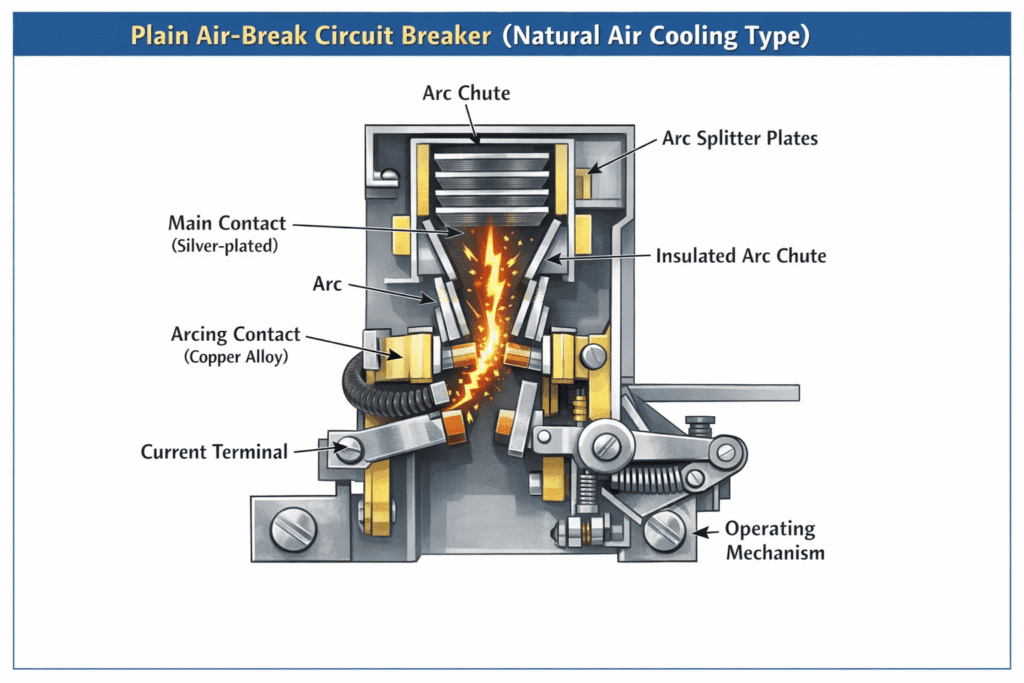
In the plain air-break circuit breaker, the arc is extinguished mainly by the natural action of air, arc lengthening and arc cooling. When the breaker opens under load or fault condition, the main contacts open first and the current is transferred to the arcing contacts. As the arcing contacts separate, an arc is formed in free air. This arc is allowed to rise naturally because of the thermal buoyancy of the hot ionized air.
Arc runners are provided to guide the arc towards the arc chute. Inside the arc chute, a number of arc splitter plates are arranged. When the arc enters this region, it is divided into several small arcs. Due to splitting and increased arc length, the arc resistance increases. At the same time, the metallic splitter plates absorb heat from the arc, which further cools it. When the arc resistance becomes sufficiently high, the system voltage cannot maintain the arc and the arc is finally extinguished (in AC systems, at current zero).
This type of air-break circuit breaker is generally used for low and medium voltage indoor switchgear where the fault level is moderate.
Important features
Simple construction
Arc extinction mainly by
→ lengthening
→ cooling
→ splitting
No external magnetic blow-out coil is used
Magnetic blow-out air-break circuit breaker
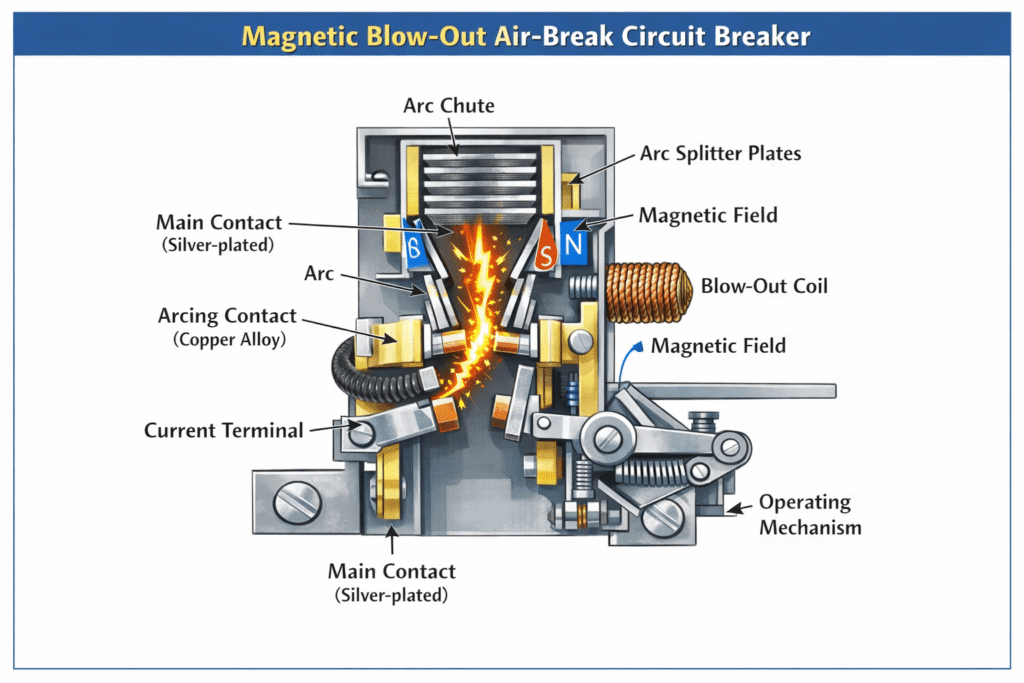
In the magnetic blow-out type air-break circuit breaker, the arc is controlled by a magnetic field in addition to the normal arc chute arrangement. When a fault occurs and the arcing contacts separate, an arc is produced. A blow-out coil or specially designed conductor arrangement carries the same current and produces a magnetic field around the arc. This magnetic field interacts with the current flowing in the arc and produces a Lorentz force on the arc column. As a result, the arc is forced rapidly towards the arc runners and into the arc chute.
Because of this forced movement:
- the arc travels faster,
- the arc is stretched more effectively,
- and it enters the splitter plates quickly.
Inside the arc chute, the arc is again split into a number of short arcs and cooled by the splitter plates. Since the arc is driven quickly into the arc chute, the arc extinction is much faster and more reliable than in the plain air-break type. This type of air-break circuit breaker is suitable for higher short-circuit currents and higher voltage ratings compared to the plain air-break type.
Important features
Better performance under heavy fault current
Magnetic field is used to drive the arc
Faster arc movement
Higher interrupting capability
Key difference between Plain air-break & Magnetic blow-out CB
| Point | Plain air-break type | Magnetic blow-out type |
|---|---|---|
| Arc movement | Mainly by natural rising of hot arc | Forced by magnetic field |
| Arc control | Moderate | Strong and fast |
| Interrupting capacity | Lower | Higher |
| Application | LV / MV, moderate faults | Higher current and higher fault level |
Advantages of Air-Blast Circuit Breaker
Advantages of Air Circuit Breaker (ACB)
- Simple and safe construction (air used as arc-quenching medium).
- No fire or explosion risk (no oil or gas).
- Suitable for high current low-voltage applications.
- Easy maintenance and inspection.
- Adjustable and accurate protection (LSIG in modern ACBs).
- Good selectivity and coordination in LV systems.
- Can be used for frequent switching.
Disadvantages of Air Circuit Breaker (ACB)
- Limited to low-voltage systems (generally up to 690 V).
- Larger size compared to MCCB for the same rating.
- Slower arc extinction compared to vacuum or SF₆ breakers.
- Not suitable for high-voltage applications.
- Higher initial cost than MCCB for small and medium ratings.
Applications of Air Circuit Breaker (ACB)
- Used as main incomer and outgoing feeder breaker in LT panels.
- Used in industrial power distribution systems.
- Used in power plant auxiliary and LT systems.
- Used in commercial buildings (malls, hospitals, offices).
- Used in data centres and UPS panels.
- Used on the LV side of generators and transformers.
- Used for bus-coupler and bus-section protection.
Related Posts: