
Distribution System in Power System
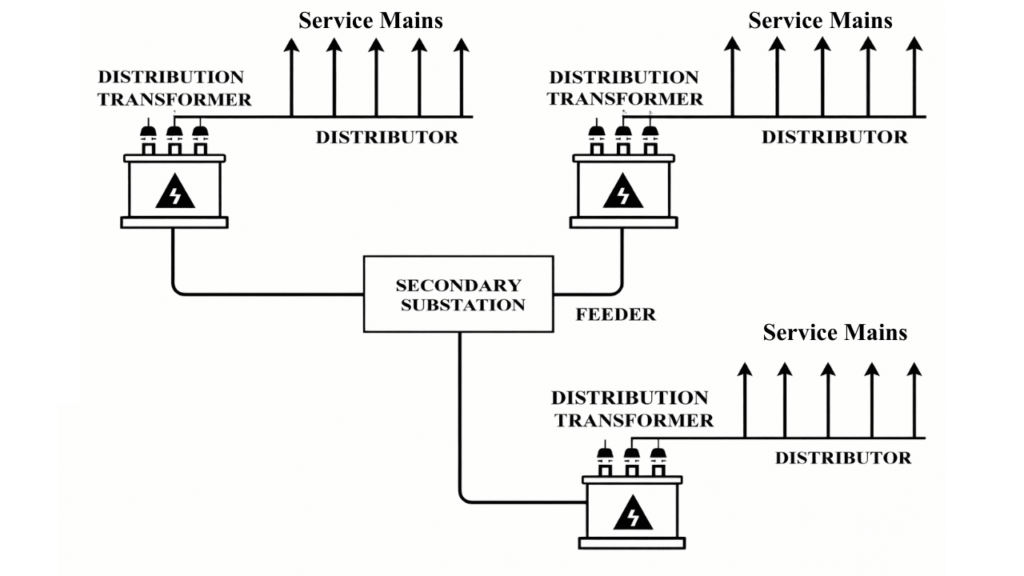
That part of the power system which distributes electric power for local use is known as the distribution system. It delivers electrical energy from the transmission system to the consumers at utilization voltage levels. The distribution system includes substations, feeders, distributors, and service mains.
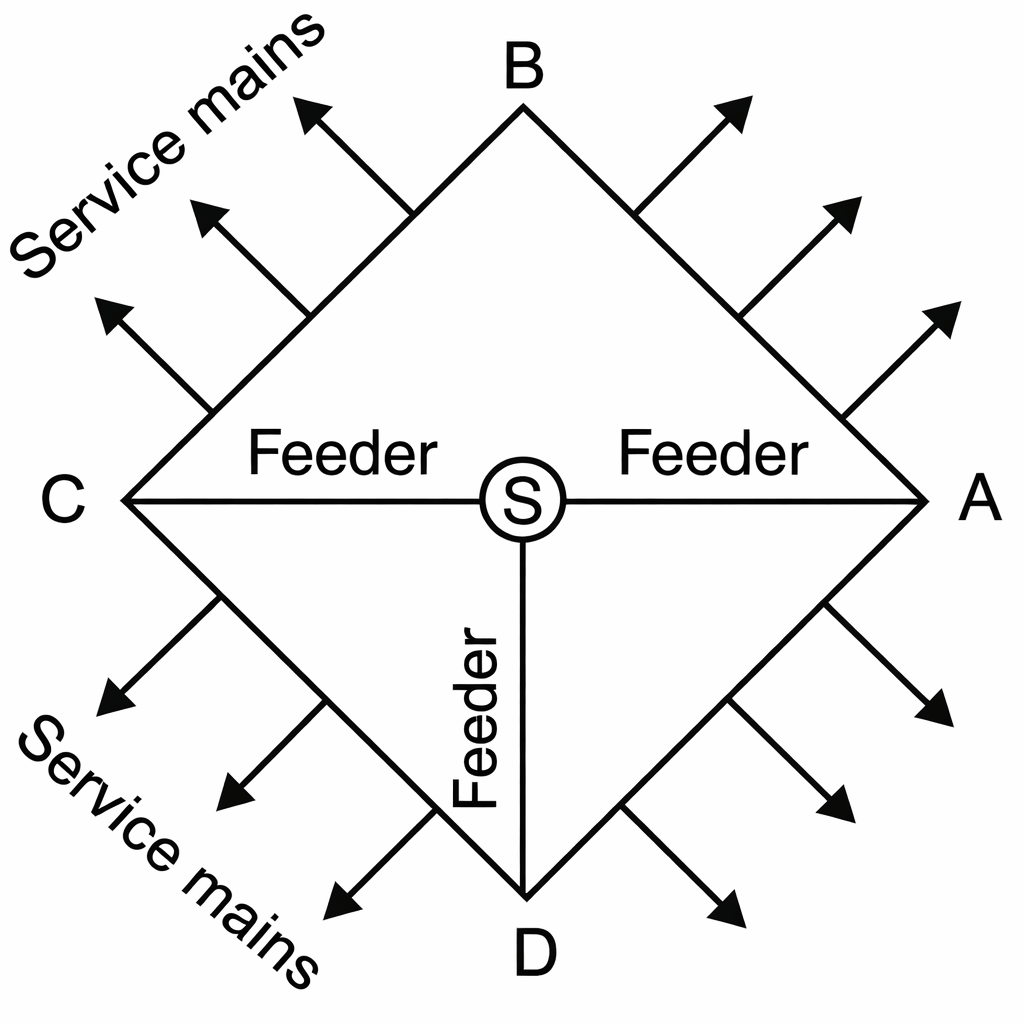
1. Feeder
A feeder is a conductor that connects the substation or generating station to the area where power is to be distributed. Generally, no tapping is taken from the feeder so that the current remains constant throughout its length. The feeder is designed mainly based on current carrying capacity, since voltage drop is not a major consideration. Feeders usually operate at 11 kV or 22 kV and carry bulk power over long distances.
2. Distributor
A distributor is a conductor from which electrical power is supplied to consumers through tapping points. The current in a distributor is not constant because loads are connected at different points along its length. While designing a distributor, the most important factor is voltage drop, since the consumer voltage must remain within ±6% of rated value as per statutory limits. Distributors usually operate at 400 V (three-phase) or 230 V (single-phase).
3. Service Mains
A service main is a small cable that connects the distributor to the consumer’s terminal. It supplies power to a single consumer only. Service mains are short in length and usually use insulated service cables. The voltage drop is less significant due to short distance and small load current. They deliver power at 230 V (single-phase) or 400 V (three-phase) depending on the type of consumer.
Classification of Distribution Systems
Distribution systems are classified based on three main aspects:
1. According to Nature of Current
- D.C. Distribution System
Used in earlier days for traction and special industrial loads. Rarely used today due to limitations in voltage transformation. - A.C. Distribution System
Most widely used system because voltage can be easily stepped up and down using transformers. Suitable for domestic, commercial, and industrial supply.
2. According to Type of Construction
- Overhead Distribution System
Uses overhead conductors mounted on poles or towers. It is economical and easy to maintain but affected by weather conditions. - Underground Distribution System
Uses underground cables. It is more reliable and safe but has higher installation and maintenance cost.
3. According to Scheme of Connection
(a) Radial System
Each distributor is supplied from one end only. It is simple and economical but less reliable because a fault interrupts supply to all consumers on that feeder.
(b) Ring Main System
The distributor forms a closed loop and is supplied from both ends. It provides better voltage regulation and higher reliability since supply continues even if one section fails.
(c) Interconnected System
Different feeders and substations are interconnected. It offers the highest reliability, better load sharing, and improved voltage profile. Widely used in urban power networks.
Difference between Feeder, Distributor and Service Main
| Basis | Feeder | Distributor | Service Main |
|---|---|---|---|
| Function | Carries power from substation to distribution area | Distributes power to consumers | Supplies power directly to a single consumer |
| Voltage Level | 11 kV – 22 kV | 420 V (3-phase) | 420 V (3-phase)220 V (1-phase) |
| Origin | From 33/11 kV substation | From 11/0.433 kV local distribution transformer | From distributor as per type of connection |
| Design Basis | Based on current carrying capacity | Based on voltage regulation (±6%) | Based on voltage regulation (±6%) |
| Tapping Points | No tapping | Multiple tapping points | Only one consumer |
| Current Variation | Almost constant | Decreases along length | Depends on consumer load |
| Length | Up to 20–30 km depending on total kVA | Up to 2 km depending on voltage regulation | Up to 180 feet maximum |
| Fault Level | High as per total kVA on feeder | Low, depends on feeder and connected load | Very low as per distributor |
| Fault Rate | High | Less than feeder | Very less (insulated cables used) |
| Conductor Type | ACSR or AAAC | AAC or GNAT | Service cable |
| Conductor Size | Large | Medium | Small |
| Costing | High compared to distributor and service main | Lower than feeder, higher than service main | Lowest among three |
| Voltage Drop Importance | Not very important | Very important | Less important |
| Typical Example | Substation to distribution point line | Street distribution line | Pole to house connection |