
Introduction
In high-voltage overhead transmission systems, the electric field around conductors becomes very strong. When this electric field exceeds a certain critical value, the surrounding air gets ionized and starts conducting partially. This produces a faint violet glow, hissing noise, ozone gas, power loss, and radio interference.
This phenomenon is known as the Corona Effect.
Corona is an important consideration in the design of high-voltage transmission lines, substations, and insulation systems, because it affects efficiency, power loss, insulation life, and communication performance.
What is Corona Effect?
Corona effect is the phenomenon in which the air surrounding a high-voltage conductor gets ionized when the electric field intensity exceeds a critical value, resulting in a violet glow, hissing sound, ozone formation, power loss, and radio interference.
Corona occurs when the applied voltage is greater than the critical disruptive voltage but less than the breakdown voltage of air. It causes partial discharge without complete insulation breakdown.
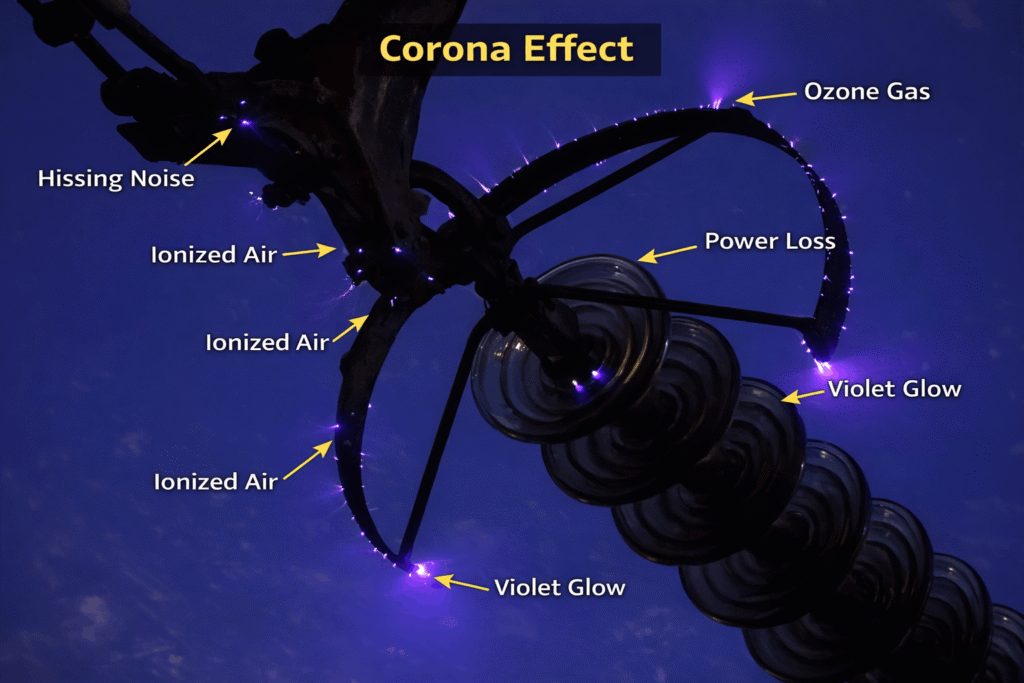
Theory of Corona Formation
Under normal conditions, air always contains a small number of ionized particles due to cosmic rays, ultraviolet radiation, and natural radioactivity. Therefore, the air around conductors contains free electrons, positive ions, and neutral molecules.
When a potential difference is applied between two conductors, an electric field (potential gradient) is established in the surrounding air. This electric field is maximum at the surface of the conductor.
As the applied voltage increases, the electric field strength increases and free electrons gain higher velocities. When the electric field at the conductor surface reaches about 30 kV per cm, the free electrons acquire sufficient energy to strike neutral air molecules and knock out electrons from them.
This produces new ions and free electrons, which are further accelerated and collide with other neutral molecules, creating more ions. This cumulative ionization process forms an ionized region around the conductor.
As a result, a conducting layer of air is formed, a faint violet glow appears, and partial discharge takes place. If the voltage is further increased, complete breakdown of air occurs and a spark or flash-over takes place between the conductors.
Factors Affecting Corona
The formation and intensity of corona depend on the following factors:
1. Atmospheric Conditions
Corona is affected by the physical condition of air.
In stormy, rainy, foggy, or dusty weather, the number of ions in air is high and corona occurs at a lower voltage. In fair and dry weather, corona occurs at a higher voltage.
2. Conductor Size and Surface Condition
Corona depends on the shape and condition of the conductor surface.
Rough, irregular, or stranded conductors produce stronger electric fields and cause more corona. Smooth and polished conductors reduce electric field concentration and hence reduce corona.
3. Spacing Between Conductors
If the spacing between conductors is large compared to their diameter, the electric field intensity at the surface is reduced and corona is minimized. Small spacing increases electrostatic stress and promotes corona formation.
4. Line Voltage
Line voltage greatly affects corona.
At low voltage, no corona is formed. When the voltage exceeds the critical disruptive voltage, corona starts. Higher voltage increases corona intensity.
Advantages of Corona
Although corona is generally undesirable, it has some useful effects:
1. Reduction of Electrostatic Stress
Due to corona, the air around the conductor becomes conducting and the effective diameter of the conductor increases. This reduces the electric field intensity and electrostatic stress between conductors.
2. Protection Against Voltage Surges
Corona reduces the effects of sudden voltage surges by absorbing part of the surge energy. This provides partial protection against lightning and switching surges.
Disadvantages of Corona
Corona produces several harmful effects:
1. Power Loss
Energy is lost in ionizing the air, which reduces transmission efficiency and increases operating cost.
2. Ozone Formation and Corrosion
Corona produces ozone gas which causes chemical corrosion of conductors and deterioration of insulation.
3. Radio and Communication Interference
Corona currents are non-sinusoidal and produce electromagnetic noise, causing interference in nearby radio, television, and communication lines.
4. Audible Noise
Corona produces hissing and crackling sounds, which may be objectionable in residential areas.
Methods of Reducing Corona Effect
To reduce corona in high-voltage transmission lines and substations, the following methods are used:
1. Increase Conductor Size
By increasing conductor diameter, the electric field at the surface is reduced and the critical disruptive voltage is increased. This significantly reduces corona formation.
2. Increase Spacing Between Conductors
Increasing the spacing between conductors reduces electrostatic stress and raises the voltage at which corona starts. However, spacing cannot be increased excessively due to mechanical and economic limitations.
3. Use Smooth and Polished Conductors
Smooth and uniform conductor surfaces reduce electric field concentration and minimize corona. Sharp points and roughness are avoided.
4. Use Bundled Conductors
In extra-high voltage transmission lines, two or more conductors per phase are used. Bundling increases the effective diameter and reduces electric field intensity, thereby reducing corona loss and radio interference.
5. Use Corona Rings and Grading Rings
Corona rings are fitted at insulator strings and terminations to distribute the electric field uniformly. This prevents localized ionization and reduces corona and insulation damage.