
Introduction
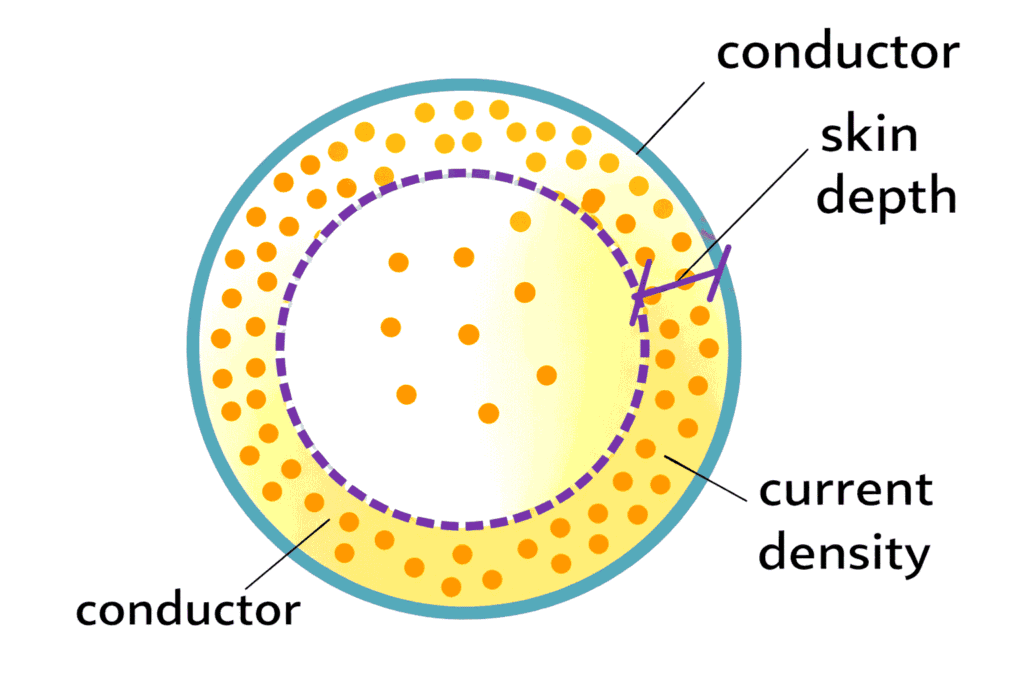
In alternating current (AC) systems, the current does not distribute uniformly across the cross-section of a conductor. Instead, it tends to concentrate near the surface of the conductor. This phenomenon is known as the skin effect. Skin effect becomes more significant at higher frequencies and in conductors with larger diameters, leading to an increase in effective resistance and power losses.
Understanding skin effect is important in the design of transmission lines, cables, transformers, and high-frequency circuits.
Definition of Skin Effect
Skin effect is the tendency of alternating current to flow mainly near the outer surface (skin) of a conductor, while the current density at the center decreases as frequency increases.
As a result, the effective cross-section available for current flow is reduced, which increases the effective resistance of the conductor.
Cause of Skin Effect
When AC flows through a conductor, it produces a time-varying magnetic field around it.This changing magnetic field induces eddy currents inside the conductor according to Faraday’s law. These eddy currents oppose the flow of current in the central region more strongly than near the surface. Hence, current is forced toward the outer layers of the conductor.
Effects of Skin Effect
The main effects of skin effect are:
- Increase in effective resistance of the conductor
- Increase in copper losses (I²R losses)
- Reduction in current-carrying capacity
- Decrease in efficiency of transmission and high-frequency circuits
Skin effect is negligible at low frequencies (like DC) but becomes important at high frequencies.
Factors Affecting Skin Effect
Skin effect depends on several factors:
(a) Frequency of Current
- Skin effect increases with increase in frequency.
- At higher frequencies, current is more concentrated near the surface.
(b) Diameter of Conductor
- Larger diameter conductors experience stronger skin effect.
- In thin conductors, current distribution is more uniform.
(c) Material of Conductor
- Conductors with higher magnetic permeability (like iron) have more skin effect.
- Copper and aluminum have lower permeability, so skin effect is less.
(d) Shape of Conductor
- Solid round conductors show more skin effect than stranded or hollow conductors.
Skin Depth
Skin depth (δ) is the depth below the surface at which the current density falls to 1/e (about 37%) of its value at the surface.
Mathematically,
where,
ρ = resistivity of conductor
ω = angular frequency = 2πf
μ = permeability of conductor
Smaller skin depth means stronger skin effect.
Reduction Methods of Skin Effect
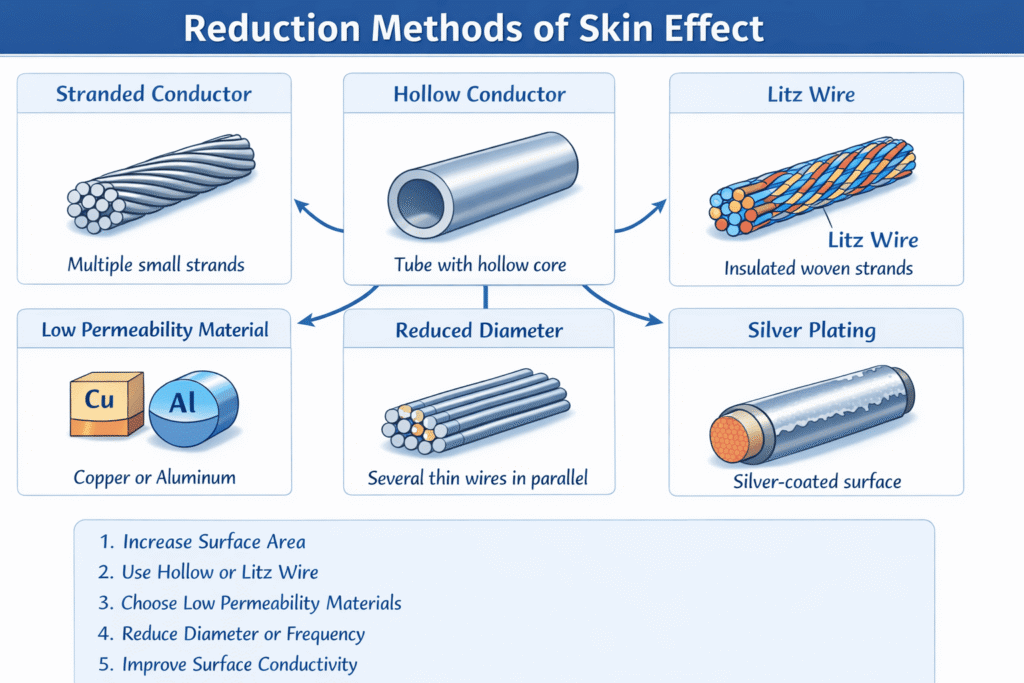
Skin effect causes alternating current to concentrate near the surface of a conductor, thereby increasing resistance, losses, and heating. To minimize these undesirable effects and improve current distribution, several practical methods are adopted in electrical engineering. These methods are explained below.
1. Use of Stranded Conductors
In this method, a solid conductor is replaced by a number of small strands twisted together. Each strand has a small diameter, which increases the total surface area available for current flow. Since skin effect is less pronounced in thin conductors, the current distributes more uniformly among the strands. This reduces effective AC resistance, lowers copper losses, and improves current carrying capacity. Stranded conductors are widely used in transmission lines, cables, and machine windings.
2. Use of Hollow Conductors
In AC conduction, most of the current flows near the outer surface, while the central portion carries very little current. Therefore, the inner core can be removed and the conductor made hollow without significantly affecting current capacity. This saves conductor material, reduces weight and cost, and improves cooling. Hollow conductors are commonly used in bus bars, high-current systems, and radio-frequency waveguides.
3. Use of Litz Wire
Litz wire consists of many thin insulated strands woven together in a special pattern so that each strand occupies all positions within the conductor. This ensures that each strand experiences the same magnetic field and carries equal current. As a result, both skin effect and proximity effect are greatly reduced. Litz wire is the most effective method for minimizing skin effect at high frequencies and is widely used in high-frequency transformers, induction heating equipment, and RF circuits.
4. Use of Low Permeability Materials
Skin effect increases with the magnetic permeability of the conductor material. Therefore, conductors made of low permeability materials such as copper and aluminium are preferred. Ferromagnetic materials like iron and steel exhibit strong skin effect and are avoided for AC conduction. Using non-magnetic materials increases skin depth and allows current to penetrate deeper into the conductor, thereby reducing resistance and losses.
5. Reduction of Conductor Diameter
Skin effect becomes severe when the conductor diameter is much larger than the skin depth. Instead of using a single thick conductor, several thin conductors connected in parallel are used. Each thin conductor allows more uniform current distribution and reduces current crowding at the surface. This method lowers AC resistance and improves efficiency in transformer windings and high-current cables.
6. Reduction of Operating Frequency
Skin effect increases directly with frequency. At low frequencies, the skin depth is large and current penetrates deeper into the conductor, making skin effect weak. Therefore, wherever possible, operating at lower frequencies reduces skin effect and associated losses. At power frequencies (50–60 Hz), skin effect is moderate, whereas at radio frequencies it becomes dominant.
7. Surface Plating of Conductors
Since current flows mainly near the surface, improving surface conductivity reduces losses. Conductors are often silver-plated because silver has very high electrical conductivity. This decreases surface resistance and minimizes high-frequency losses. This method is commonly used in RF cables, microwave circuits, and high-frequency connectors.
Conclusion
Skin effect is an important phenomenon in AC conductors where current tends to flow near the surface, increasing resistance and losses. It depends mainly on frequency, conductor size, and material. By using stranded conductors, hollow conductors, Litz wire, and suitable materials, skin effect can be effectively reduced, improving the performance of electrical systems.