
What is a “Grid” ?
An Interconnected power system covering a major portion of a country’s territory (or state) is called a Grid. The different state grids may be a interconnected through transmission lines to form a Grid.
Bulk Power Grid
The bulk power grid (also known as the bulk electric system, bulk transmission system, or inter-state transmission system in India) is the high voltage backbone of the entire power system. It handles the large-scale movement of electricity from major power generation plants (like thermal stations in Chandrapur or Tiroda near Nagpur) to regional load centers across states or even the country, before it reaches local distribution networks that supply homes, industries, and cities.
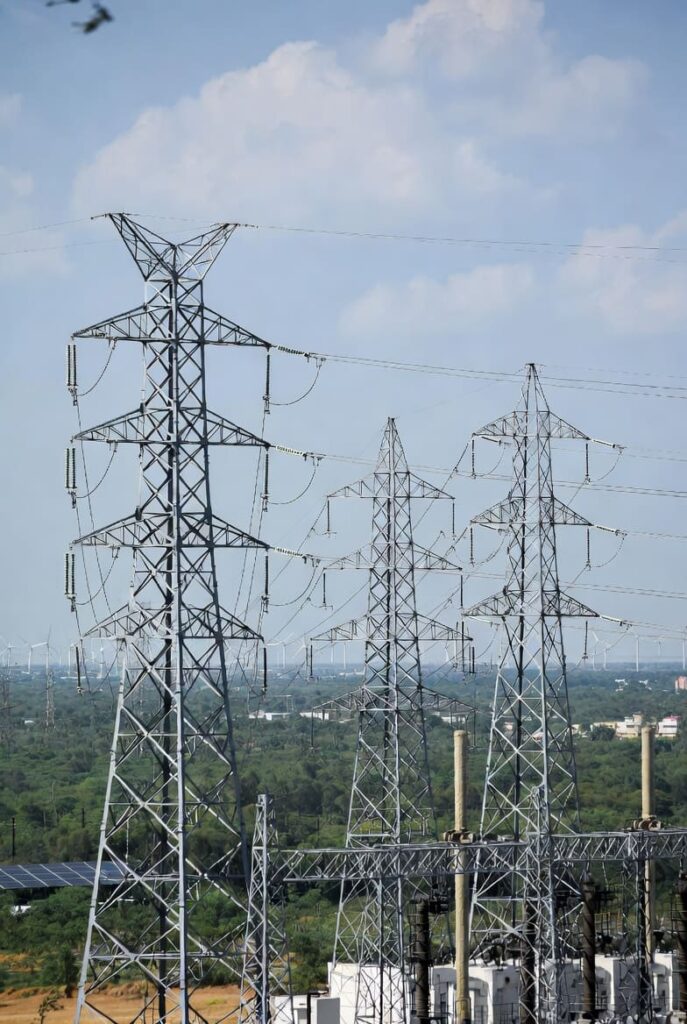
Key Features of the Bulk Power Grid
- High Voltage Levels: To reduce transmission losses (which follow I²R rule losses drop dramatically at higher voltages), power is transmitted at Extra High Voltage (EHV) or Ultra High Voltage:
- AC: 220 kV, 400 kV, 765 kV (India’s highest AC level, used extensively).
- DC: HVDC lines like ±500 kV or ±800 kV (for very long distances or undersea/submarine links, with lower losses).
- Low Losses: At 765 kV, losses can be as low as 3–4% over 1000 km, vs. 20–30% at lower voltages.
- Interconnections: Enables “one nation, one grid” pooling surplus power from one region (e.g., hydro in Northeast or coal in Vidarbha) to deficit areas (e.g., high-demand Mumbai-Pune belt).
- Controlled by Central Authority: In India, the Power Grid Corporation of India Limited (PGCIL) owns and operates ~90% of the inter-state bulk transmission network. Regional Load Despatch Centres (RLDCs) and National Load Despatch Centre (NLDC) monitor and control it in real-time.
How the Bulk Power Grid Works
- Generation Step-Up:
- Power plants (e.g., coal thermal in Chandrapur) generate at 11–25 kV.
- Step-up transformers at the plant’s switchyard boost it to 220/400/765 kV for bulk transmission.
- Bulk Transmission:
- Electricity travels via long overhead lines or HVDC corridors.
- Substations along the way switch, protect, and sometimes step voltage up/down.
- Synchronous interconnection (all regions run at same 50 Hz frequency) allows seamless power flow.
- Inter-Regional Transfer:
- India has five regional grids (Northern, Western, Southern, Eastern, North-Eastern) fully synchronized since 2013–2014 as the National Grid.
- Power flows freely based on economics and demand e.g., surplus from Western Region (Maharashtra’s coal) can go to Southern Region.
- Step-Down to Distribution:
- At regional substations (e.g., MSETCL’s 400/220 kV stations near Nagpur), voltage is reduced to 220/132/33 kV.
- Then to state transmission (MSETCL in Maharashtra) → distribution (MSEDCL) → your home at 230 V.
Advantages of Bulk Power Grid
1. Improved Reliability of Power Supply
Interconnection of generating stations and substations ensures continuous power supply. If one generating station fails, power can be supplied from another station through the grid. This greatly improves the reliability and continuity of the system.
2. Better Load Sharing
In a bulk power grid, load is shared among several generating stations. Each station supplies power according to its capacity, which ensures balanced operation and reduced overloading of any single station.
3. Improved System Stability
Interconnected operation increases the overall stability of the power system. Voltage and frequency variations are minimized because disturbances in one area are supported by other connected areas.
4. Economical Operation
Bulk power grid allows the use of the most economical generating stations to supply power to large areas. Power can be transmitted from low-cost stations to high-demand areas, resulting in reduced generation cost and better fuel utilization.
5. Reduction in Reserve Capacity
Since many stations are interconnected, standby and reserve capacity requirements are reduced. This lowers the overall investment in additional generating units.
6. Efficient Utilization of Resources
Hydro, thermal, nuclear, and renewable plants can be operated in coordination. This ensures optimum utilization of water, fuel, and energy resources.
Disadvantages of Bulk Power Grid
1. High Initial Cost
Establishment of bulk power grid requires:
- Long transmission lines
- Substations
- Protection and control systems
This involves very high capital investment.
2. Complex Operation and Control
Operation of a large interconnected grid is complicated. It requires:
- Advanced control systems
- Skilled operators
- Continuous monitoring
Fault handling and coordination become more difficult.
3. Risk of Large-Scale Blackouts
Failure in one part of the grid may spread to other parts and cause cascading failures, leading to large-area blackouts if not properly controlled.
4. Transmission Losses
Since power is transmitted over long distances, transmission losses increase, which reduces overall system efficiency.
5. Protection Coordination Problems
Coordinating protection among many interconnected lines, transformers, and generators is difficult. Incorrect protection operation may cause unnecessary tripping and power interruption.
6. Voltage and Stability Issues
Long-distance power transfer may lead to:
- Voltage instability
- Reactive power problems
- Oscillations
Micro Grid
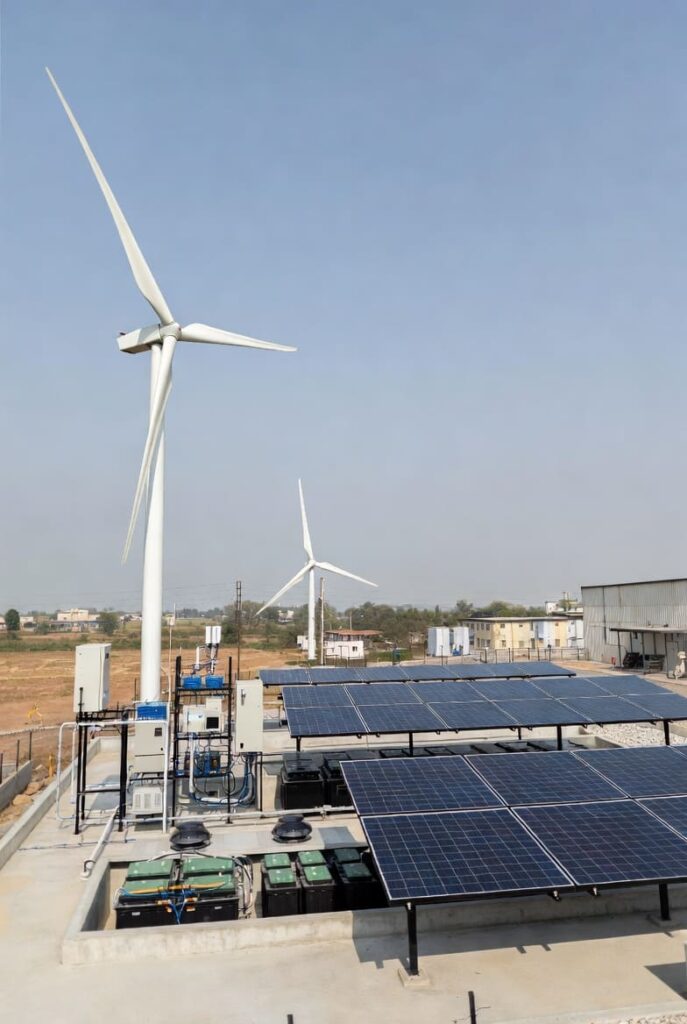
A microgrid is a localized, small scale energy system that can generate, store, distribute, and manage electricity independently or in coordination with the main (bulk) power grid. Unlike the large scale bulk power grid we discussed earlier which spans states or the entire country with massive high voltage transmission lines a microgrid operates on a much smaller scale, typically serving a specific area like a campus, village, industrial park, hospital, military base, or remote community.
Main Components of a Microgrid
- Distributed Energy Resources (DERs) – Local generation: Solar PV panels, wind turbines, small diesel/gas generators, fuel cells, or biomass.
- Energy Storage – Batteries (e.g., lithium-ion), flywheels, or pumped hydro (small-scale) to store excess energy and provide power when generation is low.
- Loads – The consumers: Homes, factories, offices, critical facilities like hospitals or data centers.
- Control & Management System – Advanced software/hardware (microgrid controller) that monitors, balances supply/demand, decides when to connect/disconnect from the main grid, and optimizes for cost/emissions.
- Switchgear & Protection – Allows seamless transition between grid-connected and islanded modes.
- Point of Common Coupling (PCC) – The connection point to the main grid.
Types of Microgrids
- Grid-Connected – Normally tied to the main grid; can island during issues (most common in urban/industrial areas).
- Remote/Off-Grid – Completely isolated, no main grid connection (e.g., rural villages or islands).
- Hybrid – Combine multiple sources (solar + diesel + battery) for reliability.
- Community – Serve a neighborhood or small town.
- Campus/Institutional – Universities, hospitals, military bases (e.g., for critical loads).
- Commercial/Industrial – Factories or data centers needing uninterrupted power.
Advantages of Microgrids
- Resilience & Reliability – Keeps power on during main grid outages, storms, or faults (crucial in areas with frequent disruptions).
- Renewable Integration – Easily incorporates solar/wind, reducing fossil fuel dependence and carbon footprint.
- Cost Savings – Lower transmission losses, peak shaving (avoid high grid tariffs), and potential bill reductions via self-consumption.
- Energy Independence – Less reliant on distant coal plants or imports.
- Environmental Benefits – Cleaner if renewable-heavy; supports India’s net-zero goals.
- Backup for Critical Loads – Hospitals, water treatment, or emergency services stay operational.
Challenges
- High upfront cost (especially storage).
- Complex control and protection systems needed.
- Regulatory hurdles in India (e.g., net metering rules, tariffs for selling excess power).
- Maintenance of local equipment.
Distinction between Bulk Power Grids and Micro-grids
| Basis | Bulk Power Grid | Micro-grid |
|---|---|---|
| Definition | A large interconnected system that transmits and distributes power over long distances between generating stations and load centers. | A small-scale, localized power system that supplies a limited area such as a campus, hospital, or community. |
| Size & Coverage | Very large geographical area (state, national, or international level). | Small geographical area (building, village, industrial park, campus). |
| Power Level | High voltage and high power (132 kV to 765 kV and above). | Low to medium voltage (typically below 33 kV). |
| Generation Sources | Large centralized power plants (thermal, hydro, nuclear, large renewables). | Distributed generation (solar PV, wind, diesel generators, batteries, fuel cells). |
| Control Structure | Centralized control through grid operators and load dispatch centers. | Decentralized or local control using intelligent controllers. |
| Mode of Operation | Always grid-connected; depends on large interconnected network. | Can operate in two modes: grid-connected and islanded (independent). |
| Reliability | High reliability but vulnerable to large-scale disturbances and blackouts. | Very high reliability for local loads; can continue supply during main grid failure. |
| Transmission Requirement | Requires long transmission lines and large substations. | Minimal transmission; power generated close to load. |
| Flexibility | Less flexible due to large system inertia and centralized structure. | Highly flexible and adaptive to load and generation changes. |
| Typical Applications | National power systems, regional grids, inter-state transmission networks. | Campuses, military bases, hospitals, rural electrification, smart communities. |
| Investment & Infrastructure | High capital cost and complex infrastructure. | Lower infrastructure cost and simpler installation. |
| Renewable Integration | Integration is complex and requires advanced grid management. | Easy integration of renewable and storage systems. |