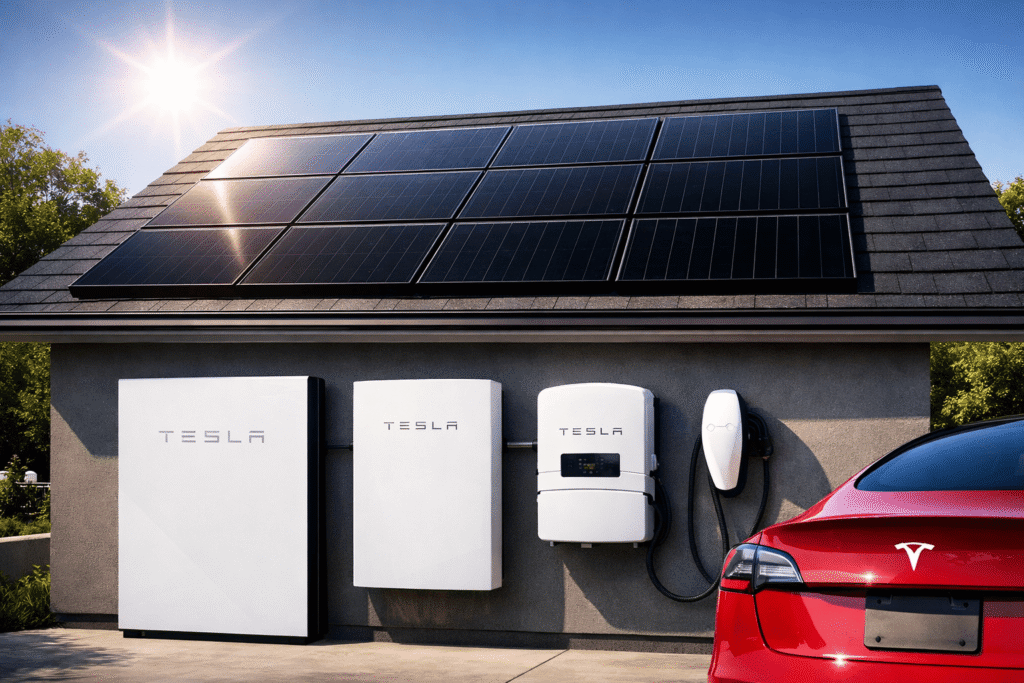
The global solar industry is steadily moving toward fully integrated home energy solutions. A major step in this direction came in January 2026 when Tesla introduced its first U.S. manufactured residential solar panels.
With the launch of the Tesla Solar Panel series (TSP 415 and TSP 420), the company now offers a complete residential energy ecosystem that combines solar panels, inverters, batteries, electric vehicles, and EV charging systems.
For the first time, homeowners can install an all Tesla energy system where every component is designed to work together seamlessly.
Concept of a Complete Home Energy Ecosystem
The idea behind Tesla’s new solar panels is to create a vertically integrated energy platform. Instead of using hardware from different manufacturers, Tesla aims to provide a single integrated system.
A typical Tesla home energy system includes:
- Solar panels for electricity generation
- Solar inverter for DC to AC conversion
- Home battery storage system
- EV charger for electric vehicles
- Smart energy management software
The solar panels work together with Tesla Powerwall battery storage and the Tesla Solar Inverter, enabling households to generate, store, and use their own electricity efficiently.
Domestic Manufacturing in the United States
The new Tesla solar panels are assembled at the company’s Gigafactory in Buffalo, New York. This facility is already known for producing components used in Tesla’s Solar Roof product.
Key manufacturing highlights include:
| Feature | Details |
|---|---|
| Manufacturing location | Buffalo, New York |
| Initial production capacity | Over 300 MW per year |
| Product series | TSP 415 and TSP 420 |
| Target market | Residential rooftop solar |
Local production allows Tesla to benefit from federal manufacturing incentives while strengthening the domestic supply chain for solar technology.
Innovative 18 Power Zone Technology
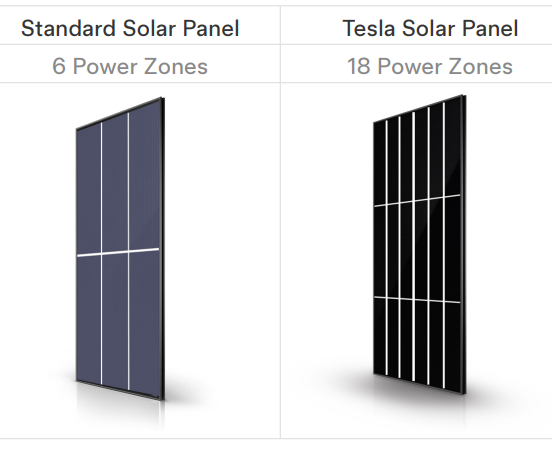
One of the most important technical innovations in Tesla’s new solar panels is the 18 Power Zone architecture.
Traditional solar panels normally use three bypass diodes, which divide the module into about six electrical zones. If a small part of the panel becomes shaded by a chimney, tree, or vent pipe, it can reduce the power output of a large portion of the module.
Tesla’s design divides the panel into 18 independent power zones, allowing the module to maintain high performance even when partial shading occurs.
Advantages of the 18 Power Zone design
• Improved performance under shading conditions
• Higher energy harvest from rooftop installations
• Reduced dependence on module level power electronics
• Improved reliability and lower system cost
The concept is similar to increasing the pixel count of a digital screen. Even if one section is shaded, the remaining zones continue generating electricity efficiently.
Integration with Inverters and Battery Storage
Tesla designed the new solar panels specifically to work with its energy storage and power conversion products.
The panels are optimized for integration with:
• Tesla Solar Inverter
• Tesla Powerwall 3 battery
• Tesla EV charging system
This integrated system allows energy generated during the day to be stored in the battery and used during the night or during grid outages.
Another important advantage is the ability to participate in Virtual Power Plant programs, where multiple homes supply electricity back to the grid during peak demand.
Rail Less Mounting System for Faster Installation
Tesla also introduced a new rail less solar mounting system to simplify rooftop installations.
Traditional solar mounting systems use metal rails attached to the roof. Tesla’s design eliminates these rails and uses the panel frame itself as the structural support.
Benefits of the new mounting system
• Installation up to 33 percent faster
• Reduced hardware components
• Cleaner and more aesthetic rooftop appearance
• Lower labor costs
The mounting structure is made from black anodized aluminum alloy, giving the system a minimalist design that blends with modern homes.
Tesla Solar Panel Technical Specifications
The Tesla Solar Panel models are competitive with current Tier 1 solar modules.
| Parameter | TSP 415 | TSP 420 |
|---|---|---|
| Nominal Power | 415 W | 420 W |
| Module Efficiency | 20.3% | 20.5% |
| Open Circuit Voltage | 40.92 V | 40.95 V |
| Short Circuit Current | 12.93 A | 13.03 A |
| Maximum System Voltage | 1000 V DC | 1000 V DC |
| Weight | 22.3 kg | 22.3 kg |
| Dimensions | 1805 × 1135 × 40 mm | 1805 × 1135 × 40 mm |
With efficiencies above 20 percent, the panels are well positioned in the modern residential solar market.
Relationship with Tesla Solar Roof
Tesla continues to offer its premium roofing product known as the Tesla Solar Roof.
The Solar Roof replaces the entire roof structure with solar glass tiles. However, the new Tesla Solar Panels are designed for homeowners who want a standard rooftop solar installation without replacing their roof.
The technology used in the new modules, including overlapping cell architecture that hides silver busbars, was originally developed for the Solar Roof system.
Virtual Power Plants and Grid Support
Another major advantage of Tesla’s ecosystem is participation in Virtual Power Plants (VPPs).
In a VPP system, thousands of homes equipped with Powerwall batteries connect to the grid and collectively supply electricity when demand is high.
Tesla has already deployed over one million Powerwall units worldwide, and about 25 percent of them are enrolled in VPP programs.
This distributed energy model benefits both utilities and consumers by improving grid stability while creating new income opportunities for homeowners.
Market Strategy and Future Outlook
The launch of Tesla’s solar panels comes during a transitional period for the U.S. solar industry, as some federal tax incentives are expected to change.
Tesla’s strategy focuses on standardization and cost reduction. By controlling every part of the system, from panels to batteries and software, the company aims to reduce installation costs and simplify the customer experience.
As electricity prices continue to rise, integrated residential solar systems are becoming an attractive solution for energy independence.
Conclusion
The introduction of Tesla’s new solar panels marks an important step toward a fully integrated home energy ecosystem. By combining solar generation, battery storage, smart inverters, and EV charging within a single platform, Tesla is redefining how residential solar systems are designed and installed.
With innovations such as the 18 power zone architecture, a rail less mounting system, and seamless integration with battery storage, Tesla’s approach demonstrates the growing shift toward smarter, more efficient, and decentralized energy systems.
For the future of residential solar, the concept of an integrated home energy platform may soon become the industry standard.