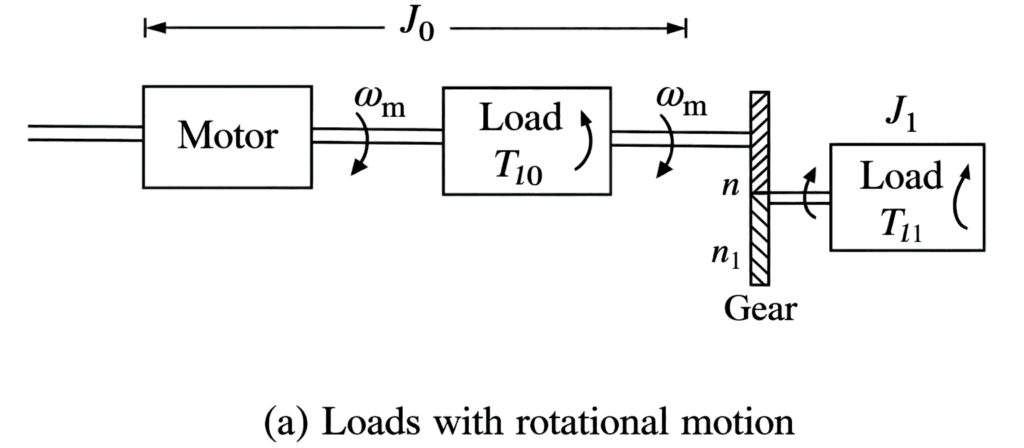
Different parts of a load may be coupled through different mechanisms, such as gears, V-belts and crankshaft. These parts may have different speeds and different types of motions such as rotational and translational. This section presents methods of finding the equivalent moment of inertia (J) of motor-load system and equivalent torque components, all referred to motor shaft.
Loads with Rotational Motion
Let us consider a motor driving two loads, one coupled directly to its shaft and other through a gear with n and n₁ teeth as shown in Fig. (a). Let the moment of inertia of motor and load directly coupled to its shaft be J₀, motor speed and torque of the directly coupled load be ωₘ and T₀ respectively. Let the moment of inertia, speed and torque of the load coupled through a gear be J₁, ωₘ₁ and T₁ respectively. Now,

where a₁ is the gear tooth ratio.
If the losses in transmission are neglected, then the kinetic energy due to equivalent inertia must be the same as kinetic energy of various moving parts. Thus
From Eqs. (i) and (ii)
Power at the loads and motor must be the same. If transmission efficiency of the gears be η₁, then…

where is the total equivalent torque referred to the motor shaft.
From Eqs. (i) and (iv)
If, in addition to the load directly coupled to the motor with inertia , there are m other loads with moments of inertia
and gear teeth ratios

then the equivalent inertia referred to the motor shaft is

If m loads with torques
are coupled through gears with teeth ratios

and transmission efficiencies

in addition to one load directly coupled, then

If loads are driven through a belt drive instead of gears, neglecting slippage, the equivalent inertia and torque can be obtained from Eqs. (vi) and (vii) by considering
as the ratios of diameters of wheels driven by the motor to the diameters of wheels mounted on the load shaft.
Load with Translational Motions
Let us consider motor driving a two loads, one coupled directly to its shaft and other through a transmission system converting rotational motion to linear motion (Fig. (b)).
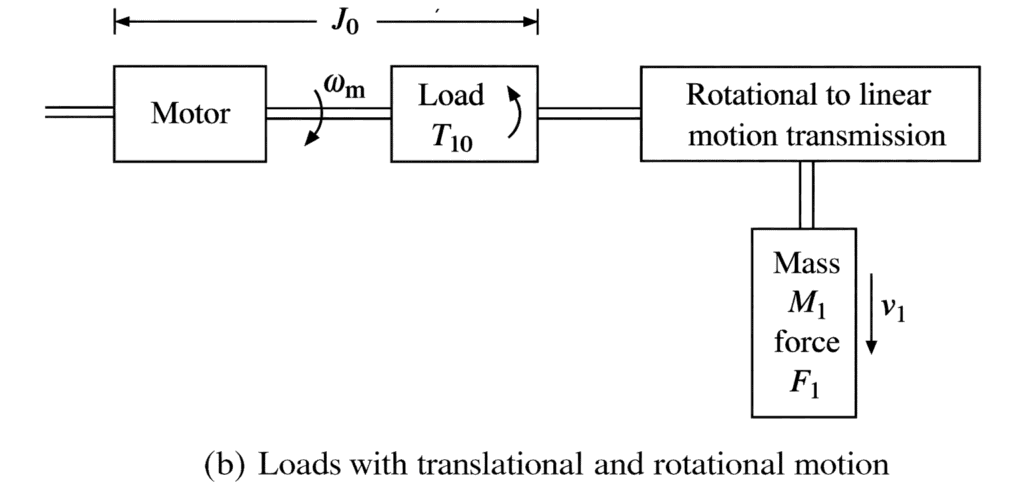
Let moment of inertia of the motor and load directly coupled to it be , load torque directly coupled to motor be
, and the mass, velocity and force of load with translational motion be
(kg),
(m/sec) and
(Newtons), respectively.
If the transmission losses are neglected, then kinetic energy due to equivalent inertia must be the same as kinetic energy of various moving parts. Thus

or
Similarly, power at the motor and load should be the same, thus if efficiency of transmission be
or
If, in addition to one load directly coupled to the motor shaft, there are m other loads with translational motion with velocities

and masses
respectively, then
and