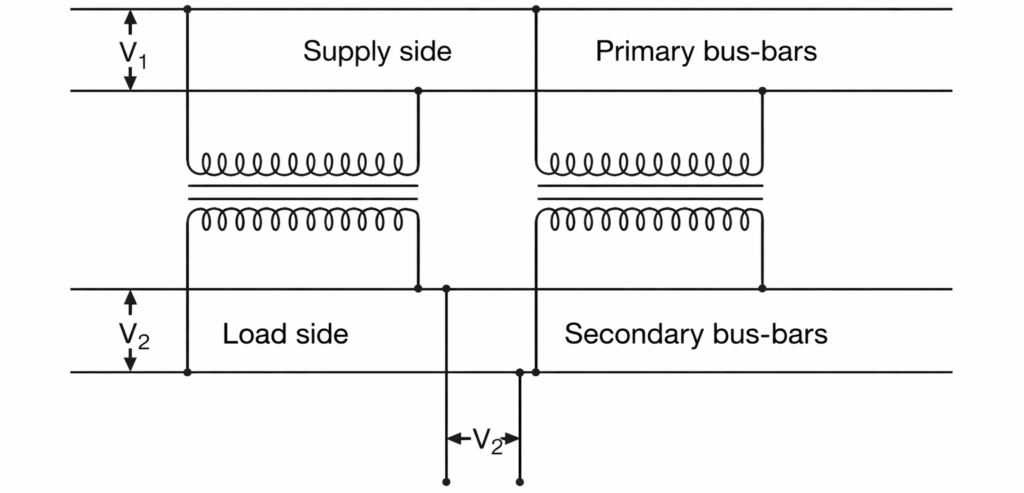
When the primary windings and secondary windings of two or more transformers are connected to the same supply lines and load lines so that they share the total load, the transformers are said to operate in parallel.
In parallel operation of two single phase transformers A and B, the primary windings of both transformers are connected to the common supply bus bars. Similarly, the secondary windings are connected to common load bus bars so that the load is shared between them.
Under this condition:
V₁ = Primary applied voltage
V₂ = V = Secondary load voltage
Necessity of Parallel Operation of Transformers
1. Increase in Load Capacity
When the load demand increases beyond the rating of a single transformer, another transformer can be connected in parallel. This increases the total capacity of the system without replacing the existing unit.
2. Reliability of Supply
If one transformer fails or is taken out for maintenance, the other transformer can continue to supply the load, at least partially. This ensures continuity of power supply and improves system reliability.
3. Maintenance without Interrupting Supply
One transformer can be disconnected for inspection or repair while the other transformer keeps the system running. This is very useful in industries and power stations where uninterrupted supply is important.
4. Flexibility in Operation
During light load conditions, one transformer can be switched off and the other can handle the load. This improves efficiency and reduces unnecessary losses.
5. Future Expansion
When planning a power system, it is easier to install transformers in stages. As the demand grows, additional transformers can be added in parallel instead of installing a large transformer at the beginning.
6. Economic Advantage
Using multiple smaller transformers is often more economical in terms of transportation, installation, and spare management compared to one large transformer.
Conditions for Parallel Operation of One-phase Transformers
For one phase transformers to operate successfully in parallel, certain conditions must be satisfied. If these conditions are not met, circulating currents and unequal load sharing may occur, which can damage the transformers.
1. Same Polarity
The transformers must have the same polarity. If the polarity is incorrect, the secondary voltages will oppose each other, resulting in a short circuit.
2. Same Voltage Ratio
The voltage or transformation ratio of the transformers should be the same. Different voltage ratios cause unequal secondary voltages, leading to circulating currents even under no load.
3. Same Rated Voltage and Frequency
Both transformers must be designed for the same primary voltage and supply frequency. This ensures proper operation and avoids overheating.
4. Same Percentage Impedance
The percentage impedance of the transformers should be equal. This ensures that the load is shared in proportion to their ratings.
5. Same Impedance Ratio
The ratio of resistance to reactance of both transformers should be the same. This helps in proper load sharing and maintains the same power factor.
6. Proper Phase Relationship
The secondary voltages of the transformers must be in phase with each other. Any phase difference will result in circulating currents.
7. Same Power Rating
Although not mandatory, it is preferable that transformers connected in parallel have equal kVA ratings. This allows uniform load sharing and efficient operation.
Load Sharing between Two Transformers Connected in Parallel
When two transformers are connected in parallel to supply a common load, the total load is shared between them. The manner in which the load is divided depends mainly on the internal impedance of each transformer.
Basic Principle of Load Sharing
Each transformer supplies a portion of the load current inversely proportional to its impedance. A transformer with lower impedance carries a higher share of the load, while a transformer with higher impedance carries a smaller share.
Case 1. Transformers with Equal Voltage Ratio and Equal Impedance
If both transformers have the same voltage ratio and equal percentage impedance, the load is shared in proportion to their kVA ratings.
If their ratings are equal, both transformers share the load equally.
Case 2. Transformers with Equal Voltage Ratio but Unequal Impedance
When the voltage ratios are the same but impedances are different, the transformer with lower impedance will carry more load current. This may lead to overloading of one transformer even when the total load is within the combined rating.
Mathematical Expression
Let
Z₁ = impedance of transformer 1
Z₂ = impedance of transformer 2
I₁ = current supplied by transformer 1
I₂ = current supplied by transformer 2
Then,
I₁ / I₂ = Z₂ / Z₁
This shows that current sharing is inversely proportional to impedance.
Effect of Impedance Angle
If the impedance angles of the two transformers are not equal, the load sharing of real power and reactive power will not be proportional. One transformer may supply more active power while the other supplies more reactive power, which is undesirable.
Practical Importance
Proper load sharing ensures
• No transformer is overloaded
• Better efficiency
• Longer transformer life
• Stable and reliable operation
Hence, for satisfactory load sharing in parallel operation, transformers should have the same voltage ratio, similar percentage impedance, and similar impedance angle.