What is a Motor Starter?
A motor starter is an electrical device used to start, stop, and protect an electric motor. When a motor is switched on directly, it draws a very high starting current which can damage the motor windings, cause voltage drop in the supply system, and reduce the life of the motor. A motor starter helps control this initial current and ensures safe operation.
Why a Motor Starter is Needed
- Limits high starting current
- Protects the motor from overload and short circuit
- Prevents sudden mechanical shock
- Improves motor life and reliability
Types of Motor Starters
Motor starters are classified based on the method used to control starting current and torque. Common types include:
- Direct Online starter
- Star delta starter
- Autotransformer starter
- Rotor resistance starter
- Soft starter
- Variable frequency drive
Direct Online starter (DOL Starter)
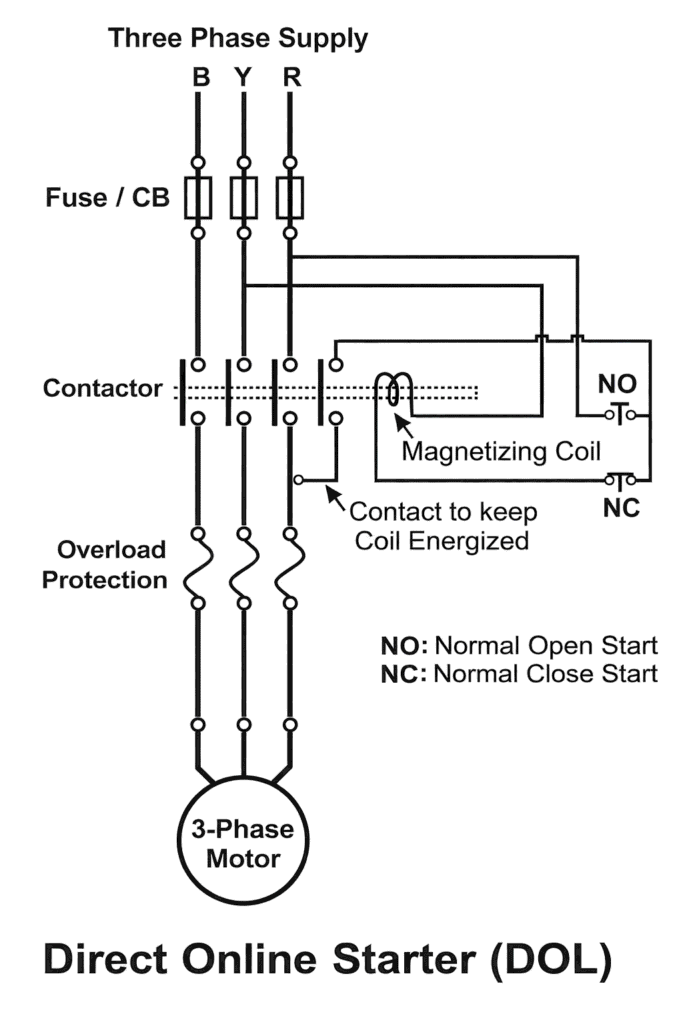
A DOL, also known as a Direct Online Starter, is the simplest type of motor starter. In this method, the motor is connected directly to the power supply without any reduction in voltage. It mainly consists of a magnetic contactor, an overload relay, and start stop push buttons. Because full supply voltage is applied at starting, this starter is generally used for motors with ratings below 5 HP.
The magnetic contactor is used to connect or disconnect the motor from the supply. The overload relay provides protection against overcurrent and overheating. The starter usually has two push buttons, one for starting and one for stopping the motor.
When the start button is pressed, the contactor coil gets energized. This pulls the contactor contacts together and completes the circuit, allowing current to flow to the motor. When the stop button is pressed, the contactor coil gets de energized, the contacts open, and the motor stops. The ON and OFF control can also be done using switches like rotary switches, level switches, or float switches depending on the application.
Although a DOL starter does not reduce the starting voltage, it provides protection through the overload relay. The overload relay has normally closed contacts connected in the control circuit. If excessive current flows, the relay trips, opening its contacts. This de energizes the contactor coil and disconnects the motor from the supply, protecting it from damage.
Advantages
- Very simple and low cost
- Easy installation and maintenance
- High starting torque
- Reliable for small motors
Disadvantages
- Very high starting current
- Causes voltage drop in supply
- Mechanical stress on motor and load
- Not suitable for large motors
Star delta starter
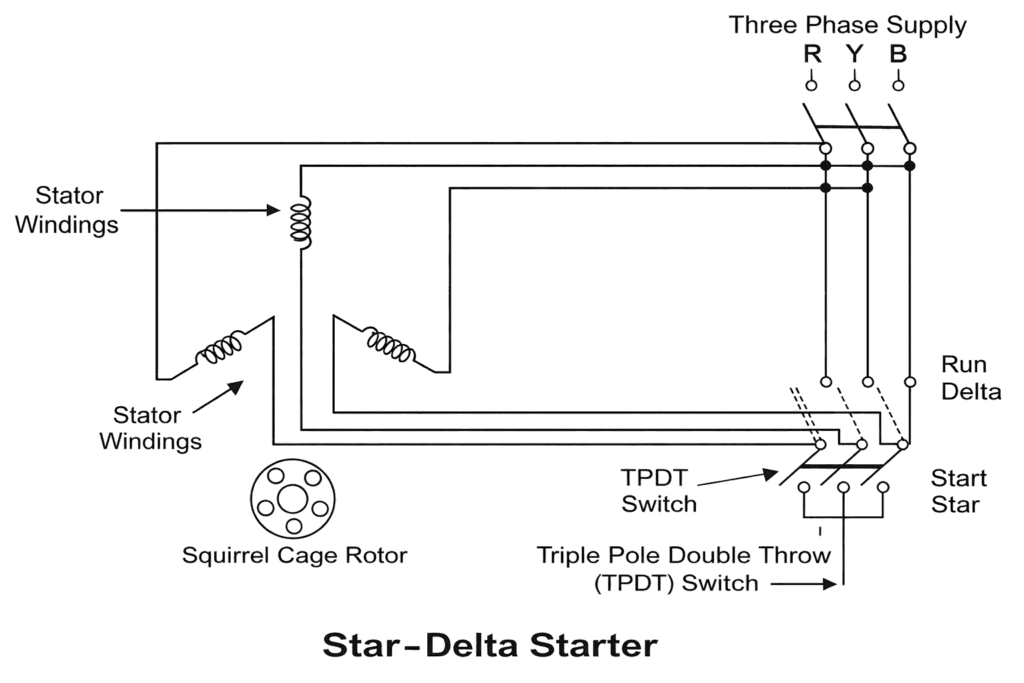
This is another commonly used starting method in industries, especially for large three phase induction motors. In this method, the stator windings of the motor are initially connected in star and later changed to delta during normal running.
At the time of starting, the induction motor is connected in star using a triple pole double throw switch or contactor arrangement. In star connection, the phase voltage is reduced to 1 divided by √3 of the line voltage. Due to this reduced voltage, the starting current and starting torque are also reduced to one third of their rated values.
As the motor picks up speed, a timer relay operates and disconnects the star connection. The stator windings are then reconnected in delta. In delta connection, full line voltage is applied across each winding, allowing the motor to run at its rated speed and torque.
Advantages of Star Delta Starter
- Reduced starting current
- Lower voltage drop during starting
- Simple and economical compared to advanced starters
- Suitable for medium size motors
Disadvantages of Star Delta Starter
- Reduced starting current
- Lower voltage drop during starting
- Simple and economical compared to advanced starters
- Suitable for medium size motors
Autotransformer starter
An auto transformer starter uses an auto transformer as a step down transformer to reduce the voltage applied to the stator during starting. It can be used with both star connected and delta connected induction motors.
The secondary winding of the auto transformer is connected to each phase of the motor. The auto transformer has multiple tapings which provide a fraction of the rated voltage. During starting, the relay remains in the start position and connects the motor to a lower voltage tap. This reduces the starting current.
As the motor speed increases, the relay shifts gradually between tap points, increasing the applied voltage step by step. Finally, the motor is connected directly to the full rated voltage supply.
Compared to other voltage reduction starting methods, the auto transformer starter provides higher starting voltage for the same starting current. Because of this, it offers better starting torque and smoother acceleration.

Advantages of Auto Transformer Starter
- Reduced starting current
- Higher starting torque than star delta
- Adjustable starting voltage
- Suitable for large motors
Disadvantages of Auto Transformer Starter
- Costlier than DOL and star delta
- Bulky size
- Requires more maintenance
- Complex control circuit
Rotor resistance starter
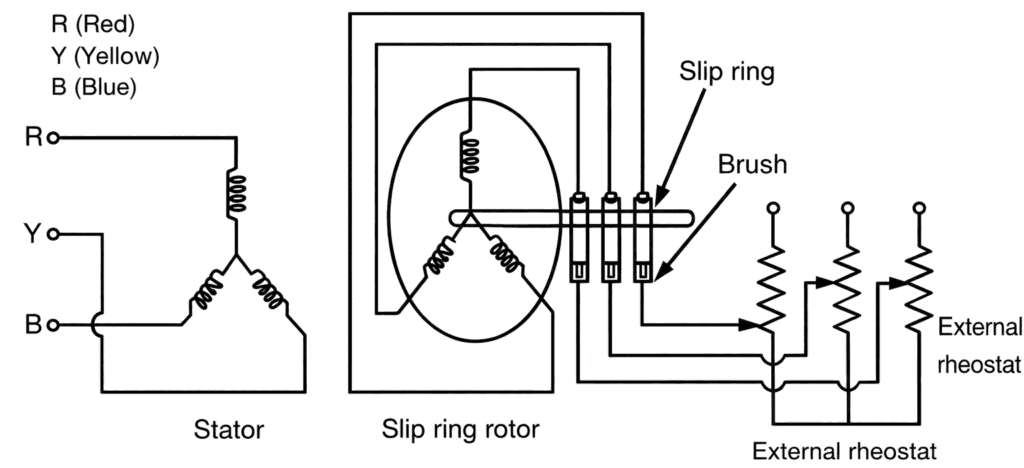
This type of motor starter uses the full line voltage during starting. It is used only with slip ring induction motors, which is why it is commonly known as a slip ring motor starter.
In this method, external resistances are connected to the rotor circuit through slip rings. These resistances are connected in star. When the motor starts, the added resistance limits the rotor current and increases the starting torque. Because of this, the stator current drawn from the supply is also reduced. Another advantage is that the power factor during starting is improved.
The external resistances are required only at the time of starting. As the motor speed increases, the resistances are gradually cut out in steps. Once the motor reaches its rated speed, all external resistance is removed and the rotor circuit is short circuited. After this, the motor runs like a normal squirrel cage induction motor.
Advantages
- Very high starting torque
- Low starting current
- Smooth acceleration
- Suitable for heavy load applications
Disadvantages
- Only used with slip ring motors
- External resistances increase losses
- More maintenance due to slip rings
- Expensive compared to squirrel cage starters
Soft starter
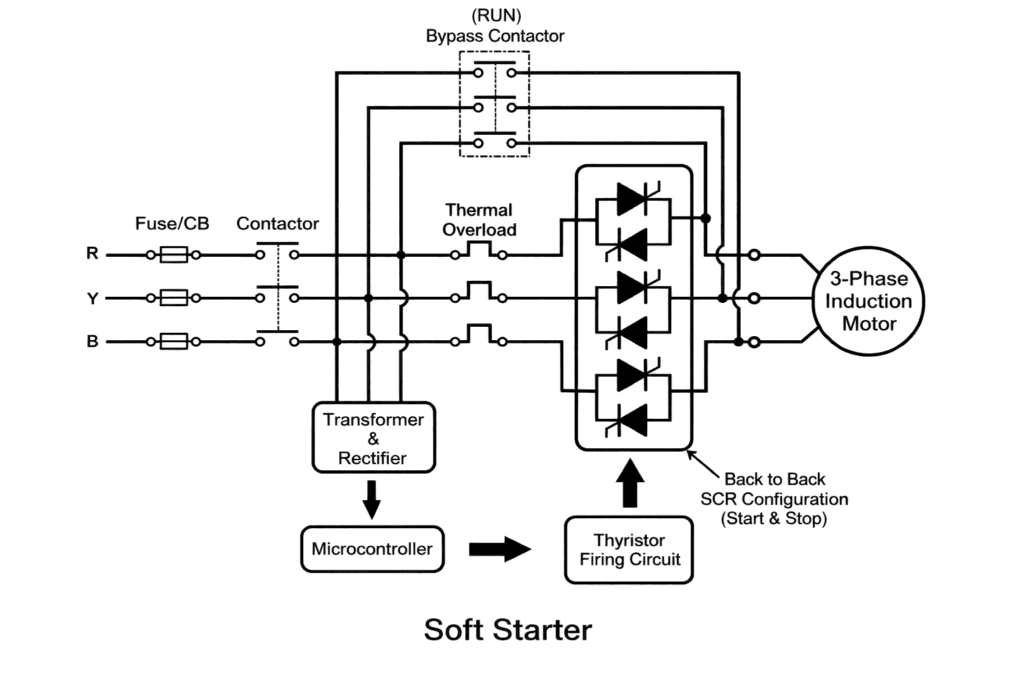
A soft starter works on the voltage reduction method of motor starting. It uses semiconductor switching devices such as TRIACs to control the voltage and starting current supplied to an induction motor.
In a soft starter, a phase controlled TRIAC is used to provide variable voltage to the motor. The applied voltage is controlled by changing the firing angle or conduction angle of the TRIAC. At the time of starting, the conduction angle is kept very small, which results in reduced voltage being applied to the motor. As the motor accelerates, the conduction angle is gradually increased, which slowly raises the motor voltage. When the conduction angle reaches its maximum value, the full line voltage is applied and the motor runs at its rated speed.
Because the voltage, current, and torque increase gradually, the motor starts smoothly without sudden mechanical shocks. This eliminates jerks during starting and reduces stress on both electrical and mechanical components. As a result, the overall life of the motor and the driven equipment is increased, and the operation becomes smooth and reliable.
Advantages
Advantages
• Smooth and controlled starting
• Reduced mechanical stress
• Lower starting current
• Increases motor life
Disadvantages
- Costlier than conventional starters
- Limited speed control
- Generates heat in power devices
- Not suitable for variable speed operation
Variable frequency drive (VFD)
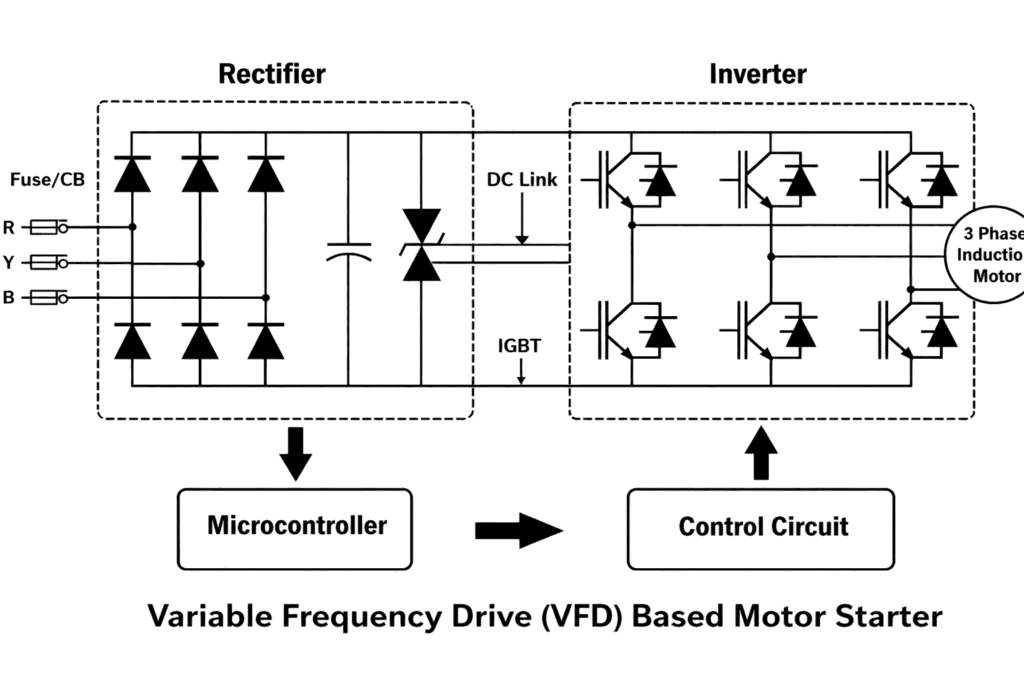
A Variable Frequency Drive, or VFD, controls an induction motor by varying both the supply voltage and frequency. Unlike a soft starter, which is mainly used only for starting, a VFD is primarily used for speed control since the speed of an induction motor depends directly on the supply frequency.
In a VFD, the AC supply from the mains is first converted into DC using a rectifier circuit. This DC is then smoothed using a DC link. After that, the DC is converted back into AC with variable voltage and variable frequency using pulse width modulation. This conversion is done through power electronic switches such as IGBTs.
By controlling the output frequency and voltage together, the VFD can provide smooth and precise control of motor speed from zero up to rated speed. Because the voltage increases proportionally with frequency, the motor draws a lower starting current and accelerates smoothly. This results in better control, improved efficiency, and reduced mechanical stress on the motor and the driven load.
Advantages
- Full control of speed and torque
- Very low starting current
- Energy efficient
- Smooth starting and stopping
Disadvantages
- High initial cost
- Complex control and programming
- Requires skilled maintenance
- Produces harmonics in supply