
Introduction of Embedded System
Embedded systems are a core part of modern electronics and play a vital role in today’s technology-driven world. An embedded system is a dedicated computer system designed to perform a specific function within a larger device, combining hardware and embedded software for efficient and reliable operation.
These systems are widely used in everyday applications such as smartphones, home appliances, automobiles, medical devices, and industrial automation.
What is a Embedded System?
Embedded System is a system that has embedded software and & computer hardware, which makes it a system for an application or specific part of an application or a part of a largest system.
- It is a combination of hardware and software.
- It is designed to perform a particular task.
- The task has to be completed in a given task for example washing machine, oven, printer,camera etc.
Block diagram of Embedded System
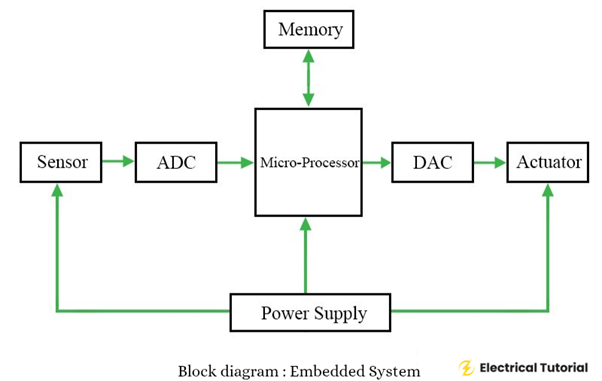
The Block diagram or hardware architecture of an embedded system defines how various hardware components are organized and interact to perform a specific task function . It is the foundation on which the embedded system operates.
An Embedded system generally consists of the following hardware components.
- Sensors
A sensors measures a physical quantity (like tempreture, pressure, speed, or light etc.) and convertes it into an electrical signals. This analog signal is then send to an analog to digital converter (ADC) for processing by the microcontroller.
For Example : A tempreture sensor converts heat into a corresponding voltage signal.
- Analog-to-digital converter (ADC)
Converts analog signals from sensors inti digital signals that the processor or microcontroller can understand.
The accuracy of the embedded system depends largely on the resolution and precision of the ADC.
For Example: 10 bit or 12 bit ADC’s are commonly used in embedded system.
- Microprocessor
The processor is the brain of the system which performs all data processing and controls other units.
Some embedded system use ASIC’s or FPGA’s for high speed, application specific operations.
The processor executes software instructions stored in memory to produce desires output.
- Memory
Memory stores both programmcode (firmware) and data. Efficient memory design is crucial to meet power and space constraint.
Embedded system usually have a two types of memory.
- Volatile Memory (RAM): Temporary storage used during execution.
- Non Volatile Memory (ROM): Permenant storage for firmware and system programm.
- Digital to Analog Converter (DAC)
Converts processed digital data from the processor back into an analog signal.
Useful when the embedded system needs to control analog devices (like motors and speaker).
For example: In an audio player, DAC converts stored digital music, data into analog sound.
- Actuator
An actuator converts an electrical signals into a physical action such as movement,pressure or rotation.It is the output devices of an embedded system.
For Example: Motor, Valves, relays and LED’s acts as actuator.
Actuator compares the output signal with the desired output and correct errors if necessary.
- Other Supporting Components
- Clock circuit: Provides timing signals for processor synchronization.
- Power Supply: Provides regulated power to all components.
- Communication Interfaces: UART, SPI, I2C, CAN etc. allow data exchange between subsystem.
- (I/O Port): Interface the system with external devices like displays, keyboards, or sensors.
Types of Embedded system
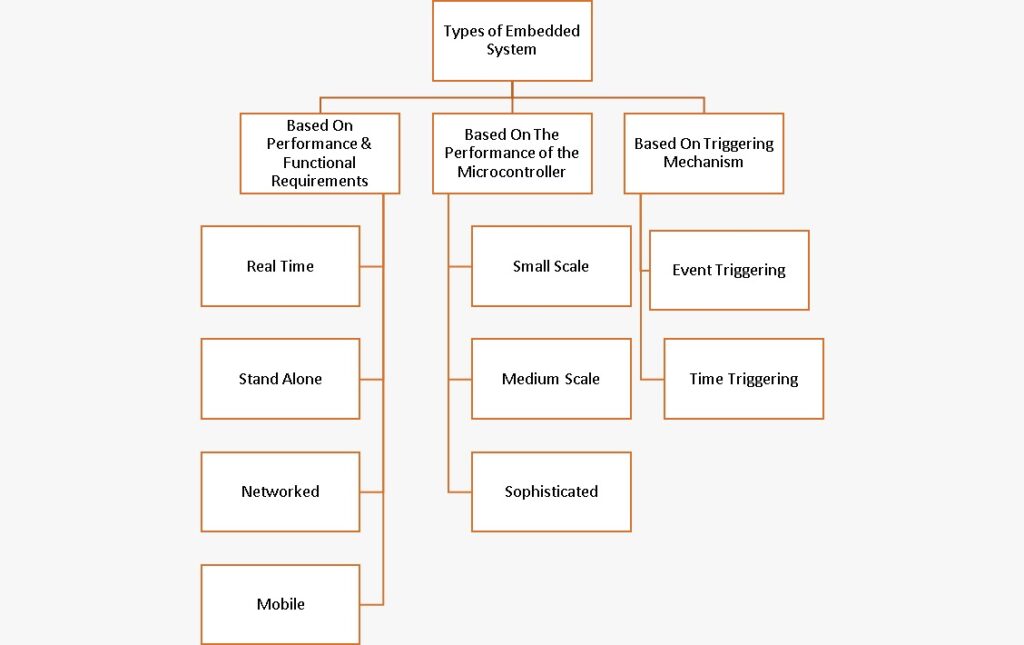
Types of Embedded Systems
Embedded systems are categorized based on their functional requirements and the performance of their internal controllers.
1. Based on Performance and Functional Requirements
- Real-Time: Systems that must provide a response within a strict time limit (e.g., automotive airbag systems).
- Stand-Alone: These function independently without a host computer (e.g., digital cameras or microwave ovens).
- Networked: Systems connected to a network (LAN/WAN) to share data (e.g., home security systems or IoT devices).
- Mobile: Small, portable devices designed for mobility (e.g., fitness trackers).
2. Based on the Performance of the Microcontroller
- Small-Scale: Usually built around 8-bit or 16-bit microcontrollers with limited hardware and software complexity.
- Medium-Scale: Utilize 16-bit or 32-bit microcontrollers and may involve complex software integration.
- Sophisticated: These involve high-performance 32-bit or 64-bit processors and are designed to handle highly complex tasks (e.g., medical imaging equipment).
3. Based on Triggering Mechanism
- Event Triggering: The system reacts only when a specific external event occurs (e.g., a smoke detector).
- Time Triggering: The system performs tasks at predetermined time intervals (e.g., a digital clock or a scheduled irrigation system).
Applications of Embedded System with Examples
Embedded systems are categorized by their performance and where they are used:
- Automotive (The Safety Focus)
Example: Anti-lock Braking System (ABS).
How it works: Wheel speed sensors detect skidding; the CPU processes this instantly and triggers actuators to “pulse” the brakes, preventing the car from sliding.
- Healthcare (The Precision Focus)
Example: Pacemaker.
How it works: A Real-Time embedded system that monitors heart signals. If a skipped beat is sensed, it sends an electrical pulse to regulate the heart instantly.
- Consumer Electronics (The Convenience Focus)
Example: Smart Washing Machine.
How it works: Sensors detect the weight of the clothes; the software calculates the exact water and detergent needed, and the actuator (motor) spins at the optimal speed.
- Industrial Automation (The Productivity Focus)
Example: Robotic Assembly Arms.


1 thought on “What is an Embedded System? Overview, Types, and Applications”
Hello