Primary and Backup Protection
The protection provided by protective relaying equipment can be divided into two main types:
- Primary protection
- Backup protection
Primary protection is the main and first level of protection provided for a power system element such as a line, transformer, generator or busbar. It is designed to detect faults within its own protected zone and trip the circuit breaker quickly. The main purpose of primary protection is to remove the faulty part as fast as possible so that damage to equipment and disturbance to the system are minimum.
Backup protection is an additional level of protection provided in a power system to operate when the primary protection fails to clear a fault. Its main function is to remove the faulted section if the main relay, circuit breaker, or tripping circuit does not operate properly.
Backup protection is provided because the main protection system can fail for several reasons, such as:
- Failure of the circuit breaker
- Failure of the protective relay
- Failure of the tripping circuit
- Failure of the DC tripping supply
- Loss of voltage or current supply to the relay
If backup protection is not available and the main protection fails, there is a high risk of serious damage to the power system.
When the primary protection is taken out of service for maintenance, the backup protection works as the main protection. Therefore, the backup protection scheme should be arranged in such a way that a failure in the main protection does not cause the backup protection to fail. This requirement is satisfied when the primary and backup relays do not have any common components.
For this reason, backup protection is usually installed at a different location from the primary protection. From the cost and economic point of view, backup protection is generally provided only for protection against short circuit faults and not for other abnormal operating conditions.
Concept of Backup Relaying
Consider the backup relaying scheme used for the transmission line section E–F, as shown in the figure.
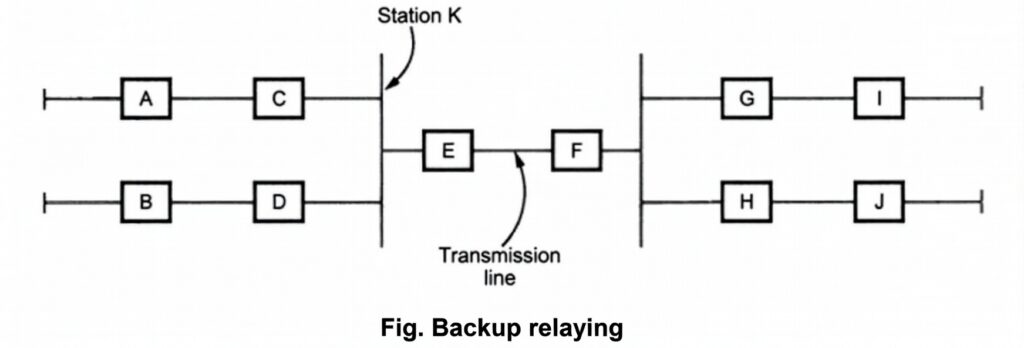
In this arrangement, the relays C, D, G and H act as the primary relays, while A, B, I and J act as the backup relays.
Normally, a backup relay operates only when the corresponding primary relay does not work. For example, if the primary relay E fails to trip, then the backup relays A and B will operate. The backup relays and their associated equipment are installed physically away from the faulty equipment so that they are not affected by the same failure. The backup relays A and B provide backup protection for faults occurring at station K. Similarly, the backup relays at A and F provide backup protection for faults on the line section D–B.
In many practical cases, the backup relaying system also works as the main protection when the primary relays are taken out of service for maintenance. It is clear that when a backup relay operates, a larger part of the power system gets disconnected as compared to primary protection. An important requirement of backup relaying is that it must operate with a sufficient time delay so that the primary protection gets enough opportunity to clear the fault first. When a fault occurs, both the primary and backup relays start operating, but the primary relay is expected to trip first. The backup relay then resets without completing its operation.
When one set of backup relays provides protection for several nearby system sections, the slowest primary relay among those sections decides the minimum time delay setting required for the backup relays.
Related Post:
Methods of Backup Protection
The different methods used for providing backup protection can be classified as follows.
1. Relay backup protection
In this method, the same circuit breaker is used for both primary and backup protection. However, the two protection systems are separate and independent in their operation.
2. Breaker backup protection
In this method, separate circuit breakers are provided for primary and backup protection. Both the breakers are installed at the same substation.
3. Remote backup protection
In this method, different circuit breakers are used for primary and backup protection, and they are located at different substations. The two sets of breakers are completely isolated and work independently of each other.
4. Centrally coordinated backup protection
In this method, the primary protection is provided at different substations, while the backup protection for all stations is handled from a central control room. The central control system continuously monitors the power flow and system frequency. If any part of the system fails, the load flow changes and this is detected by the control room. A digital computer system then decides the correct switching operation. This method is also known as centrally controlled backup protection.