What is Lamp?
A lamp is a device which produces visible light by using electricity, based on different physical principles such as heating, gas discharge or semiconductor action. It is used to make objects visible by producing controlled and usable light in homes, streets, industries, offices, and public places. In electrical engineering, a lamp is treated as a load connected to the power supply whose main purpose is lighting, not heating or mechanical work.
For example
- Incandescent lamp produces light by heating a filament
- Fluorescent lamp produces light by gas discharge
- LED lamp produces light by a semiconductor junction
Types of Lamps
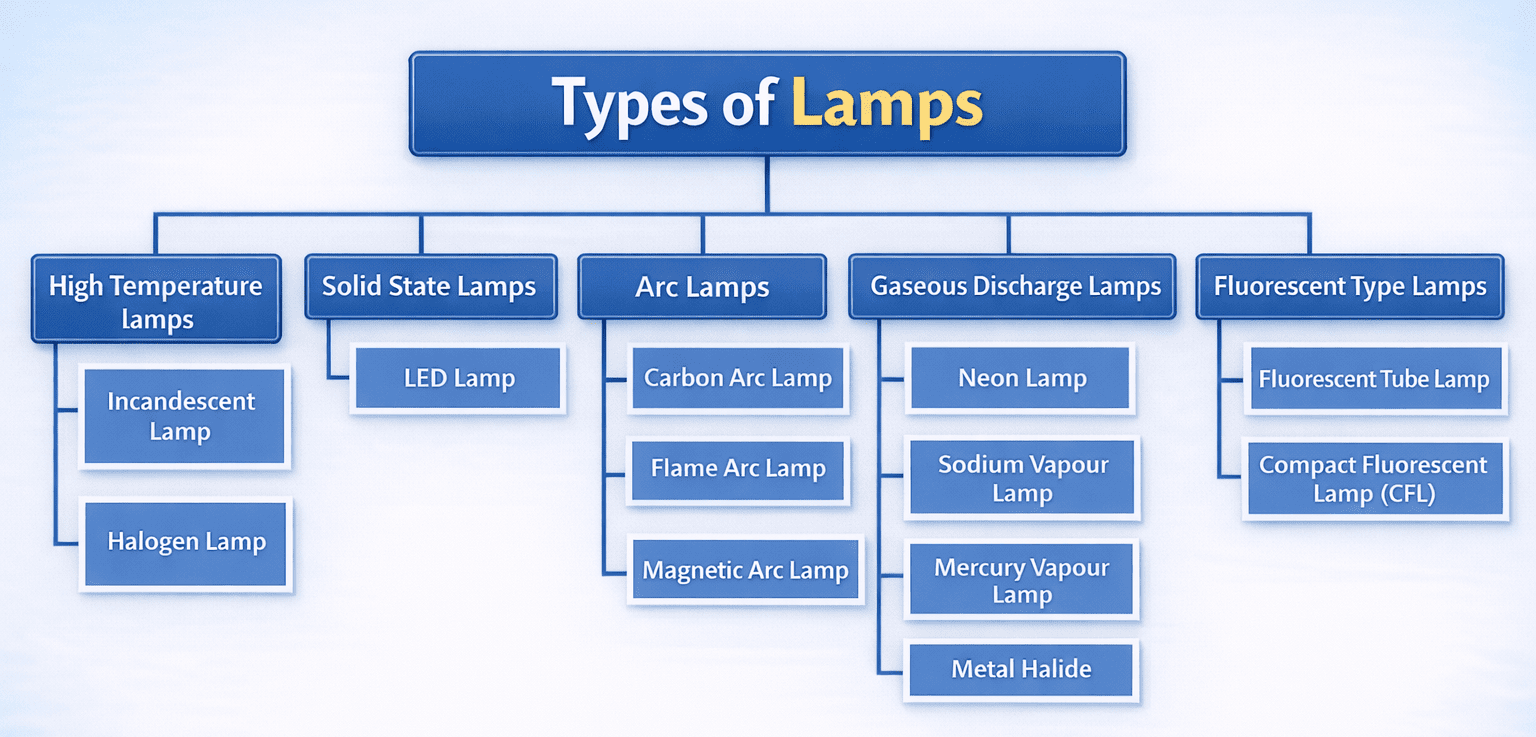
High Tempreture Lamps (filament)
A high temperature lamp is a lamp in which light is emitted due to incandescence of a filament at very high temperature. When electric current passes through the filament, its resistance causes heating. The filament becomes white hot and emits visible light.
Types of high temperature lamps:
- Incandescent lamp
- Halogen lamp
Incandescent Lamp
An incandescent lamp is an electrical light source that operates on the principle of incandescence. It produces light when an electric current passes through a thin filament and heats it to a very high temperature, causing it to glow and emit visible light.
The materials used for the filament of the incandescent lamp have the following properties.
- The melting point of the filament material should be high.
- The temperature coefficient of the material should be low.
- It should be high resistive material.
- The material should possess good mechanical strength to withstand vibrations.
- The material should be ductile.
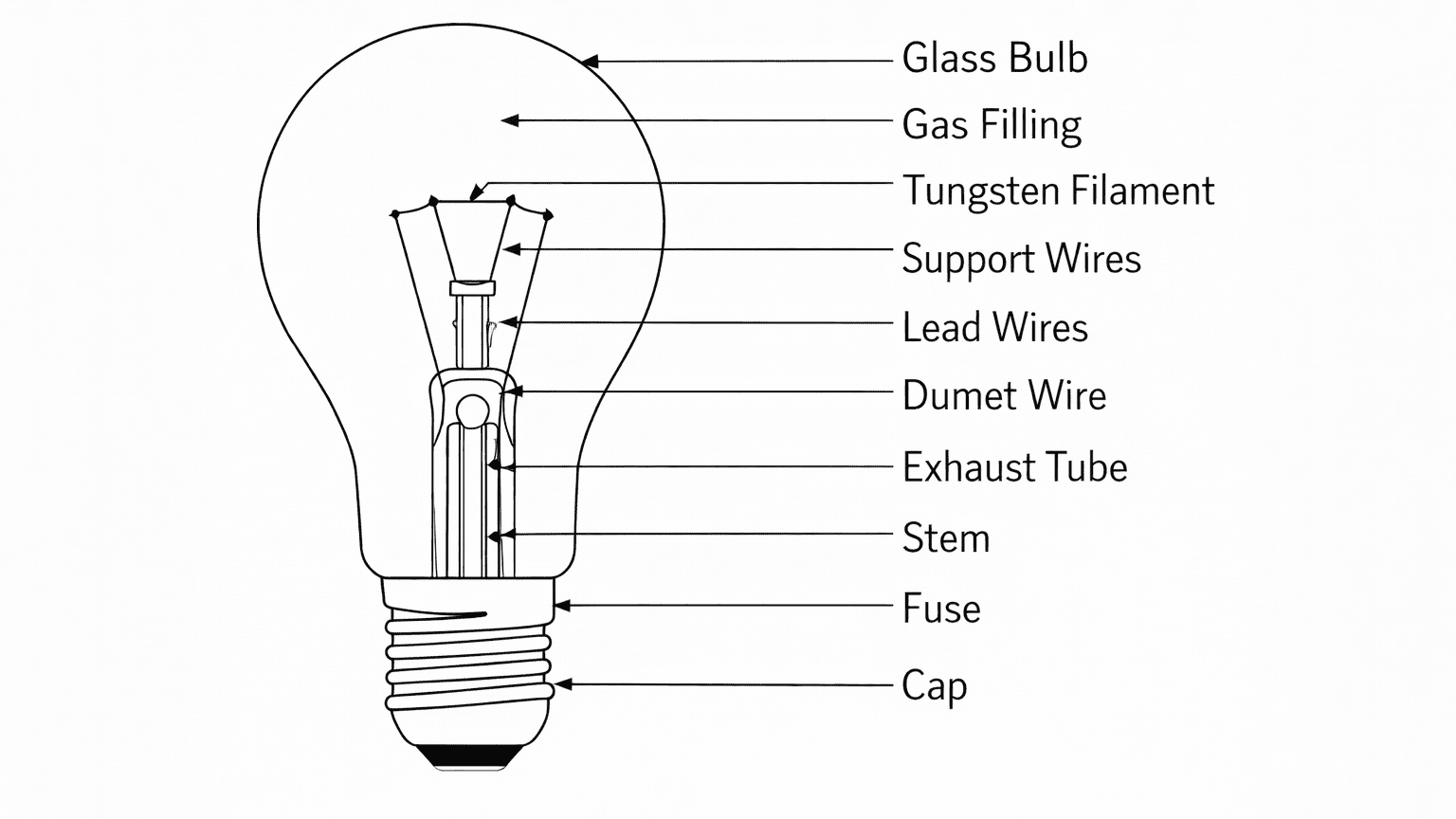
Construction of Incandescent Lamp
An incandescent lamp is constructed with a very thin tungsten filament supported by fine metal wires and sealed inside a glass bulb. The filament is made in a coiled or coiled-coil form and is connected to the external terminals through lead-in wires sealed into a glass stem. The whole internal assembly, called the mount, keeps the filament accurately at the centre of the bulb.
The glass bulb is made air-tight and is filled with an inert gas such as argon or a mixture of argon and nitrogen, or sometimes kept at low pressure, to reduce evaporation of tungsten and improve lamp life. During manufacture, air is removed through a small exhaust tube and the required gas is filled before sealing. The lower part of the bulb is fixed to a metallic base or cap using heat-resistant cement and an insulating disc, which provides both mechanical support and electrical connection to the supply.
Important operating data of an incandescent lamp
| Parameter | Typical value |
|---|---|
| Filament material | Tungsten |
| Filament operating temperature | about 2500 to 3000 °C |
| Melting point of tungsten | about 3422 °C |
| Gas inside the bulb | Argon or argon-nitrogen mixture |
| Gas pressure inside the bulb | about 0.6 to 0.9 atm (low pressure compared to outside air) |
| Supply voltage (common lamps) | 230 V AC (India) |
Working of Incandescent Lamp
An incandescent lamp works on the principle of heating effect of electric current. When the lamp is connected to the supply and the switch is turned ON, electric current flows from the base terminals through the lead in wires and enters the thin tungsten filament. Because the filament has comparatively high resistance, electrical energy is converted into heat and the filament temperature rises very quickly to about 2500 to 3000 °C. At this very high temperature, the tungsten filament becomes white hot and starts emitting visible light. This production of light due to heating of a conductor is called incandescence.
The filament is enclosed inside an airtight glass bulb filled with an inert gas such as argon or a mixture of argon and nitrogen at low pressure. This gas prevents the hot filament from reacting with oxygen and also reduces the evaporation of tungsten, which helps in increasing the life of the lamp. In simple words, an incandescent lamp produces light because electric current heats the tungsten filament to a very high temperature, and the glowing filament gives out visible light.
Halogen lamp
A halogen lamp is a special type of incandescent lamp and has better performance than an ordinary incandescent lamp. In a normal lamp, tungsten slowly evaporates from the filament and reduces lamp life and efficiency. In a halogen lamp, a small amount of halogen vapour such as iodine or bromine is added inside the bulb. When tungsten evaporates, it reacts with the halogen gas and forms a temporary compound. Near the hot filament, this compound breaks and tungsten is deposited back on the filament. This continuous process is called the halogen cycle and it improves lamp life and light output.
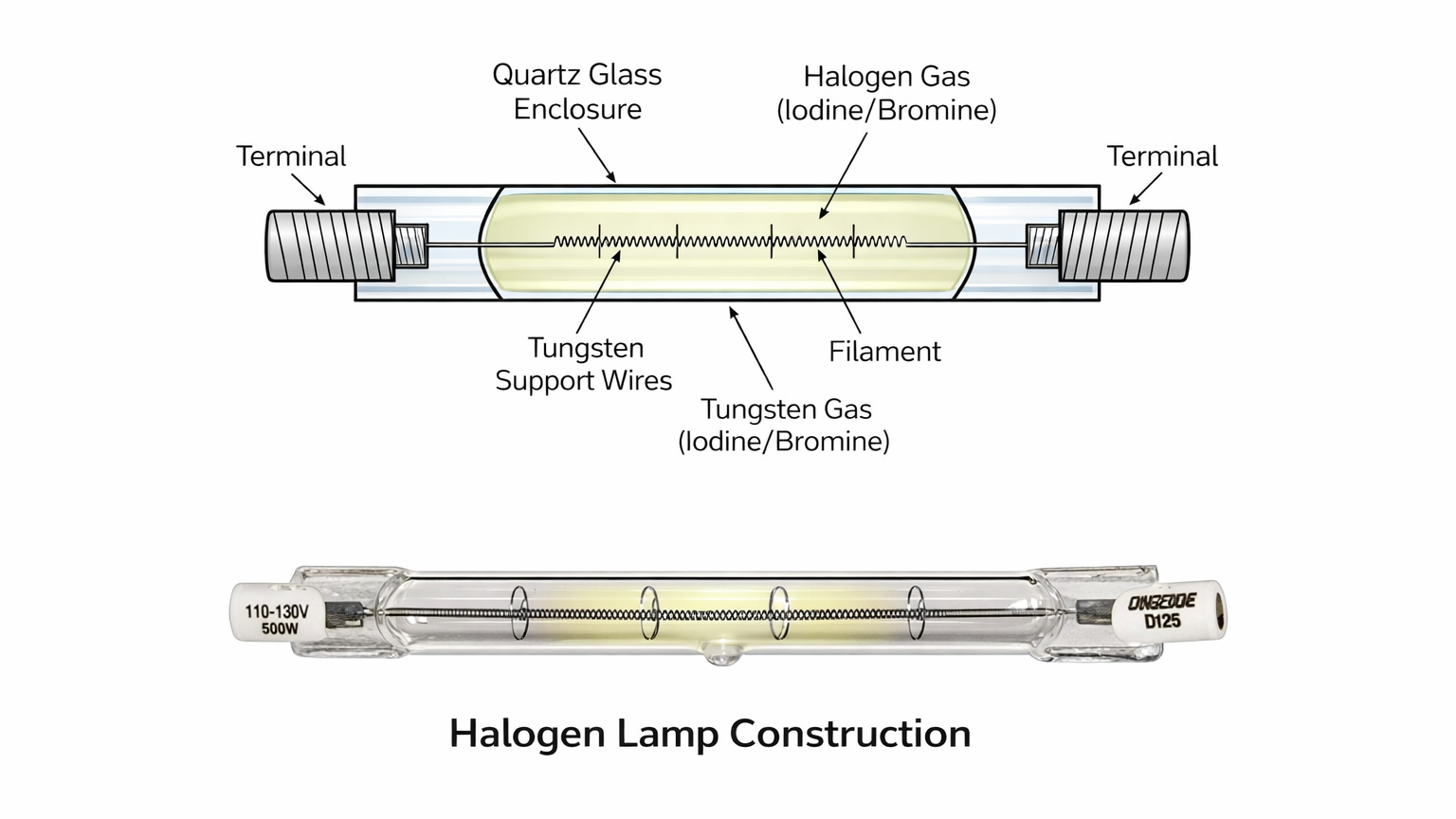
Construction of Halogen Lamp
A halogen lamp is constructed with a thin tungsten filament mounted at the centre of a small quartz glass enclosure. The filament is supported by fine tungsten support wires and connected to the external terminals through lead in wires provided at both ends. The enclosure is filled with a small quantity of halogen gas, usually iodine or bromine, along with an inert carrier gas.
Quartz glass is used instead of ordinary glass because it can withstand very high operating temperature and high internal pressure. The compact sealed capsule allows the filament to operate at a higher temperature and makes the halogen cycle possible, which improves the efficiency and life of the lamp.
Working of Halogen Lamp
The working of a halogen lamp is based on incandescence combined with a regenerative chemical process called the halogen cycle. When the supply is applied, current flows through the tungsten filament and heats it to a very high temperature, typically around 2800 to 3200 °C, causing it to emit visible light. At this temperature, tungsten atoms evaporate from the filament surface, but inside the quartz capsule a small amount of halogen gas, such as iodine or bromine, reacts with the evaporated tungsten to form a volatile tungsten halide compound.
This compound moves within the hot capsule and, near the hotter region of the filament, it decomposes and redeposits tungsten back onto the filament. As a result, filament thinning is reduced, bulb blackening is prevented, and the lamp can operate at higher temperature and pressure, giving higher luminous efficiency and longer service life compared to an ordinary incandescent lamp.
Solid State Lamps
Solid state lamps are lighting devices in which light is produced by a solid semiconductor material instead of a hot filament or gas discharge. The most common solid state lamp is the LED lamp. In these lamps, light is generated inside a semiconductor junction when electric current flows through it. Because there is no filament and no gas filled tube, the lamp is mechanically strong and highly efficient.
Light Emitting Diode (LED)
A Light Emitting Diode, commonly called an LED, is a special type of PN junction diode. It is fabricated using specially doped semiconductor materials so that it can convert electrical energy directly into light. When the LED is operated in forward bias, electrons and holes recombine at the junction and release energy in the form of light. Because of this direct energy conversion, LEDs are highly efficient and widely used in modern lighting and display applications.
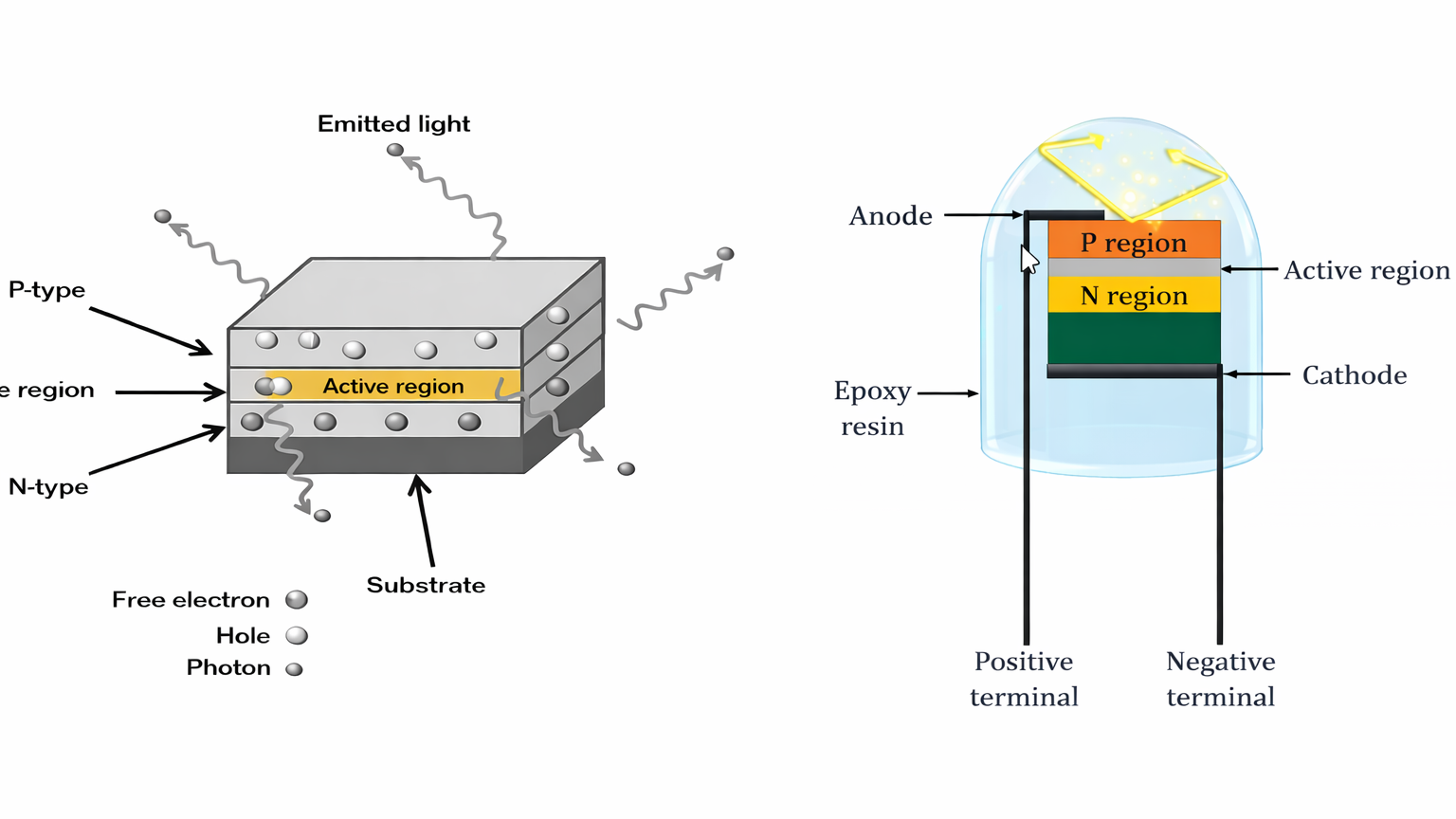
Construction of LED
An LED is constructed by forming a PN junction using two layers of specially doped semiconductor material, one P type and one N type. The most commonly used materials for LED fabrication are Gallium Arsenide (GaAs) and Gallium Arsenide Phosphide (GaAsP), because they efficiently produce light when charge carriers recombine.
The PN junction chip is mounted on a metal support which acts as the cathode and also helps in heat dissipation. A fine bonding wire is connected to the P side to form the anode. The entire chip is then enclosed in a transparent epoxy resin case. This epoxy package protects the device and also acts as an optical lens to direct the emitted light outward.
Working of LED
An LED operates on the principle of electroluminescence. When a forward bias is applied across the PN junction, the potential barrier decreases and electrons from the N region and holes from the P region move toward the junction. These charge carriers recombine in the depletion region, which is also called the active region.
During recombination, electrons fall from a higher energy level to a lower energy level. The energy released in this transition is emitted in the form of light photons. The colour of the emitted light depends on the energy band gap of the semiconductor material used in the LED.
Related Posts: Types of Lighting Schemes
Arc Lamps
Arc lamps are electric lamps in which light is produced by an electric arc between two electrodes. When a high voltage is applied and the electrodes are brought close, an arc is formed. This arc produces very intense light due to the very high temperature of the ionised air or vapour between the electrodes.
Electric supply → electrodes → arc is formed → very bright light
Types of Arc Lamps:
- Carbon arc lamp
- Flame arc lamp
- Magnetic arc lamp
Carbon Arc Lamp
A carbon arc lamp is a lamp in which light is produced by an electric arc formed between two carbon rod electrodes connected to a DC supply.
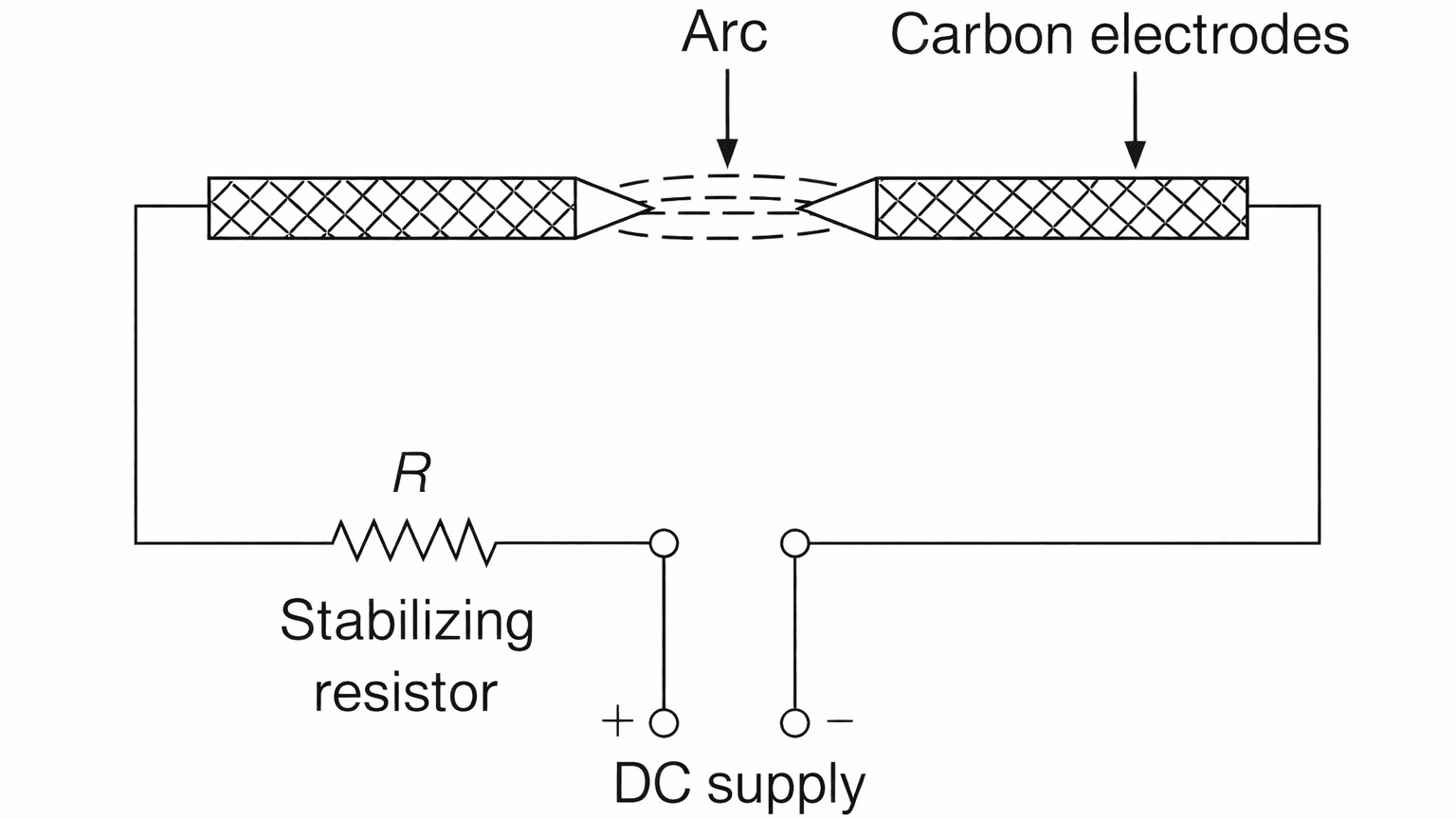
Construction of carbon arc lamp
A carbon arc lamp consists of two hard carbon rod electrodes mounted end to end in adjustable holders and connected to the supply through a series stabilising resistance R. For DC operation, the positive electrode is made larger in diameter than the negative electrode because it is consumed faster. For AC operation, both electrodes are of the same cross sectional area since their rate of consumption is equal. A simple feeding and positioning mechanism is provided to maintain a small air gap of about 2 to 3 mm between the tips. The normal operating supply is not less than 45 V.
Working of carbon arc lamp
When the supply is switched on, the two carbon rods are first brought into contact and then separated by about 2 to 3 mm. An electric arc is formed between the electrode tips and intense light is produced due to the very high temperature of the arc and the incandescent carbon tips. As the arc current increases, the rate of carbon vaporisation increases and the arc resistance decreases. This reduces the voltage drop across the arc. Hence, a series resistance R is necessary to stabilise and maintain the arc.
The voltage required to maintain the arc is
V = 39 + 2.8 l volts
where l is the length of the arc in mm.
The normal voltage drop across the arc is about 60 V. The temperature of the positive electrode is about 3500°C to 4200°C, and that of the negative electrode is about 2500°C. The luminous efficiency is approximately 9 to 12 lm/W.
In a carbon arc lamp, about 85% of the light is produced by the positive electrode, about 10% by the negative electrode, and the remaining 5% by the arc in air.
Flame arc lamp
In simple words, a flame arc lamp produces light by an electric arc between salt filled carbon electrodes, and the light mainly comes from the luminous metal vapour in the arc rather than only from the hot carbon tips.
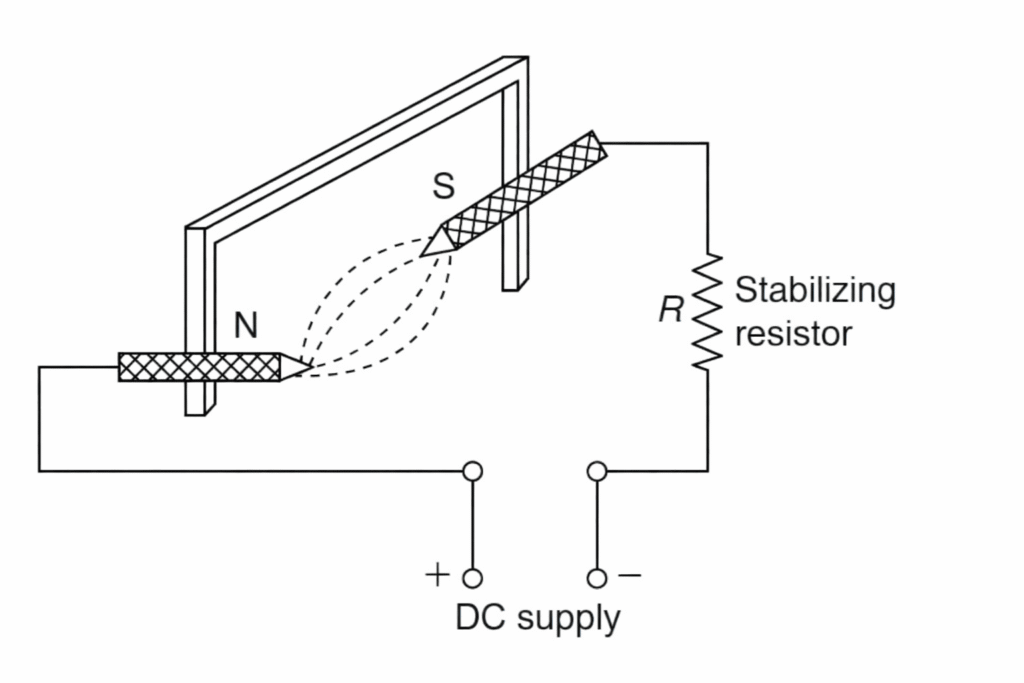
Construction of flame arc lamp
A flame arc lamp uses core type carbon electrodes. Each electrode is made of about 85% carbon and 15% fluoride, which is called the flame material. The electrodes have a central cavity and this cavity is filled with fluoride. The two electrodes are mounted end to end in suitable holders and connected to the supply through a series resistance to stabilise the arc. The general construction is similar to that of a carbon arc lamp, except that treated, cored electrodes are used.
Working of flame arc lamp
When the supply is switched on, the two electrodes are first brought into contact and then separated slightly to strike an arc. After the arc is established, both the carbon and the fluoride material get vaporised in the arc stream. The hot metal vapour and fluoride vapour form a bright flame like arc and produce very high luminous intensity.
The colour of the light produced depends on the type of flame material used in the electrodes. A series resistance is connected with the lamp to maintain and stabilise the arc. The luminous efficiency of a flame arc lamp is about 8 lumens per watt.
Magnetic arc lamp
A magnetic arc lamp is an arc lamp in which light is produced by an electric arc and the arc is controlled with the help of a magnetic field. Its principle of operation is similar to that of a carbon arc lamp. The lamp uses a positive electrode made of copper and a negative electrode made of magnetic oxide of iron, and the electrodes are connected to the supply through a series resistance to stabilise the arc. When the electrodes are brought into contact and then separated slightly, an arc is formed between them and light is emitted.
An electromagnet placed near the arc produces a magnetic field which deflects and stretches the arc, making it steadier and helping in better distribution of light. Magnetic arc lamps are rarely used in practice today because of their bulky construction and the availability of more efficient modern light sources.
Gaseous Discharge Lamps
Gaseous discharge lamps are electric lamps in which light is produced by an electric discharge through a gas or metal vapour enclosed in a sealed tube. When a suitable voltage is applied, the gas becomes ionised and emits radiation due to atomic excitation. These lamps require a current controlling device such as a ballast and are widely used because of their higher efficiency and longer life compared with incandescent lamps.
Neon Lamp
A neon lamp is a low pressure gaseous discharge lamp in which light is produced by an electric discharge through neon gas sealed inside a small glass tube. When a suitable voltage is applied across its electrodes, the neon gas becomes ionised and emits a characteristic bright reddish orange glow. Neon lamps are mainly used for indicator purposes, sign boards and decorative lighting rather than for general illumination.
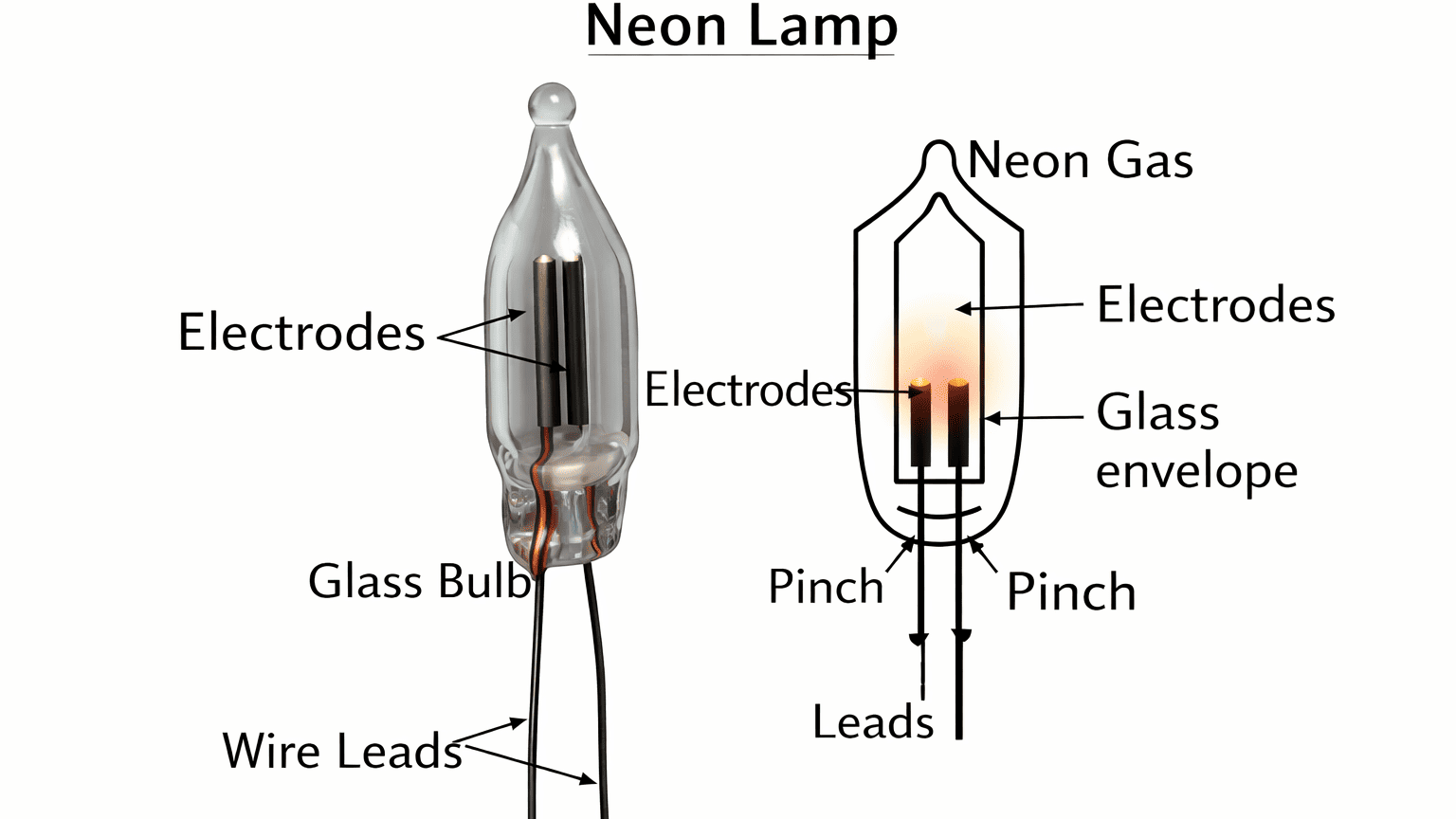
Construction of neon lamp
A neon lamp consists of a small sealed glass discharge tube filled mainly with neon gas, with a very small percentage of argon added to improve starting. The gas is filled at low pressure, typically about 8 torr. Two cold electrodes made of high resistive metal are sealed at the two ends of the tube. A small gap of about 2 to 3 mm is maintained between the electrodes. The glass envelope is usually made of soft glass and the electrodes are brought out through sealed leads for external connection.
Working of neon lamp
When a suitable AC or DC voltage is applied across the electrodes, the electric field accelerates free electrons present in the gas. These electrons collide with neon atoms and excite them. When the excited neon atoms return to their normal energy state, they emit light, producing the characteristic glow of the neon lamp. The discharge in a neon lamp is a glow discharge and not an arc discharge. Since the electrodes are cold cathodes, light is produced mainly due to gas excitation and de excitation, not due to heating of electrodes. By using different gases or adding suitable coating and chemical materials, the colour of the emitted light can be changed.
Sodium Vapour Lamp
A sodium vapour lamp is a high efficiency gas discharge lamp in which light is produced by the excitation of sodium vapour. It is mainly used for outdoor and large area lighting because of its very high luminous efficacy and long operating life. These lamps are commonly seen in street lighting, highways, parking areas and industrial yards. They produce a strong yellowish light that is very effective for visibility, especially in foggy and dusty conditions.
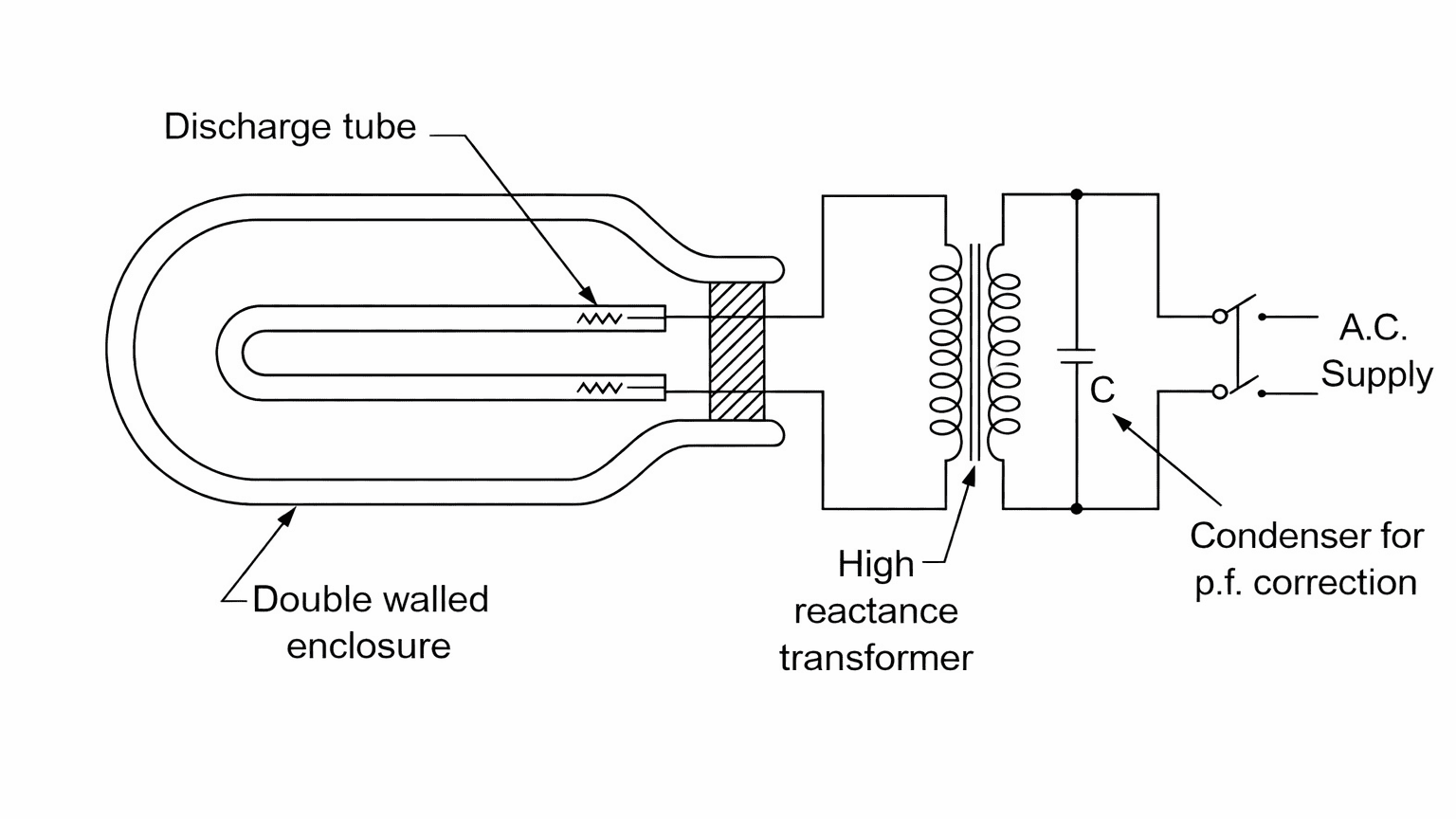
Construction of sodium vapour lamp
A sodium vapour lamp consists of a narrow U shaped inner discharge tube made of special glass, with two electrodes sealed at its ends. The tube contains a small quantity of metallic sodium and a small amount of neon gas for starting. Since the light output of the lamp is strongly affected by temperature, the inner discharge tube is enclosed inside an outer double walled glass jacket. A vacuum is created between the inner tube and the outer glass envelope to reduce heat loss and maintain the required operating temperature. The complete assembly is mounted on a suitable base and is operated with external control gear such as a transformer and ballast.
Working of sodium vapour lamp
Before switching on, the sodium inside the inner tube is in solid form and is deposited on the inner wall of the tube. When supply is applied, the neon gas first gets ionised and a weak discharge starts, producing a reddish glow and heating the tube. As the temperature rises, the sodium gradually vaporises and takes part in the discharge.
The arc then mainly occurs through sodium vapour and the lamp emits its characteristic yellow light. After about 10 to 20 minutes, sufficient sodium vapour pressure is established and the lamp reaches full light output. A starting voltage of about 410 V is required, while the normal operating voltage of the lamp is around 165 V, and the supply is provided through a leakage transformer or suitable ballast.
Mercury Vapour Lamp
A mercury vapour lamp is a high intensity discharge lamp in which light is produced by an electric arc through vaporised mercury. It is widely used for street lighting, factories, workshops and large indoor areas because it gives higher light output than incandescent lamps. The lamp operates at high pressure and requires a ballast for proper starting and current control. Due to its long life and good efficiency, it became one of the commonly used discharge lamps in general illumination systems.
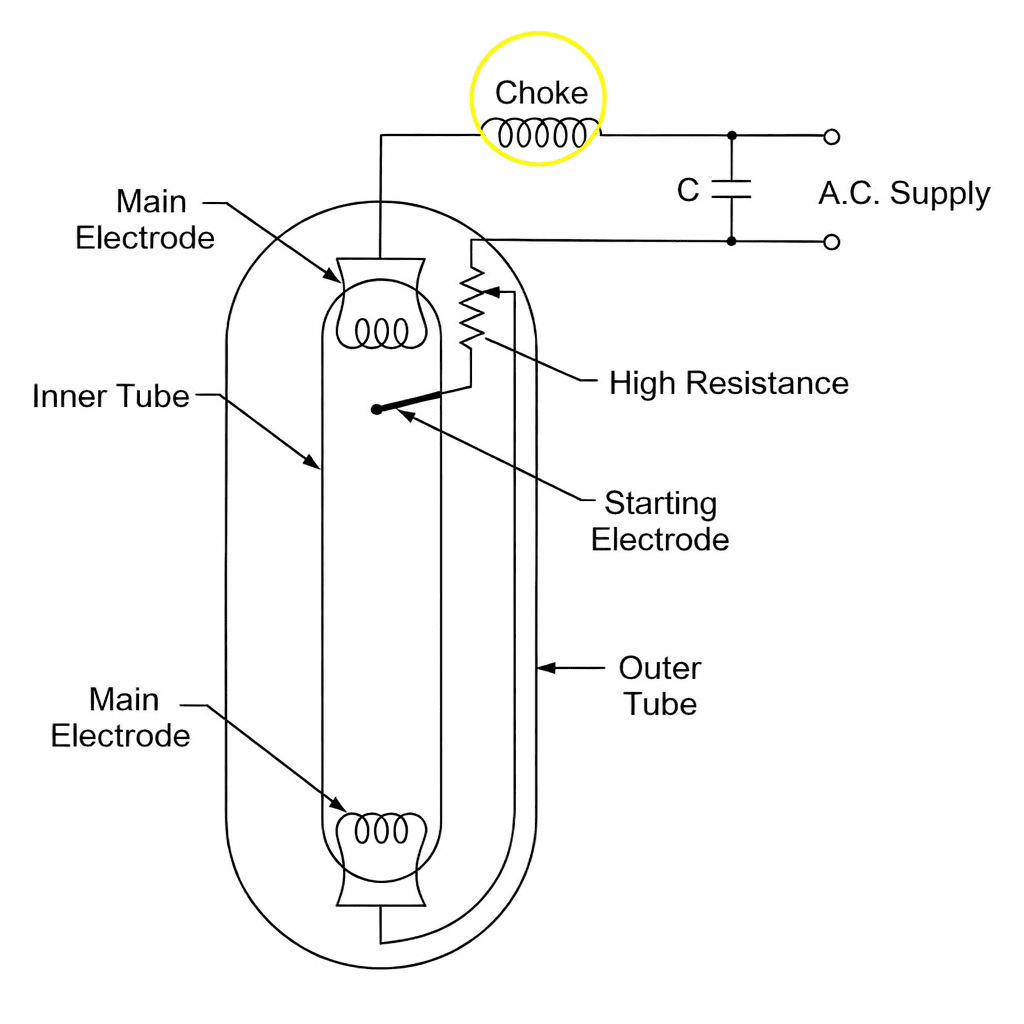
Construction of High Pressure Mercury Lamp
The construction & connection diagram is as shown in figure. As per this construction there are following components.
Choke: The choke is acting as the ballast. At the time of supply voltage variation, the current flowing through the inner tube is maintained constant to keep uniform light intensity. Sometimes choke can be designed to get the higher voltages, to apply to the inner tube of mercury vapour lamp.
Starting resistance/limiting resistance: Whenever current flows through the starting resistance, there is a I2R loss which is converted into heat. If the temperature of this heat goes near about 600 °C then inert gases ionization starts.
Auxiliary electrode & Main electrode: It is made by high resistive element. The ionization is takes place through the inert gases whenever current flows from auxiliary electrode to main electrode.
Inner Tube: The various inert gases e.g. Argon, Nitrogen etc with mercury powder are filled in the inner tube at 5 to 7 times of the atmospheric pressure.
Outer Tube: The function of outer tube is to make the vacuum surrounding the inner tube to avoid thermal dissipation or to maintain 600 °C surrounding the inner tube.
Power factor improvement Capacitor: The function of power factor improvement capacitor is to improve the power factor from 0.5 to 0.95.
Working of High Pressure Mercury Vapour Lamp
Whenever 1-ph, 230V, AC Supply is provided to the discharge tube of MVL, initially the current flows from Phase to
the choke to the starting electrode to neutral. The starting electrode or resistance is made of tungsten filament having more resistance ( 5 to 10 kΩ), so that whenever current flows through the tungsten filament, as per the thermal emission, the light is emitted through the filament. The initial colour of light is therefore blue.
At the same time the rated voltages is applied in between the main electrode No.1 & main electrode no. 2. Due to this voltage, there will be collision of neon gas particles & current will start to flow through the discharge tube, Whenever temperature surrounding the inner tube increases up to 600 °C the mercury powder will start vaporizing & the continuous collision process of all inert gases takes place so that full light is emitted through the discharge tube. The colour of light is bluish white. The full light is emitted after 10-15 min.
Metal Halide Lamp
A metal halide lamp is a high intensity discharge lamp in which light is produced by an electric arc passing through a mixture of mercury vapour and metal halide compounds inside a small arc tube. It is mainly used where high light output and good colour quality are required, such as stadiums, industrial halls, campuses and large outdoor areas.
Compared to a simple mercury vapour lamp, the addition of metal halides improves colour rendering and increases luminous efficiency. The lamp requires external control gear such as a ballast and an ignitor for safe starting and stable operation.
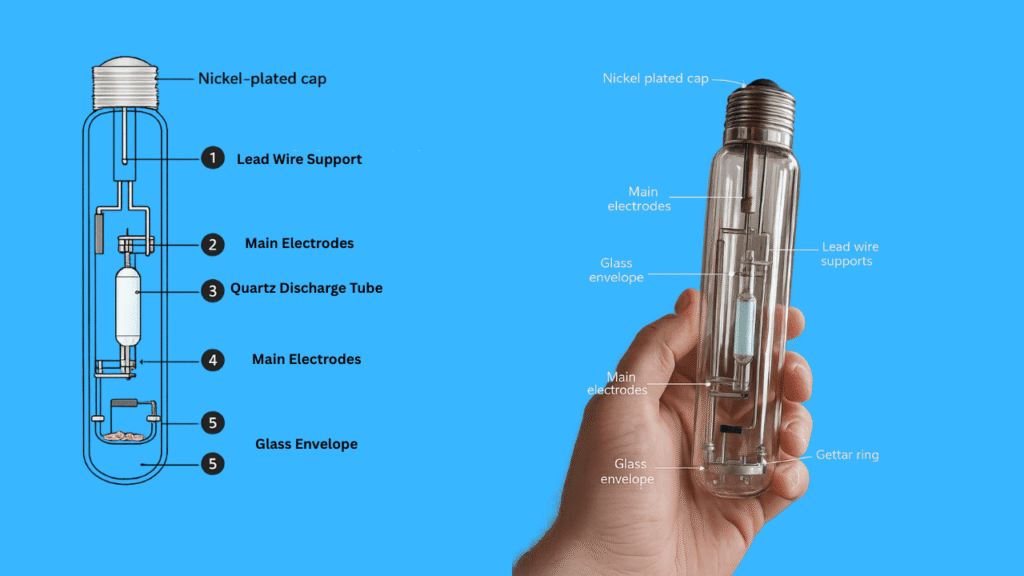
Construction of Metal Halide Lamp
A metal halide lamp is a type of high intensity discharge lamp in which light is produced inside a small sealed arc tube. The main part is the arc tube, made of quartz or ceramic, mounted at the centre of an outer glass bulb. Inside this arc tube, two main tungsten electrodes are fixed at opposite ends. A small quantity of mercury, inert starting gas (usually argon) and carefully selected metal halide salts such as sodium iodide, scandium iodide or dysprosium iodide are filled inside the tube.
The arc tube is supported by a rigid metal frame and connected to the base through lead wires. The outer bulb protects the arc tube and also helps in maintaining thermal stability. In many designs, the outer bulb is coated with a UV blocking layer to prevent harmful radiation from coming out.
Working of a Metal Halide Lamp
When supply is applied through a ballast, a high starting voltage is produced across the electrodes. This initiates an electric discharge through the argon gas present inside the arc tube. In the first few seconds, the discharge mainly takes place in argon and mercury vapour. The arc temperature rises rapidly and heats the arc tube. As the temperature increases, the metal halide salts inside the tube start to vaporise.
After vaporisation, the metal atoms and halogen compounds participate in the discharge. These metal vapours emit strong spectral lines, which significantly improve the colour quality and luminous efficacy of the lamp. During normal operation, a stable high temperature arc is maintained between the two main electrodes. The light output is therefore produced by a combined radiation of mercury vapour and metal halide vapour. The ballast is essential because the discharge has a negative resistance characteristic. Without current control, the lamp would draw excessive current and get damaged.
Fluorescent Type Lamps
A fluorescent type lamp is a low pressure gaseous discharge lamp in which electrical energy is first converted into ultraviolet radiation and then into visible light by a phosphor coating on the inner surface of the tube.
Fluorescent Tube Lamp
A fluorescent tube lamp is a low pressure mercury vapour discharge lamp in which light is produced indirectly by a phosphor coating inside the tube. When electric current flows through the gas inside the lamp, ultraviolet radiation is generated. This ultraviolet radiation strikes the phosphor layer and is converted into visible light. Compared to incandescent lamps, a fluorescent tube lamp gives higher luminous efficiency, lower heat loss and longer service life.
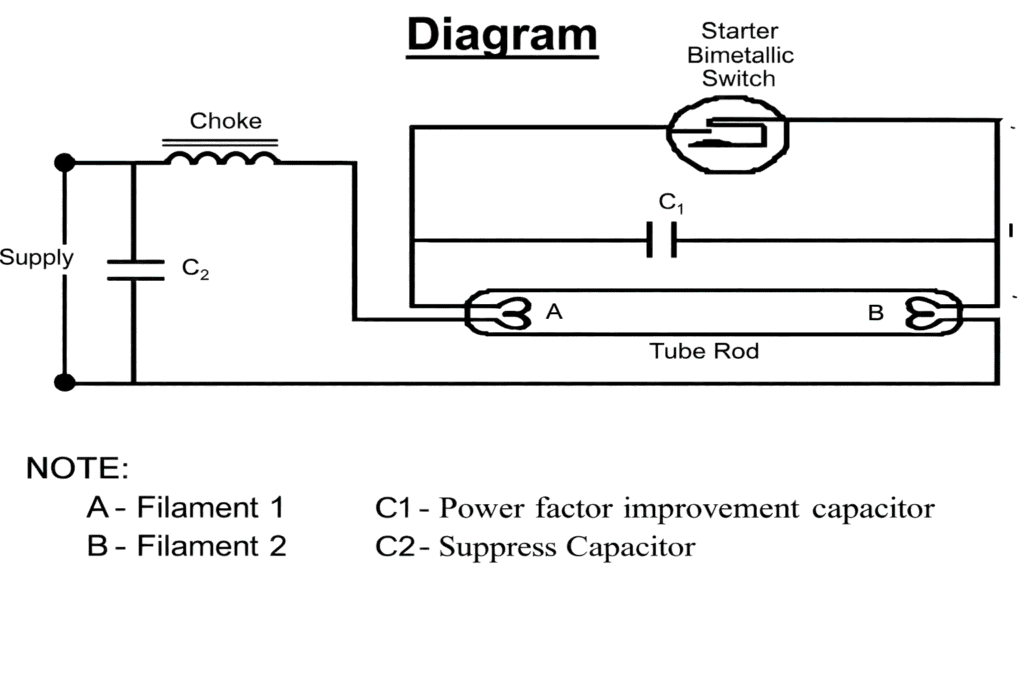
Construction of Fluorescent Tube Lamp
A conventional fluorescent lamp mainly consists of four parts.
Glass tube: A long glass tube is sealed at both ends with one heated filament electrode at each end. The inner wall of the tube is coated with fluorescent (phosphor) powder. Inside the tube there is a small quantity of mercury vapour and an inert gas such as argon for easy starting.
Choke (ballast): The choke is an inductor connected in series with the lamp. It limits the lamp current during normal operation. It also produces a high induced voltage at starting.
Starter: The starter is a small glow switch connected across the lamp electrodes. It is used only during starting to preheat the filaments and to help generate the striking voltage.
Power factor improvement capacitor: A capacitor is connected across the supply. It does not take part in starting of the lamp. It improves the overall power factor of the circuit.
Working of Fluorescent Tube Lamp
When the supply is switched ON, current flows through the choke → filament 1 → starter → filament 2 → neutral. Both filaments start heating. Inside the starter, a small glow discharge takes place and its contacts close. This allows a higher current to pass through both filaments and they become properly heated. After a short moment, the starter contacts open.
Due to the sudden interruption of current, the choke produces a high induced voltage.
This high voltage appears across the two heated filaments. The argon gas and mercury vapour inside the tube get ionized and an electric discharge is established. The mercury discharge mainly produces ultraviolet radiation.
The phosphor coating on the inner wall absorbs this UV and converts it into visible light. Once the tube starts conducting, the starter remains open and out of the circuit. The choke now only acts as a current limiting device and the lamp operates steadily.
Compact Fluorescent Lamp (CFL)
Compact Fluorescent Lamp (CFL) is an energy efficient electric lamp developed as a smaller and improved form of the conventional fluorescent tube lamp. It produces light by exciting mercury vapour inside a glass tube and converting the ultraviolet radiation into visible light using a phosphor coating. A CFL consumes much less electrical power than an incandescent lamp for the same light output and also offers a longer service life.
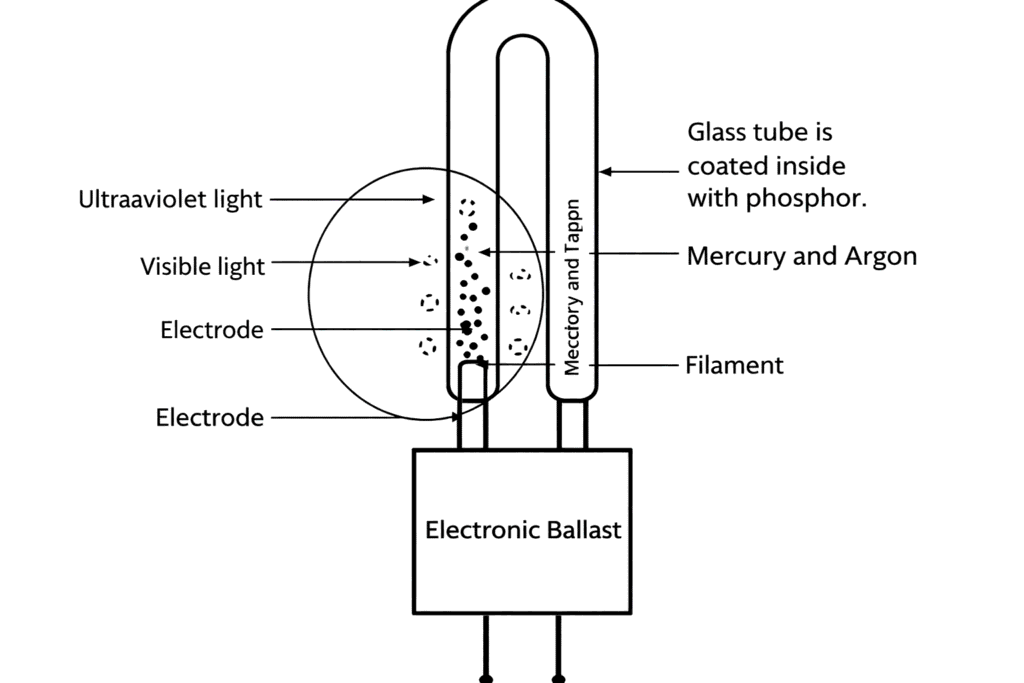
Construction of CFL
A Compact Fluorescent Lamp consists of a narrow glass tube, usually bent in U or spiral shape, whose inner surface is coated with a phosphor layer. Inside the tube, a small quantity of mercury vapour and an inert gas such as argon is filled at low pressure. An electrode or filament is provided at each end of the tube to initiate and maintain the discharge. At the base of the lamp, an electronic ballast is fitted which supplies high frequency AC and controls the lamp current. The complete tube and ballast assembly is enclosed in a compact plastic housing with a standard lamp cap.
Working of CFL
When the supply is switched ON, the electronic ballast first provides a high starting voltage across the electrodes.
This voltage produces an electric discharge through the low pressure argon and mercury vapour inside the tube. During the discharge, mercury atoms emit mainly ultraviolet radiation. The ultraviolet rays strike the phosphor coating on the inner wall of the tube and are converted into visible light. After ignition, the electronic ballast limits and controls the current and keeps the lamp operating at high frequency, which improves efficiency and reduces flicker.
Advantages, disadvantages and applications of lamps
| Lamp type | Advantages | Disadvantages | Applications |
|---|---|---|---|
| Incandescent lamp | • Simple and cheap construction • Instant starting • Very good colour rendering• Works on AC and DC | • Very low luminous efficiency • Short service life • Large heat loss • High power consumption | • Decorative lighting • Table lamps • Indicator and signal lamps |
| Halogen lamp | • Higher efficiency than incandescent • Compact size • Better brightness and beam control • Good colour rendering | • Very high operating temperature • Higher cost than filament lamp • Lower efficiency than LED and CFL | • Stage lighting • Spot lighting • Automotive headlamps |
| Fluorescent tube lamp | • High luminous efficiency • Long service life • Low heat generation • Suitable for large areas | • Requires choke and starter• Contains mercury• Flicker and humming possible• Bulky size | • Offices and classrooms• Factories and workshops• Laboratories and hospitals |
| Compact Fluorescent Lamp (CFL) | • Energy saving compared to incandescent lamp • Longer service life • Less heat generation • Easy replacement in existing holders | • Contains mercury • Slow starting and warm up • Poor performance under frequent switching • Electronic ballast failure | • Residential lighting • Offices and hotels • Corridors and common areas |
| LED lamp | • Very high efficiency • Very long life • Instant start • No mercury • Low voltage operation possible | • High initial cost • Requires driver circuit • Heat dissipation is critical | • Domestic lighting • Street lighting • Solar lighting systems • Decorative lighting |
| Mercury vapour lamp | • Long operating life • Suitable for continuous operation• Robust construction | • Poor colour rendering • Long warm up time • Contains mercury • Lower efficiency than modern lamps | • Industrial yards • Warehouses • Old street lighting installations |
| Metal halide lamp | • High light output • Better colour rendering than mercury lamp • Suitable for high mounting heights | • Requires ballast and ignitor • Warm up and re strike delay • Contains mercury • Higher maintenance cost | • Stadiums and sports halls • Flood lighting • High bay industrial lighting |
| High pressure sodium vapour lamp (HPSV) | • Very high luminous efficiency • Long service life • Reliable outdoor performance | • Very poor colour rendering • Warm up time required • Needs ballast and ignitor | • Street lighting • Highways • Parking areas |
| Carbon arc lamp | • Very high light intensity • Excellent colour quality • Simple operating principle | • Very low efficiency • Frequent carbon electrode replacement • High maintenance cost • Produces noise and fumes | • Searchlights • Old cinema projectors • Early stage and studio lighting |
Typical technical data of common lamps
| Lamp type | Light output (lumens) | Power consumption (W) | Colour temperature (K) | Supply voltage range | Rated life (hours) |
|---|---|---|---|---|---|
| Incandescent lamp | 300 to 2000 lm | 25 to 200 W | 2700 to 2900 K | 200 to 250 V AC | 750 to 1000 h |
| Halogen lamp | 400 to 3000 lm | 20 to 500 W | 3000 to 3200 K | 12 V or 200 to 250 V AC | 2000 to 4000 h |
| Fluorescent tube lamp | 1200 to 5200 lm | 18 to 58 W | 3000 to 6500 K | 200 to 250 V AC (with ballast) | 10000 to 20000 h |
| Compact Fluorescent Lamp (CFL) | 400 to 1800 lm | 5 to 26 W | 2700 to 6500 K | 200 to 250 V AC | 6000 to 10000 h |
| LED lamp | 400 to 5000 lm | 4 to 50 W | 2700 to 6500 K | 100 to 277 V AC (through driver) | 25000 to 50000 h |
| Mercury vapour lamp | 3000 to 20000 lm | 80 to 400 W | 3800 to 4200 K | 200 to 250 V AC (with ballast) | 16000 to 24000 h |
| Metal halide lamp | 3000 to 110000 lm | 35 to 2000 W | 3000 to 5600 K | 200 to 250 V AC (with ballast and ignitor) | 10000 to 20000 h |
| High pressure sodium vapour lamp (HPSV) | 4000 to 130000 lm | 50 to 1000 W | 1900 to 2200 K | 200 to 250 V AC (with ballast and ignitor) | 18000 to 30000 h |
| Carbon arc lamp | 2000 to 20000 lm | 300 to 3000 W | 5000 to 6000 K | 40 to 60 V DC (typical arc supply) | 50 to 200 h (carbon electrodes) |