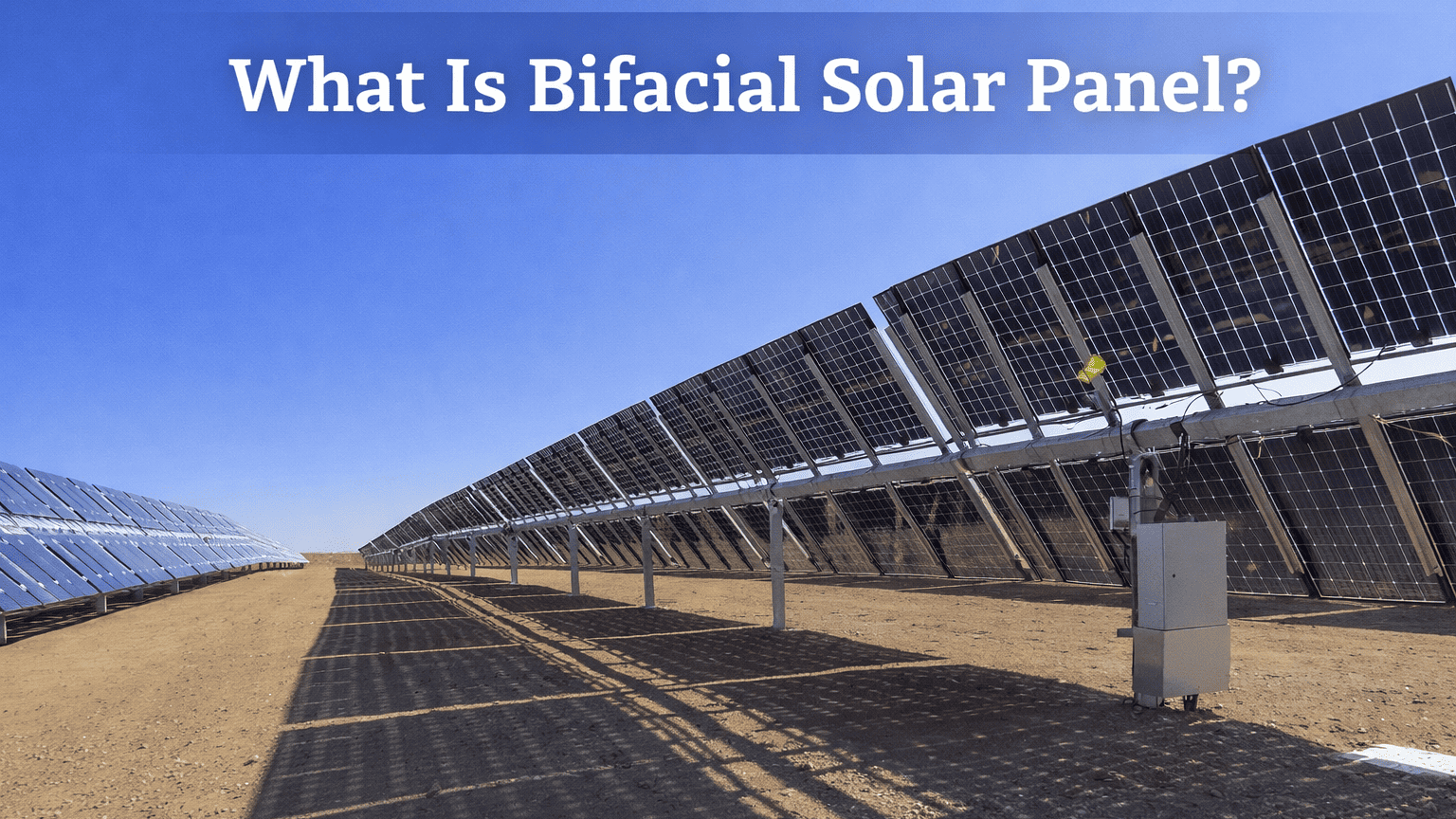
What Is a Bifacial Solar Panel?
A bifacial solar panel is a photovoltaic module that can generate electricity from both sides of the panel. Unlike a normal solar panel, which produces power only from the front side, a bifacial panel has active solar cells on the front and the rear side.
The front side receives direct sunlight, while the rear side receives reflected sunlight from the ground or nearby surfaces. Because of this double sided operation, the total energy output of a bifacial solar panel is higher than a conventional panel.
Construction of Bifacial Solar Panel
The construction of a bifacial solar panel is designed in such a way that both the front and rear sides can receive light and generate electricity.
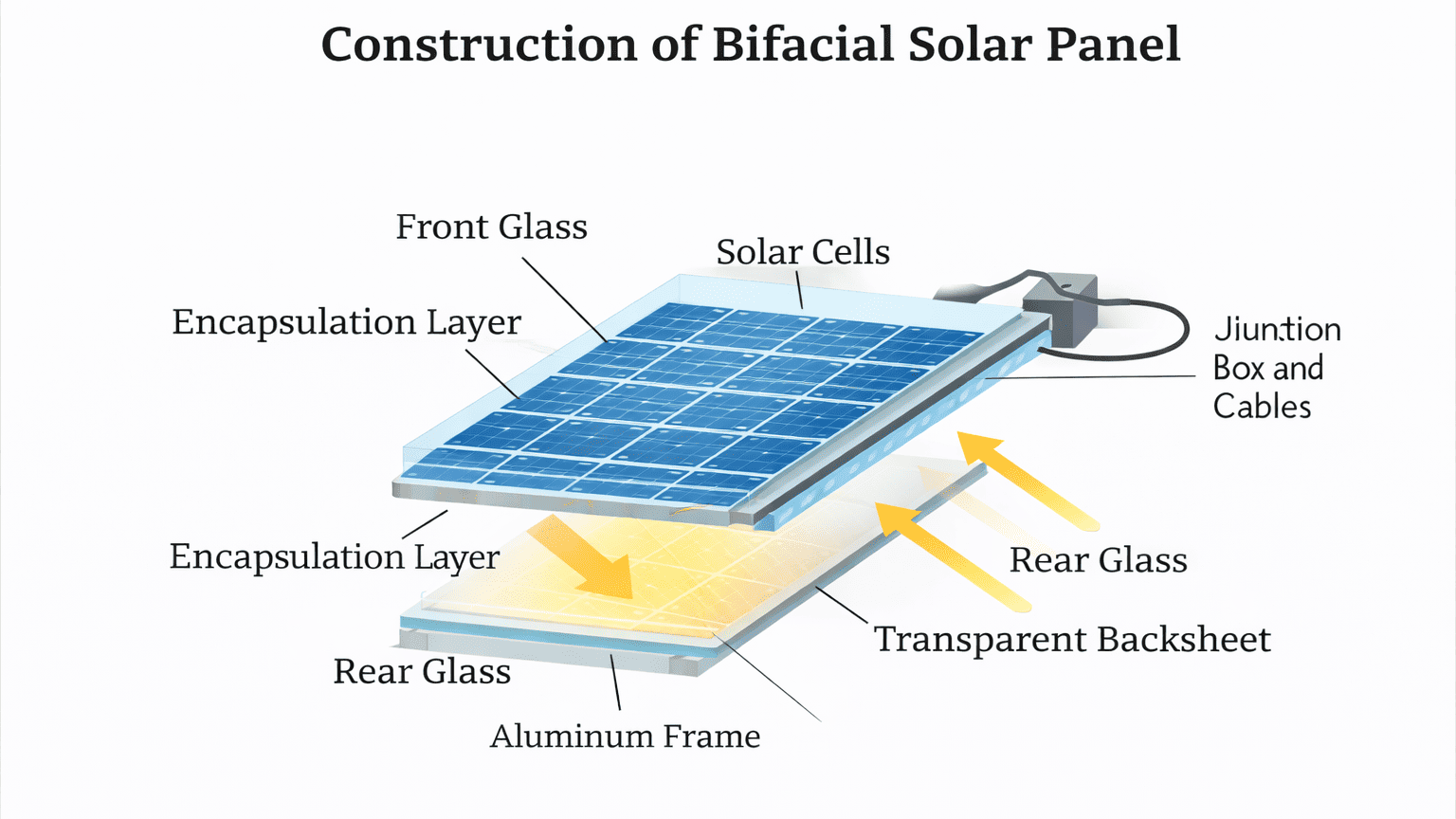
A typical bifacial solar panel consists of the following main parts.
1. Front glass
It is a toughened transparent glass placed on the top side of the panel.
It protects the solar cells and allows sunlight to pass to the cells.
2. Front encapsulation layer
A transparent encapsulant layer (EVA or POE) is placed below the front glass.
It holds the cells in position and provides electrical insulation.
3. Bifacial solar cells
These special photovoltaic cells can absorb light from both sides.
They are responsible for converting light energy into electrical energy.
4. Rear encapsulation layer
Another transparent encapsulant layer is provided below the solar cells for protection and mechanical support.
5. Rear glass or transparent backsheet
Instead of an opaque backsheet, bifacial panels use rear glass or a transparent backsheet.
This allows reflected light to reach the rear surface of the solar cells.
6. Aluminium frame
An aluminium frame is fitted around the panel to provide mechanical strength and easy mounting.
7. Junction box and cables
The junction box is mounted at the rear side and collects the electrical output from the cells for external connection.
How Bifacial Solar Panel Works?
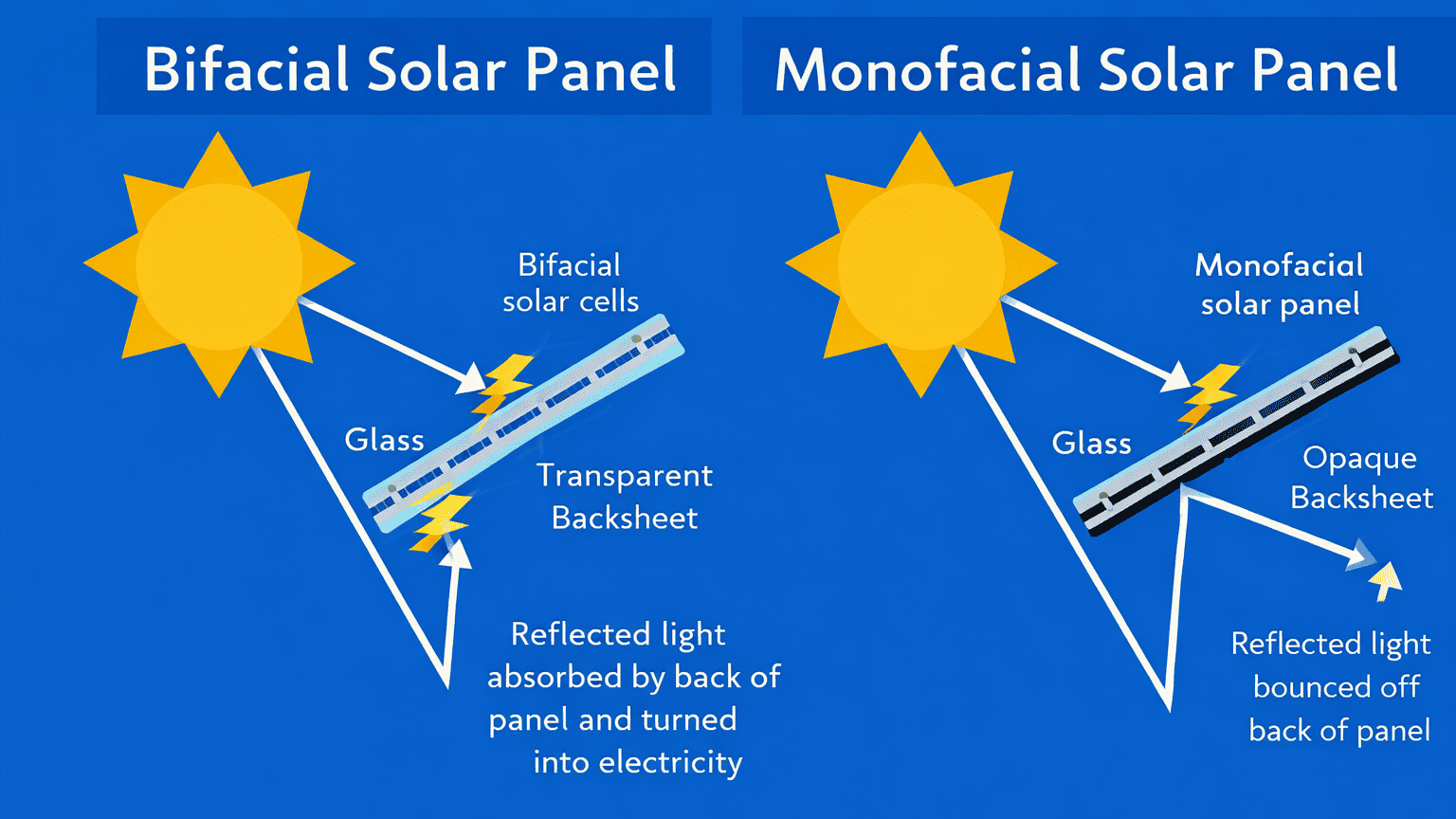
A bifacial solar panel operates on the principle of dual sided photovoltaic energy conversion, in which the same solar cells are designed to collect and convert light from both the front and the rear surfaces of the module. When direct solar radiation strikes the front surface, the photovoltaic cells absorb the incident photons and generate electrical energy in the conventional manner. At the same time, a portion of the incoming sunlight is reflected from surrounding surfaces such as the ground, roofs, water bodies, or nearby structures.
This reflected radiation reaches the rear surface of the panel through the transparent rear glass or transparent backsheet. The rear side of the bifacial cells is also photo active and converts this reflected light into additional electrical energy. The electrical output produced from both faces of the module is internally combined, resulting in a higher overall energy yield compared to a monofacial solar panel installed under the same operating conditions.
Comparison of Bifacial and Monofacial Solar Panels
Bifacial solar panels generate power from both sides and provide higher energy output when installed under suitable site conditions, whereas monofacial solar panels generate power only from the front side and are simpler and more economical for conventional installations.
| Feature | Bifacial Solar Panel | Monofacial Solar Panel |
|---|---|---|
| Power generation | Generates electricity from both front and rear sides | Generates electricity from only the front side |
| Use of reflected light | Can use reflected and scattered light from ground or nearby surfaces | Cannot use reflected light from the rear side |
| Rear side construction | Uses transparent glass or transparent backsheet | Uses opaque backsheet |
| Energy output | Higher total energy yield due to rear side contribution | Lower total energy yield compared to bifacial panels |
| Installation requirement | Needs proper mounting height and reflective surface for best performance | Can be installed easily without special rear side considerations |
| Performance dependency | Performance strongly depends on albedo and site conditions | Performance mainly depends on direct sunlight only |
| Typical applications | Ground mounted plants, carports, floating solar, high reflectivity sites | Rooftops, residential systems, small commercial installations |
| Cost | Slightly higher initial cost | Generally lower initial cost |
| Structural design | Often glass to glass structure, more robust | Usually glass front with polymer backsheet |
| Suitable locations | Best for open areas and high reflectivity environments | Suitable for almost all common installation sites |
What is Albedo in Bifacial Solar Panels?
Albedo is the measure of how much sunlight a surface reflects. In bifacial solar panel systems, albedo is very important because the rear side of the panel generates electricity from this reflected light. It is expressed as a value between 0 and 1. A higher albedo means more reflected light and higher rear side energy gain.
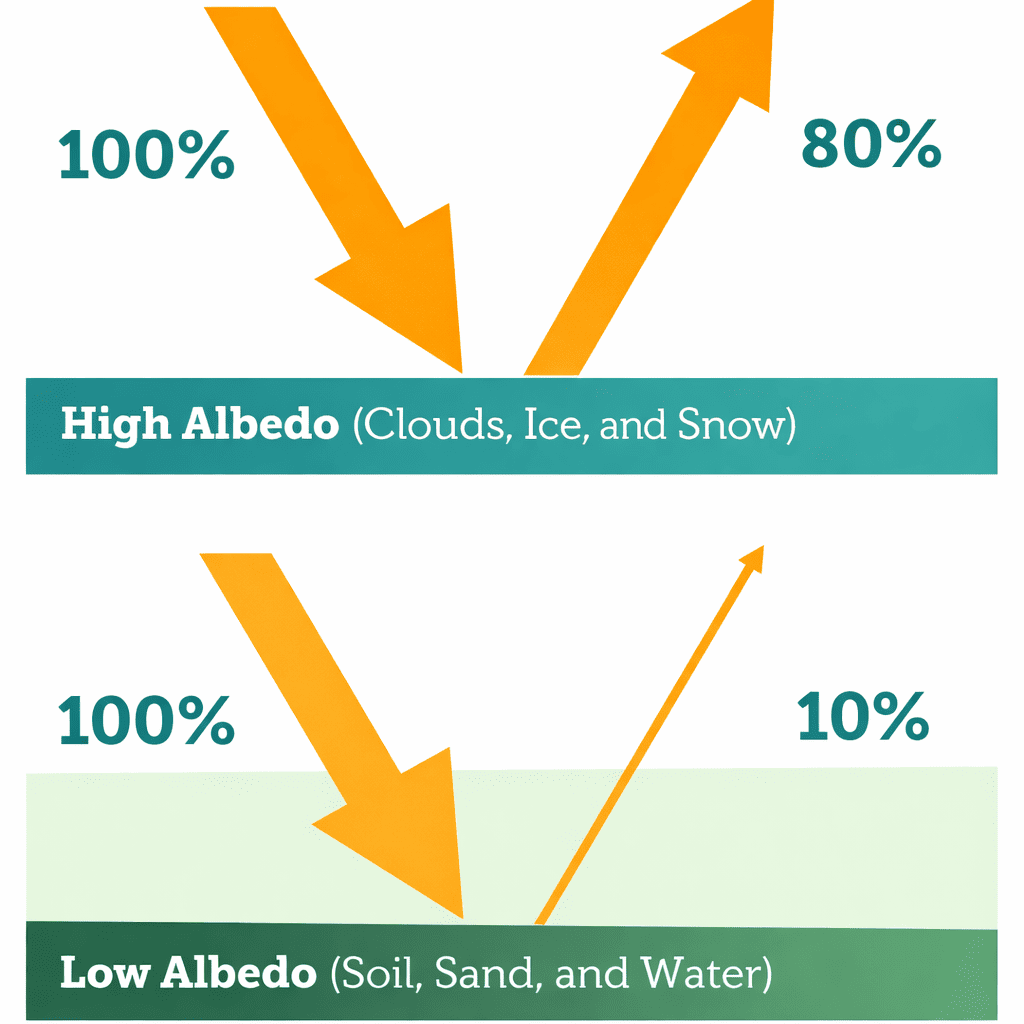
Typical albedo values :
| Surface type | Typical albedo value |
|---|---|
| Grass or normal soil | 0.18 to 0.25 |
| Concrete or light coloured ground | 0.40 to 0.60 |
| White painted surface | 0.60 to 0.80 |
| Snow covered surface | 0.80 to 0.90 |
Types of Bifacial Solar Panels
Main types are
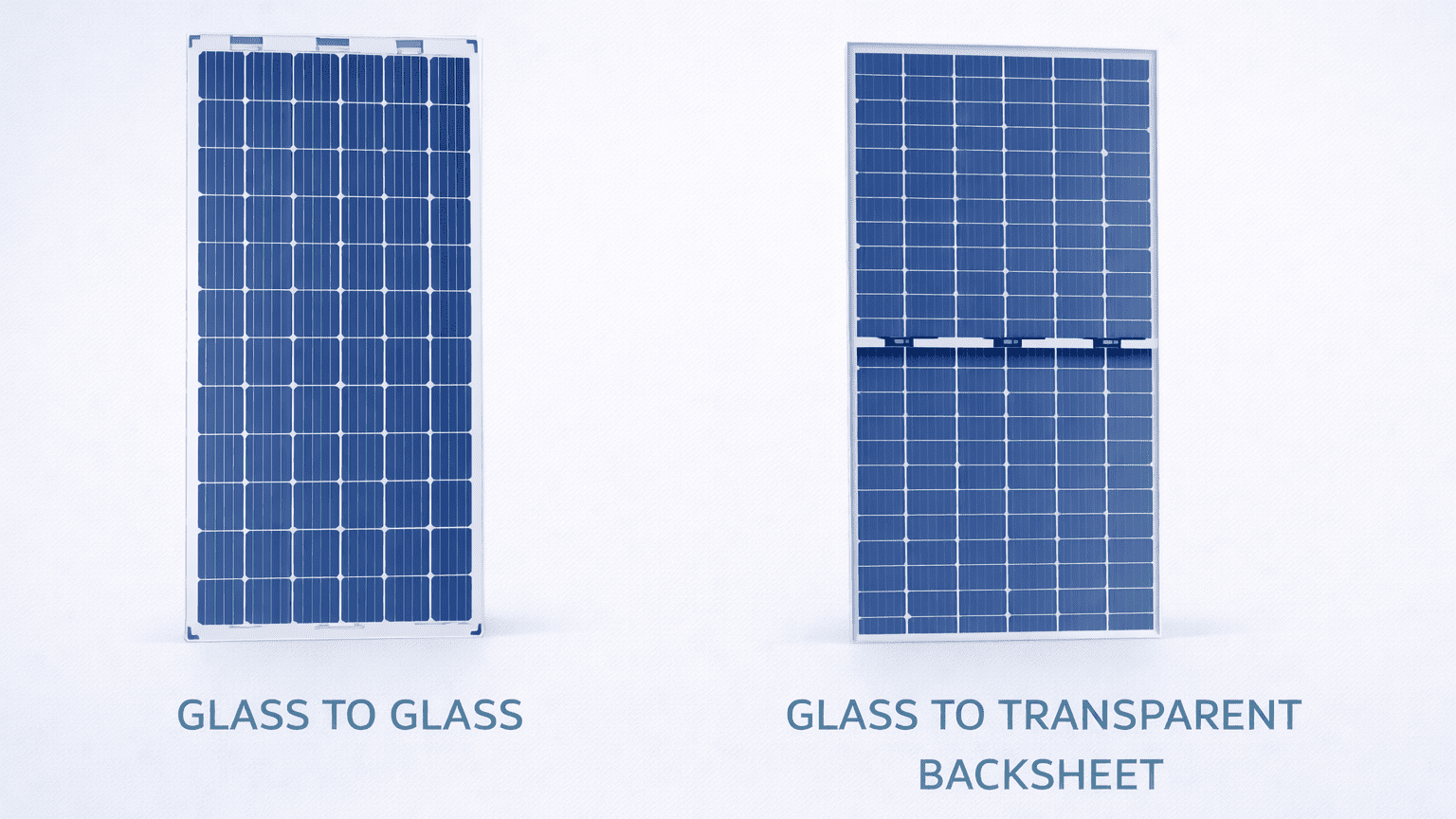
• Glass to glass bifacial module
• Glass to transparent backsheet bifacial module
1. Glass–Glass (G2G)
In this type, tempered glass is used on both the front and rear sides of the panel. It provides high mechanical strength, better weather resistance and excellent light transmission to the rear side. Glass–glass modules are more durable and reliable and are widely used in large solar power plants.
2. Glass–Backsheet (G2B)
This construction uses glass on the front side and a transparent polymer backsheet on the rear side. It is lighter in weight and lower in cost compared to glass–glass modules. However, its long term durability is slightly lower than G2G type.
3. Hybrid designs
Hybrid bifacial panels combine features of both constructions. They usually have a glass front with a specially designed transparent polymer backsheet at the rear. The aim is to achieve a balance between cost, weight and mechanical strength while still allowing rear side power generation.
Advantages of Bifacial Solar Panels
- Higher energy yield
- Better performance in high reflective areas
- Longer life due to glass construction
- Better thermal and mechanical stability
Disadvantages of Bifacial Solar Panels
- Higher initial cost
- Installation complexity
- Not suitable for all rooftops
- Output depends heavily on ground reflectivity
Applications of Bifacial Solar Panels
- Solar power plants
- Ground mounted solar projects
- Car parking sheds
- Industrial rooftops with reflective surfaces
- Floating solar systems
Related Posts: Types of Solar Panels
Installation Requirements for Bifacial Solar Panels
The installation design of bifacial solar panels is more critical than that of conventional monofacial panels because the rear surface also participates in power generation. Proper mounting geometry, surface treatment and shading control directly influence the achievable rear side gain.
Mounting height
Mounting height refers to the vertical distance between the lower edge of the panel and the ground or reflective surface.
In practice, bifacial systems are usually installed at a height of 0.8 m to 1.5 m above the ground.
Field studies and commercial projects show that increasing the mounting height from about 0.5 m to 1.2 m can improve rear side irradiance by 3 to 8 percent, because a larger portion of reflected light reaches the rear surface and self shading by the structure is reduced.
For tracker based systems, higher clearance is often used to limit shading of the rear surface by torque tubes and mounting beams.
Tilt angle
The tilt angle must be selected to optimise both the front side irradiance and the collection of reflected light at the rear side. In most fixed tilt installations, the optimum tilt angle is close to the site latitude and typically lies in the range of 15° to 30° for many regions in India and other tropical locations.
For bifacial systems, simulations show that slightly higher tilt angles, typically 5° to 10° more than monofacial designs, can increase rear side contribution by allowing better visibility of the reflective ground. However, the front side output should not be sacrificed excessively, and therefore a combined optimisation is normally performed.
Ground surface preparation
Ground surface reflectivity, also known as albedo, is one of the most important parameters for bifacial installations.
Typical albedo values are
- Natural soil and grass: 0.18 to 0.25
- Light coloured gravel or concrete: 0.40 to 0.60
- White coated surfaces or reflective membranes: 0.60 to 0.80
Changing the ground from natural soil to a light coloured gravel or concrete surface can increase the rear side gain by 4 to 10 percent, depending on mounting height and row spacing. In utility scale projects, reflective ground treatment is often used only below the panel rows to improve cost effectiveness.
Shadow free rear side
The rear surface of a bifacial panel must be protected from shading by mounting structures, cable trays, junction boxes, nearby rows and site equipment. Even partial shading of the rear surface can reduce rear side contribution significantly. In practical installations, rear side shading losses of only 10 to 15 percent of the rear irradiance can reduce the overall bifacial gain by 2 to 5 percent.
Therefore, structures such as torque tubes and beams are usually designed with minimum cross section or placed in positions that limit their obstruction of reflected light. Row spacing is also selected carefully so that shadows from the front row do not block the reflected light field for the rear side of the next row.
Overall practical impact
When bifacial panels are installed with
- Mounting height around 1.0 to 1.2 m,
- Tilt angle properly optimised for both sides,
- Ground albedo improved to at least 0.4, and
- Minimal rear side shading,
the typical additional annual energy yield obtained from the rear side is in the range of 8 to 15 percent, and in well engineered installations it can reach up to 20 to 30 percent.
Bifacial Solar Panel Efficiency
Bifacial solar panel efficiency refers to the total electrical output obtained from both the front and rear sides of the same solar module. The final energy produced depends on how efficiently the front side converts direct sunlight and how much additional energy is obtained from the rear side using reflected light.
Front side efficiency
Front side efficiency is the conversion efficiency of the front surface of a bifacial panel under standard test conditions.
In modern bifacial modules, this value is typically 20 percent to 22.5 percent. It is almost the same as a high quality monofacial panel and contributes the major portion of total power.
Rear side gain
Rear side gain is the extra energy generated by the rear surface of the bifacial panel due to reflected and scattered light.
In practical installations, the rear side gain is usually 8 percent to 15 percent, and in well designed systems it can reach up to 30 percent. This gain depends strongly on mounting height, tilt angle, row spacing and ground reflectivity.
Bifaciality factor
The bifaciality factor indicates how efficiently the rear side of the cell works compared to the front side. It is defined as the ratio of rear side power to front side power under the same irradiance. Commercial bifacial modules normally have a bifaciality factor of 70 percent to 90 percent. This means that if the front side produces 100 W, the rear side can produce 70 W to 90 W under identical light conditions.
Effect of reflected light
Reflected light, also known as the albedo effect, has a major influence on bifacial panel efficiency. Surfaces with higher reflectivity send more light to the rear side of the panel and increase rear side output.
Typical surface reflectivity values are –
- 0.18 to 0.25 for soil or grass
- 0.40 to 0.60 for concrete or light coloured ground
- 0.60 to 0.90 for white surfaces and snow.
Higher albedo directly increases rear side irradiance and improves the overall energy yield of bifacial solar panels.
Bifacial Solar Panel Performance in India
Bifacial solar panels perform very well in India because the country has high solar potential, long sunshine hours and large open land areas, which are favourable for rear side light collection and higher energy yield.
Climatic conditions
India receives strong and consistent solar radiation for most of the year. The average daily solar radiation in most parts of the country lies between 4.0 and 6.5 kWh per square metre per day. Hot and dry climatic conditions, especially in western and central India, create excellent operating conditions for bifacial panels because the ground remains bright and dust free surfaces can be maintained more easily. However, proper cleaning and maintenance are important in dusty and semi arid regions to avoid loss of reflectivity and front side soiling.
High solar irradiation zones
Regions with the highest solar irradiation in India include Rajasthan, Gujarat, Maharashtra, Madhya Pradesh, Telangana, Andhra Pradesh and parts of Karnataka. These areas typically receive annual global horizontal irradiation of about 1,900 to 2,200 kWh per square metre. Such high irradiation levels allow bifacial modules to generate strong front side output while also benefiting from rear side gain when installed over suitable ground surfaces.
Suitable regions and sites
Bifacial solar panels are especially suitable for large ground mounted solar parks, desert and semi desert regions, industrial zones, and solar projects with reflective surfaces such as concrete or light coloured gravel. Locations with open land, good row spacing and the possibility of improving surface reflectivity provide the highest bifacial gains. In India, utility scale solar plants in Rajasthan and Gujarat, floating solar projects in reservoirs, and large industrial rooftops with light coloured surfaces are among the most suitable sites for bifacial installations.
Bifacial Solar Panel Cost in India
Bifacial solar panels are becoming more popular in the Indian market because they can deliver extra energy yield compared to conventional monofacial modules. However, the cost structure is a bit different, and several factors affect the final investment.
Approximate Price Range (India)
The cost of bifacial solar panels depends on brand, cell technology, and module power rating. In India (2025–26):
| Item | Typical Price Range |
|---|---|
| Bifacial solar panel (per watt) | ₹22 to ₹35 / W |
| Monofacial solar panel (per watt) | ₹18 to ₹25 / W |
| Bifacial panel module (higher tier brands) | ₹30+ / W |
So bifacial modules are generally 10–25% more expensive than comparable monofacial panels.
Factors Affecting Cost
Several elements influence the total cost of a bifacial solar project.
- Module type & quality: Premium bifacial modules (high bifaciality factor, better efficiency) typically cost more. Higher warranty and brand reputation also push prices up.
- Power rating: Higher wattage panels cost more per module but may reduce balance-of-system costs per watt.
- Mounting & structure: Bifacial panels require careful mounting to allow rear side light access. This means stronger mounting structures and more design work, increasing costs.
- Ground reflectivity preparation: Improving ground reflectivity (e.g., concrete, light gravel, reflective coatings) adds to site preparation costs but improves output.
- Tracking systems: Adding solar trackers (which follow the sun) can boost rear side generation but increases both equipment and installation labor costs.
- Freight & logistics: Bifacial modules are heavier (e.g., glass–glass type), so transportation and handling costs are slightly higher.
Installation and Structure Cost (India)
Below is a simple cost summary table for a typical 1 MW ground mounted bifacial solar project:
| Cost Component | Approx. Cost Range (₹ per MW) |
|---|---|
| Bifacial panels | ₹2.0 Cr to ₹2.8 Cr |
| Mounting structure (with clearance) | ₹0.4 Cr to ₹0.7 Cr |
| Site work & ground preparation | ₹0.1 Cr to ₹0.3 Cr |
| Electrical & trackers | ₹0.3 Cr to ₹0.6 Cr |
| Civil & fencing | ₹0.1 Cr to ₹0.2 Cr |
| Miscellaneous (design, permits) | ₹0.05 Cr to ₹0.15 Cr |
Total estimated cost for 1 MW bifacial installation: ₹2.9 Cr to ₹4.7 Cr
*Prices can vary widely based on location, tariff negotiations, taxes, and local labor costs.
Is Bifacial Solar Panel Worth It?
Whether a bifacial solar panel is worth investing in mainly depends on the type of project and the installation conditions. Bifacial panels are designed to generate electricity from both the front and the rear sides, which allows them to produce more energy than conventional panels when installed correctly.
For residential projects
In most residential rooftop systems, the rear side of the panel receives very little reflected light because of low mounting height, limited spacing and dark roof surfaces. As a result, the additional energy gained from the rear side is usually small, often below 5 percent. Since bifacial panels are also slightly more expensive, they are generally not the most cost effective option for small residential rooftops, unless the roof is highly reflective and the system is specially designed.
For commercial and industrial projects
In commercial and industrial installations, especially on large flat roofs with white coating or metal sheets, bifacial panels can perform better. The higher mounting height and more reflective surfaces can provide a rear side gain of about 5 to 10 percent. In such cases, bifacial panels can be a good investment, particularly when space is limited and higher energy yield from the same area is important.
For utility scale solar power plants
Bifacial panels are most beneficial in large ground mounted solar projects. Open land, proper row spacing, higher mounting structures and the possibility of improving ground reflectivity allow the rear side to contribute significantly. In well designed utility scale plants, bifacial systems typically deliver 8 to 15 percent higher annual energy output, and in some optimized sites the gain can reach up to 20 percent or more. For this reason, bifacial technology is generally considered worthwhile and economically attractive for utility scale solar installations.
Future of Bifacial Solar Panels
Bifacial solar panels have a strong future because they can generate 8 to 15 percent more energy than conventional panels in properly designed systems.
With improving cell technologies, higher bifaciality factors and falling manufacturing costs, bifacial modules are becoming the preferred choice for large utility scale solar projects, especially in high irradiation countries like India.