Oil Circuit Breaker
In an oil circuit breaker, insulating oil (such as transformer oil) is used as the arc-quenching medium. The contacts are separated while immersed in oil and, during separation, an electric arc is formed between the contacts.
The high temperature of the arc causes the surrounding oil to evaporate and decompose, producing a large quantity of hydrogen gas at high pressure. The volume of the gas generated is nearly one thousand times the volume of the oil that is decomposed.
Due to this rapid gas formation, the oil is forced away from the arc region and an expanding bubble of hydrogen gas surrounds the arc and the adjacent portions of the contacts. This hydrogen-rich atmosphere helps in cooling and de-ionizing the arc, thereby assisting in its extinction.
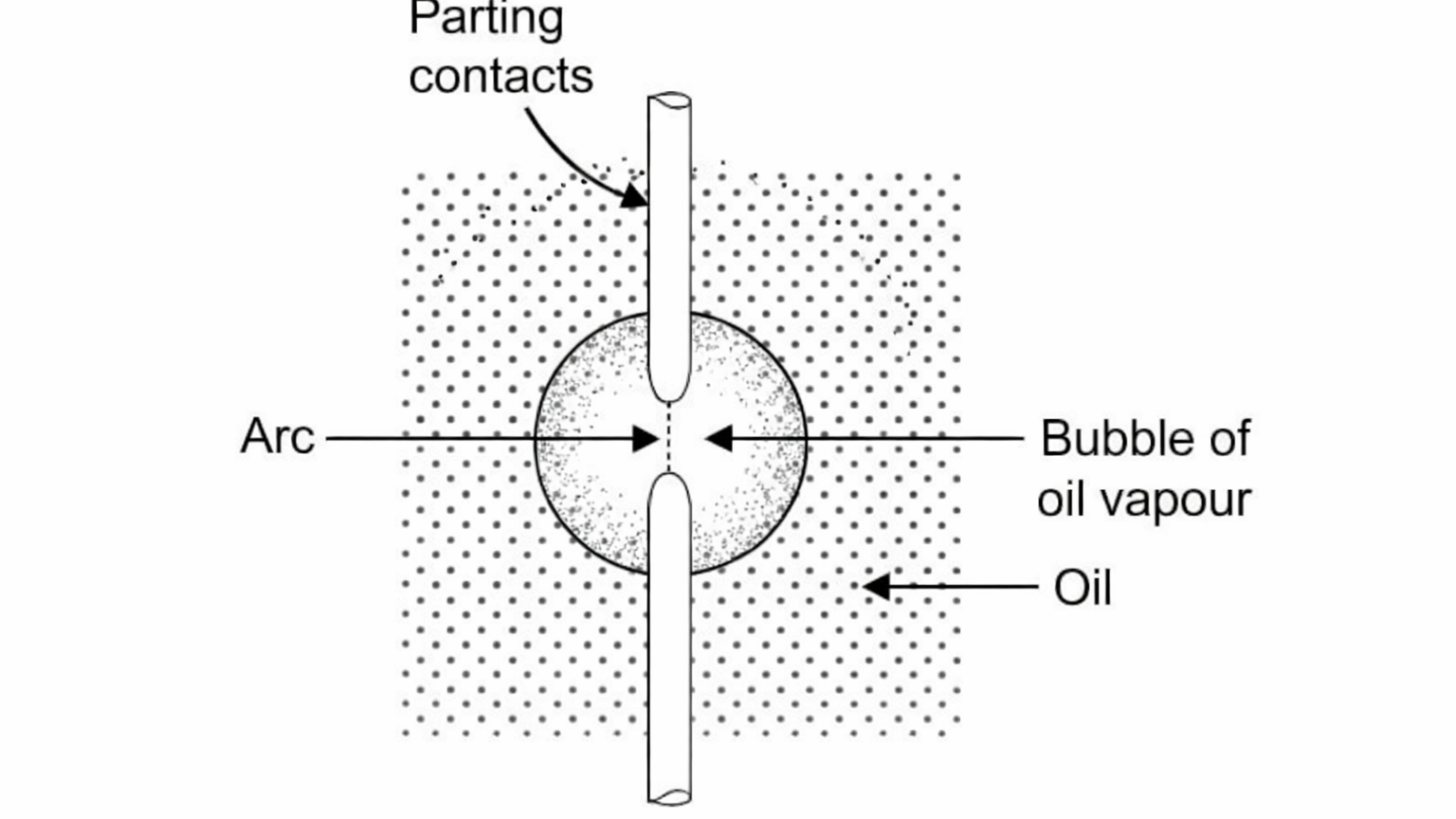
Arc extinction in an oil circuit breaker is mainly achieved by two mechanisms. First, the hydrogen gas produced due to the decomposition of oil has very high thermal conductivity. It rapidly removes heat from the arc column and thereby helps in the cooling and de-ionisation of the medium between the contacts.
Second, the high-pressure gas creates strong turbulence in the surrounding oil and forces fresh oil into the contact gap. This action removes the hot and ionised particles from the arc path. As a result of these two processes, the arc is extinguished and the circuit current is successfully interrupted.
Types of Oil Circuit Breakers
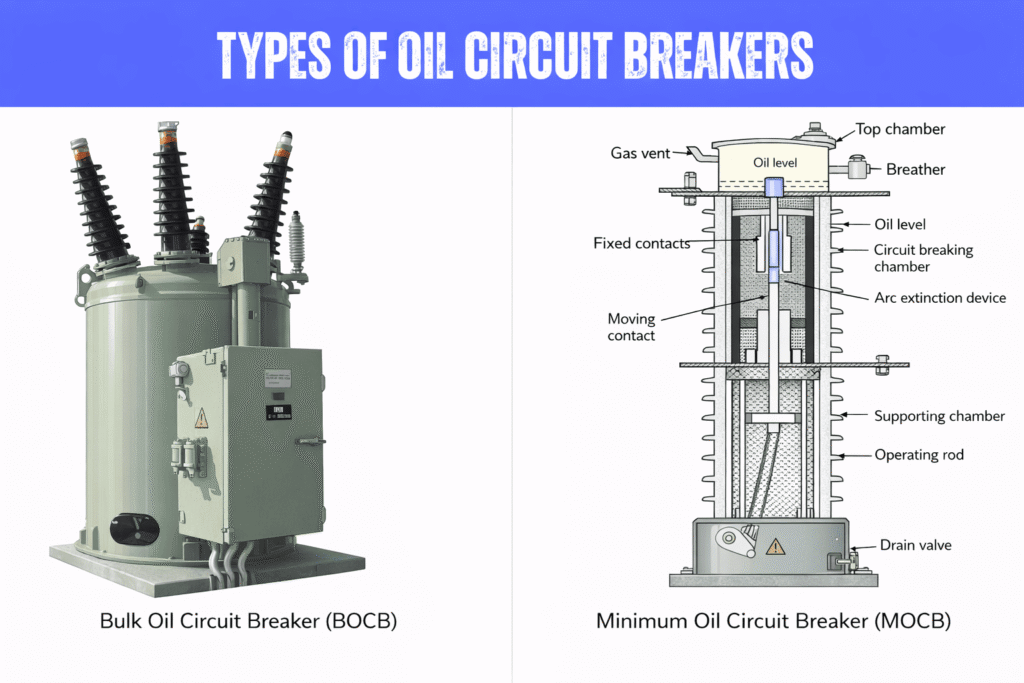
Oil circuit breakers are mainly classified into the following two types:
(i) Bulk oil circuit breaker (BOCB)
In this type, a large quantity of oil is used. The oil acts both as the arc-quenching medium and as the main insulating medium between live parts and earth.
(ii) Low oil (Minimum oil) circuit breaker (MOCB)
In this type, only a small quantity of oil is used and it is confined to the arc-interruption chamber. Insulation is mainly provided by solid insulating materials.
Related Posts: Sulphur Hexafluoride (SF₆) Circuit Breaker
Bulk Oil Circuit Breaker (BOCB)
A bulk oil circuit breaker is a type of circuit breaker in which a large quantity of insulating oil is used both for arc extinction and for insulation between live parts and the earthed tank.
Construction of a Bulk Oil Circuit Breaker
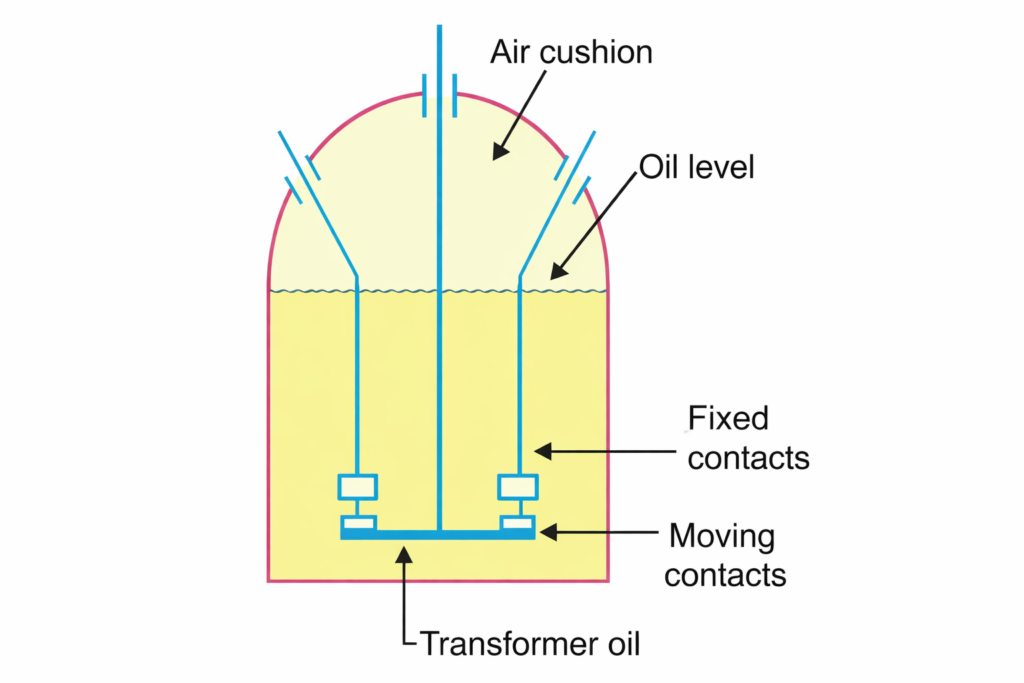
A bulk oil circuit breaker consists of a steel tank completely filled with transformer oil, in which the fixed and moving contacts are immersed. The oil serves two purposes: it acts as the arc-quenching medium and also provides insulation between the live parts and the earthed tank. The contacts are brought into the tank through insulated leads, and the moving contact is operated by a mechanical operating mechanism.
An oil level is maintained above the contact system, and an air cushion is provided at the top of the tank to accommodate the gases produced during interruption and the thermal expansion of oil. The large quantity of oil surrounding the contacts ensures adequate insulation from earth as well as effective arc control.
Operation of a Bulk Oil Circuit Breaker
Under normal operating conditions, the moving contact remains in contact with the fixed contact and current flows through the breaker. When a fault occurs, the operating mechanism separates the contacts and an arc is formed under oil. The intense heat of the arc vaporises and decomposes the surrounding oil, producing a large amount of high-pressure hydrogen gas.
This rapidly expanding gas pushes the oil away from the arc and forms a gas bubble around the contact gap. The hydrogen gas, due to its high thermal conductivity, cools the arc and promotes de-ionisation, while the turbulent motion of oil removes the hot and ionised particles from the arc path. At the next current zero, the dielectric strength between the contacts rises quickly and the arc is extinguished, thereby interrupting the circuit.
Advantages of Bulk Oil Circuit Breaker
- Oil provides both arc-quenching and insulation.
- Oil has high dielectric strength.
- The oil absorbs a large amount of arc energy during interruption.
- Gases produced by oil decomposition give effective cooling of the arc.
- Construction is simple and well-proven.
- Suitable for medium and high voltage applications.
Disadvantages of Bulk Oil Circuit Breaker
- Requires a large quantity of oil.
- High fire and explosion risk due to the presence of oil.
- Needs large space for installation.
- High maintenance because oil gets contaminated and carbonized.
- Slower operation compared to modern circuit breakers (VCB and SF₆).
Applications of Bulk Oil Circuit Breaker
- Used in medium and high voltage substations.
- Used for feeder protection.
- Used for transformer protection.
- Used for generator protection.
- Used in older transmission and distribution systems where oil circuit breakers were standard.
Minimum Oil Circuit Breaker (MOCB)
A minimum oil circuit breaker (MOCB) is a type of oil circuit breaker in which a small quantity of insulating oil is used only in the interrupting chamber for arc extinction. Unlike bulk oil circuit breakers, where a large volume of oil is required for both insulation and arc quenching, a minimum oil circuit breaker employs solid insulating materials for insulation and uses oil only where it is essential for interrupting the arc.
The main objective of a minimum oil circuit breaker is to reduce the amount of oil, thereby decreasing the size, weight, fire risk and maintenance requirements of the circuit breaker, while still providing effective arc-quenching performance. Minimum oil circuit breakers are widely used in medium and high voltage power systems and typically cover voltage ratings from 3.3 kV up to about 400 kV.
Construction of Minimum Oil Circuit Breaker
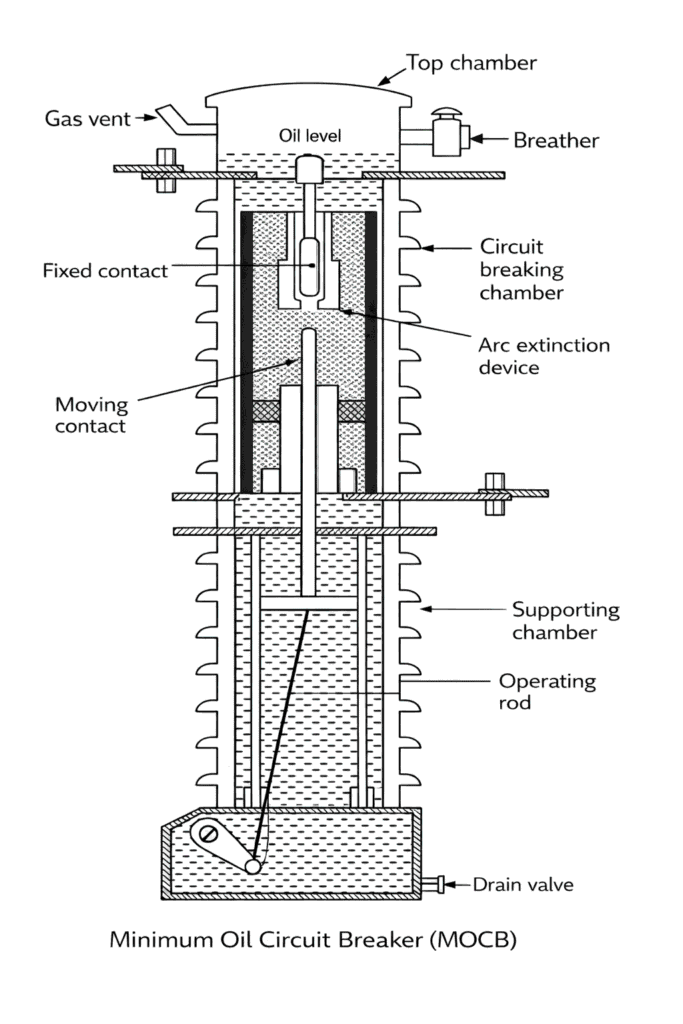
A minimum oil circuit breaker is provided with two separate oil-filled compartments. The upper compartment is the circuit-breaking chamber, while the lower compartment forms the supporting chamber. Both chambers contain oil, but the oil in each chamber is completely isolated from the other by a partition.
This arrangement offers two important advantages.
First, the circuit-breaking chamber requires only a small quantity of oil, which is sufficient for arc extinction.
Second, since the oil in the supporting chamber is not exposed to the arc, it does not become contaminated, thereby reducing the quantity of oil that needs to be replaced during maintenance.
i) Supporting chamber
The supporting chamber is a porcelain enclosure mounted on a metal housing. It is filled with oil that is physically separated from the oil in the circuit-breaking chamber. The oil in this chamber, together with the annular space between the porcelain insulation and the bakelised paper, is used only for insulation purposes.
ii) Circuit-breaking chamber
The circuit-breaking chamber is a porcelain enclosure mounted above the supporting chamber. It is filled with oil and contains the main interrupting components, namely:
- upper and lower fixed contacts,
- a moving contact, and
- a turbulator.
The moving contact is hollow and incorporates a cylindrical portion that slides over a fixed piston during operation. The turbulator is an arc-control device provided with both axial and radial vents. Axial venting assists in the interruption of low currents, whereas radial venting is used to interrupt high fault currents.
iii) Top chamber
The top chamber is a metal enclosure mounted above the circuit-breaking chamber. It provides an expansion space for the oil in the circuit-breaking chamber. A separator is also provided in the top chamber to prevent loss of oil due to centrifugal action during circuit-breaker operation under fault conditions.
Operation of Minimum Oil Circuit Breaker
Under normal operating conditions, the moving contact remains in contact with the upper fixed contact. When a fault occurs, the moving contact is pulled downward by the tripping springs and an electric arc is formed between the fixed and moving contacts.
The energy of the arc vaporises the surrounding oil and produces high-pressure gases. This pressure forces the oil to flow through the central opening in the moving contact and then through the respective passages of the turbulator.
The process of turbulation takes place in an orderly manner. The arc is divided into several sections and each section is successively quenched by separate high-velocity streams of oil flowing across it. These oil streams also carry away the hot gases produced by the arc, thereby extinguishing the arc effectively.
Advantages of Minimum Oil Circuit Breaker
- Requires less quantity of oil compared to bulk oil circuit breakers.
- Occupies smaller space, resulting in compact construction.
- Maintenance requirement is lower because a smaller volume of oil is used.
- Cost per breaking capacity (MVA) is lower, making it economical for medium and high voltage applications.
- Suitable for both manual and automatic operation.
Disadvantages of Minimum Oil Circuit Breaker
- The risk of fire and explosion still exists because oil is used as the arc-quenching medium.
- The oil is subject to contamination and carbonization due to repeated arcing, which reduces its insulating and arc-quenching properties.
- Regular oil testing and replacement are required to maintain reliable operation.
- The construction is more complicated than air and vacuum circuit breakers.
- The interrupting performance deteriorates if the oil quality is not properly maintained.
Applications of Minimum Oil Circuit Breaker
- Used in distribution and sub-transmission systems.
- Used for feeder protection in substations.
- Used for transformer protection.
- Used for transmission line protection.
- Employed in industrial and utility power systems where moderate to high breaking capacity is required.
Maintenance of Oil Circuit Breakers
Regular maintenance of oil circuit breakers is essential to ensure reliable operation and adequate breaking capacity. During fault interruption and repeated load switching, the contacts are subjected to arcing and may become worn or damaged. At the same time, the insulating oil may lose its dielectric strength due to carbonisation and contamination. If these effects are not corrected, the interrupting performance of the breaker is reduced. Therefore, periodic inspection (typically at intervals of about 3 to 6 months, depending on service conditions) is necessary.
The following checks are normally carried out during maintenance:
- Current-carrying parts and contacts should be inspected for burning, pitting or excessive wear. Damaged parts must be replaced.
- Dielectric strength of the oil should be tested. If the oil shows discolouration or deterioration, it should be filtered, reconditioned or replaced. In good condition, the oil should withstand the specified test voltage (for example, about 30 kV for one minute with a 4 mm electrode gap).
- Insulating parts and internal surfaces should be examined for cracks, tracking or carbon deposits. All deposits must be removed and the surfaces cleaned with a dry, clean cloth.
- Oil level inside the tank must be checked and corrected if required.
- Closing and tripping mechanisms should be inspected to ensure correct operation and proper mechanical alignment.
Proper and periodic maintenance helps in maintaining the dielectric strength of the oil, prevents contact failures and ensures dependable operation of oil circuit breakers.