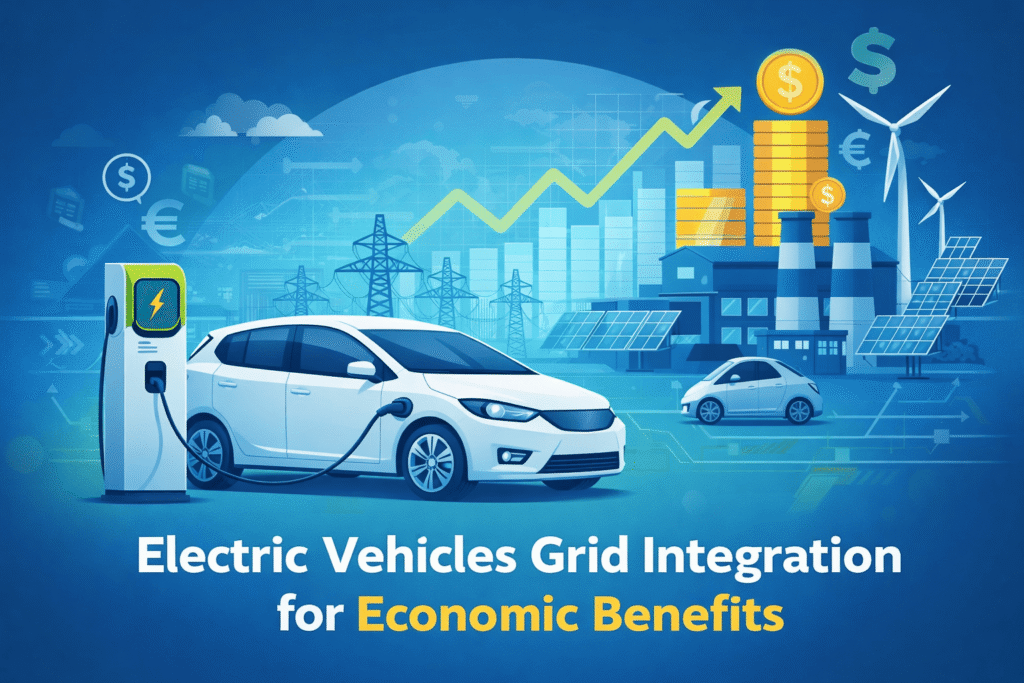
Electric Vehicles (EVs) are no longer only transportation devices, they are emerging as flexible and distributed energy resources that can actively support modern power systems. By intelligently coordinating EV charging and discharging with the power grid, multiple stakeholders in the electricity sector can obtain significant economic and operational benefits.
This article explains how EVs are integrated into the grid and how economic benefits are created for different participants such as generation companies, distribution operators, aggregators, and end users, based on a comprehensive review of recent research.
Concept of EV Grid Integration
The core idea is to treat EVs as controllable electrical loads and, in some cases, as mobile energy storage systems through Vehicle-to-Grid (V2G) operation.
Depending on the market structure and control architecture, EVs can be coordinated by an aggregator or directly by system operators to provide services such as:
- demand shifting,
- peak reduction,
- reserve support,
- and renewable energy balancing.
The overall framework links all major power-system participants to a common objective: economic benefit creation.
Overall Framework for Economic Benefits
The following diagram is illustrates how economic benefits are generated through coordination among the main actors.
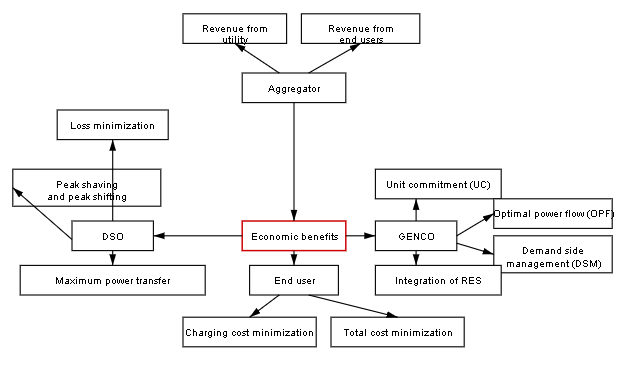
Description of the diagram
- GENCO (Generation Company)
Applies scheduling and operational tools such as:- Unit Commitment (UC)
- Optimal Power Flow (OPF)
- Integration of Renewable Energy Sources (RES)
- DSO (Distribution System Operator)
Focuses on:- peak shaving and peak shifting
- loss minimization
- network constraint management
- Aggregator
Acts as an intermediate entity that coordinates a large number of EVs and provides grid services. - End User (EV owner)
Targets:- charging cost minimization
- total electricity cost reduction
All these entities contribute to and benefit from the central objective of economic benefits.
The grid-integration framework connects four main actors generation companies, distribution operators, aggregators, and end users through coordinated charging and vehicle-to-grid operation. Economic benefits are achieved when EV flexibility is used to optimize generation scheduling, reduce network stress, support renewable energy sources, and minimize charging and operational costs across the system.
Economic Benefits for Generation Companies (GENCOs)
For generation companies, coordinated EV charging and V2G operation improve generation scheduling and reduce operating costs.
Major benefit mechanisms include:
- improved unit commitment decisions,
- better utilization of renewable generation,
- reduced reliance on expensive peak generators,
- improved spinning reserve management.
Table I Grid integration of EV: economic benefits for GENCO
| Performance objective | Solving method / algorithm used | UC | Integration of RES | DSM | OPF | V2G capability |
|---|---|---|---|---|---|---|
| Generation cost and emission minimization | Particle swarm optimization | Yes | Yes | No | No | No |
| Total operation cost and emission minimization | Fireworks algorithm | Yes | Yes | No | No | Yes |
| Total cost minimization | Mixed-integer linear programming | Yes | Yes | No | No | Yes |
| Grid operation cost minimization | Mixed-integer programming | SCUC | Yes | No | No | Yes |
| Total cost of generation minimization | Non-convex optimization | Yes | No | No | No | Spinning reserve |
| Generation cost and emission minimization | Mixed-integer linear programming | Yes | Yes | No | No | Spinning reserve |
| Total cost of system minimization | Simulated annealing algorithm | Yes | No | No | No | Spinning reserve |
| Generation cost minimization | Game theory | No | No | Valley filling | No | No |
| Optimal control for valley filling | Convex optimization | No | No | Valley filling | No | No |
| Generation cost minimization | Maximum sensitivities selection optimization | No | No | Valley filling | No | No |
| Demand fulfillment in microgrid | Game theory | No | Yes | Load shifting | No | Yes |
| Generation cost minimization | Convex optimization | No | No | Valley filling | Yes | No |
| Generation cost minimization | Lagrange multiplier | No | No | No | Security-constrained OPF (SCOPF) | No |
| System-wide generation cost minimization | Linear optimization | No | No | Valley filling | Yes | No |
| Frequency control | Simulation study | No | Yes | No | No | Frequency regulation |
| Total operation cost minimization | Monte-Carlo simulations | No | Yes | No | No | Yes |
| Financial cost of supply minimization | Evolutionary optimization | No | Yes | No | No | Yes |
| Wind integration cost minimization | Rolling-horizon algorithm | Yes | Yes | Yes | No | No |
| Wind power mismatch and V2G cost minimization | Genetic algorithm coupled with Monte-Carlo simulation | No | Yes | No | No | Yes |
| Expected cost minimization | Stochastic programming | No | Yes | No | No | Yes |
| Generation cost and emission minimization | Linear optimization | No | Yes | No | No | Frequency regulation |
| Viability VPP formation | Linear programming | No | Yes | No | No | Yes |
| Frequency control | Simulation study | No | Yes | No | No | Yes |
By allowing EVs to absorb excess renewable generation and supply power during high-price periods, GENCOs can lower fuel costs and reduce start-up and shut-down operations of thermal units.
For generation companies, coordinated EV operation helps improve unit commitment and optimal power flow decisions. EVs absorb excess renewable energy and reduce the need for expensive peak generation, which lowers fuel consumption, reduces generator start-ups and shutdowns, and improves the overall efficiency and profitability of power generation.
Economic Benefits for Distribution System Operators (DSOs)
Distribution operators benefit mainly through reduced network congestion, lower technical losses, improved voltage profiles, and better utilization of existing infrastructure. Smart and coordinated charging enables peak shaving and peak shifting, which delays costly network upgrades and improves the reliability of the distribution system. Distribution networks are highly affected by uncoordinated EV charging. Research shows that controlled charging and V2G significantly improve network performance.
Table II Grid integration of EV: economic benefits for DSO
| Performance objective | Solving method / algorithm used | Loss minimization | DSM | Maximum power transfer | V2G capability |
|---|---|---|---|---|---|
| Grid energy loss minimization | Maximum sensitivities selection optimization | Yes | Valley filling | No | No |
| Voltage profile improvement | MATLAB based algorithm | Yes | Peak shaving | No | No |
| Charging maximization and cost minimization | Linear optimization | Yes | No | No | – |
| PHEV impact minimization | Heuristic or sequential method | Yes | No | Yes | No |
| Power loss and charging cost minimization | Multi-objective particle swarm optimization | Yes | No | No | No |
| PEV charging impact estimation | General algebraic modelling system | Yes | No | No | No |
| Total energy consumption and PAR minimization | Game theory | No | Peak shaving | No | No |
| Peak power demand minimization | Linear and convex optimization | No | Peak shaving | No | Yes |
| Peak demand minimization | Two-stage V2G control algorithm | No | Peak shaving | No | Yes |
| Electricity demand cost minimization | Proposed control algorithm | No | Peak shaving | No | No |
| Total energy cost and peak demand minimization | Game theory | No | Peak shaving | No | Yes |
| EWH power consumption control | MATLAB simulation | No | Peak shaving | No | No |
| PHEV impact assessment | MATLAB simulation | No | Peak shifting, load shedding | No | No |
| Distribution transformer utilization improvement | Proposed control algorithm | No | Peak shifting | No | No |
| Load curve flattening of LVT | Convex optimization | No | Peak shaving | No | No |
| Cost minimization | Heuristic-based | No | Load shedding | No | No |
| Maximize power delivered to EV | Linear programming | No | No | Yes | No |
| Grid congestion minimization | Sequential quadratic programming | No | No | Yes | No |
| Congestion prevention | Lagrange multiplier | No | No | Yes | No |
Main benefits for DSOs include:
- reduction of feeder and transformer overloading,
- minimization of distribution losses,
- voltage profile improvement,
- peak shaving and peak shifting.
Through coordinated charging strategies, DSOs can defer expensive grid reinforcement investments while maintaining reliable operation integration.
Economic Benefits for Aggregators
Aggregators manage large fleets of EVs and participate in electricity and ancillary service markets on behalf of EV owners. By optimally scheduling charging and discharging, aggregators can earn revenue from energy trading, frequency regulation, and reserve services, while also ensuring that users’ mobility requirements are satisfied. An aggregator manages a fleet of EVs and participates in electricity and ancillary service markets on their behalf.
Table III Grid integration of EV: economic benefits aggregator
| Performance objective | Solving method / algorithm used | V2G capability | Ancillary service |
|---|---|---|---|
| Aggregator revenue maximization | Linear programming | Yes | Frequency regulation |
| Aggregator revenue maximization | Linear programming | Yes | Spinning reserve and frequency regulation |
| Aggregator profit maximization | Mixed-integer linear programming | Yes | Frequency regulation |
| Aggregator profit maximization | Stochastic linear programming | Yes | Frequency regulation |
| Online scheduling of EV | Convex optimization | Yes | Frequency regulation |
| Regulation quality improvement | Convex optimization | Yes | Frequency regulation |
| Energy trading profile maximization | Scheduling and dispatching algorithm | No | No |
| Aggregator revenue maximization | MILP model and heuristic algorithm | Yes | Frequency regulation |
| Aggregator revenue maximization | Dynamic programming | Yes | Frequency regulation |
| Charging discharging cost minimization | Linear and quadratic optimization | Yes | No |
| Charging cost minimization of PHEV | Mixed-integer linear programming | No | No |
| Energy trading cost minimization | Mixed-integer programming | Yes | No |
| Total electricity cost minimization | Linear programming | Yes | No |
| Aggregator revenue risk management | Lagrange relaxation | Yes | No |
| Aggregator revenue maximization | Linear programming | Yes | Frequency regulation |
| Aggregator profit maximization and charging cost minimization | Heuristic dynamic optimization | Yes | No |
| EV user cost minimization | Quadratic programming | Yes | Frequency regulation |
| Social welfare maximization | Dynamic programming | No | No |
| Cost of electricity for PHEV minimization | k-nearest neighbors (kNN) classification | No | No |
| Aggregator revenue maximization | Mixed-integer linear programming | Yes | No |
Key benefits include:
- revenue from frequency regulation and reserve markets,
- profit from energy arbitrage,
- optimized charging schedules across multiple EV owners.
Advanced scheduling and bidding strategies allow aggregators to maximize revenue while respecting user mobility constraints and battery limitations.
Economic Benefits for End Users (EV Owners)
End users mainly benefit through reduced charging costs and lower total electricity bills. By charging during low-price periods and participating in vehicle-to-grid programs, EV owners can receive financial incentives without affecting their daily travel needs, provided that smart charging strategies are applied. From the user perspective, EV grid integration mainly focuses on reducing charging and energy costs.
Table IV Grid integration of EV: economic benefits for end user
| Performance objective | Solving method / algorithm used | V2G capability |
|---|---|---|
| PEV charging impact estimation | General algebraic modelling system | No |
| Charging cost minimization | Heuristic method | No |
| Charging cost minimization | Linear and quadratic approximation | No |
| Charging cost minimization | Quadratic programming | No |
| Total cost of fuel and electricity minimization | Multi-objective genetic algorithm | No |
| Total charging cost minimization | Convex optimization | Yes |
| Total charging cost minimization | Electricity price based control algorithm | Yes |
| EV profit maximization | Non-linear programming | Yes |
| Total charging cost minimization | Proposed price based algorithm | Yes |
| Daily electricity cost minimization | Dynamic programming | Yes |
| Spinning reserve and user cost optimization | Proposed algorithm | Yes |
| EV scheduling considering battery wear cost | Mixed-integer linear problem | Yes |
Important advantages are:
- charging during low-tariff periods,
- participation in V2G programs for additional income,
- reduced overall electricity bills through smart scheduling.
Well-designed charging strategies ensure that users’ mobility needs are preserved while still enabling economic participation in grid services.
Key Enabling Technologies
Several technologies enable the practical realization of this framework:
- smart charging infrastructure,
- real-time communication and control platforms,
- advanced optimization and forecasting algorithms,
- secure data exchange between EVs, aggregators and grid operators.
These technologies allow real-time coordination and large-scale deployment of EV-based grid services
Open Challenges and Future Research Directions
Major challenges include large-scale commercialization of vehicle-to-grid systems, cybersecurity and privacy protection, upgrading charging and distribution infrastructure, and designing suitable regulatory and market mechanisms. Future research must focus on scalable control methods, battery degradation modeling, and fair market participation frameworks for EV owners.
Conclusion
Large-scale integration of electric vehicles increases electricity demand and can stress existing power system infrastructure. However, smart and optimal EV charging and scheduling can reduce generation cost, support renewable energy integration, minimize distribution network losses, and improve demand-side management. At the same time, aggregators and EV users can earn economic benefits by optimizing charging and providing grid support services. Overall, multi-objective EV integration strategies help multiple stakeholders achieve economic and operational benefits simultaneously.