Introduction
A 3-phase induction motor is the most widely used electrical machine in industries because of its simple construction, rugged nature and reliable performance. In almost every industrial plant such as pumping systems, conveyors, compressors and machine tools the main driving machine is a three-phase induction motor. For an electrical engineering student, it is one of the most important machines to understand because it directly links electromagnetic principles with real industrial applications.
What is 3 phase Induction Motor?
A 3-phase induction motor is an AC motor in which a three-phase supply is given to the stator, producing a rotating magnetic field. The rotor does not receive electrical power directly from the supply; instead, current is induced in the rotor by electromagnetic induction.
Construction of a 3-Phase Induction Motor
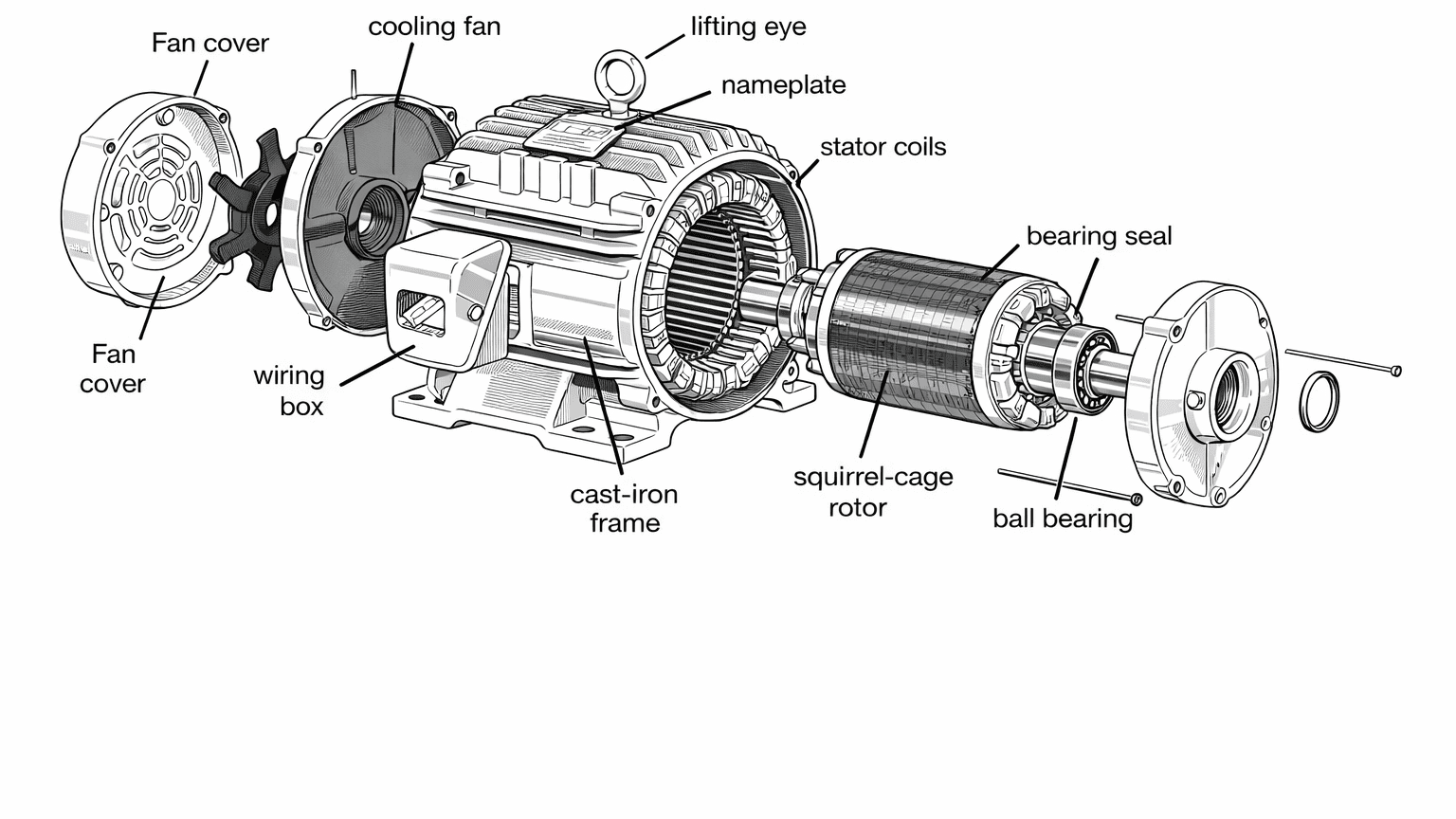
A three-phase induction motor is mainly constructed with two basic parts: the stator (stationary part) and the rotor (rotating part), separated by a small and uniform air gap.
The stator consists of a laminated silicon-steel core having slots on its inner periphery. A three-phase distributed winding is placed in these slots. When a three-phase AC supply is given to this winding, it produces a rotating magnetic field. Laminations are used to reduce eddy current losses and heating.
The rotor is placed inside the stator and is also made of laminated steel sheets mounted on a shaft. According to construction, the rotor may be of squirrel-cage type or slip-ring (wound-rotor) type. In a squirrel-cage rotor, aluminium or copper bars are placed in the rotor slots and short-circuited by end rings. In a slip-ring rotor, a three-phase insulated winding is placed in the rotor slots and its ends are connected to slip rings.
A small air gap is maintained between stator and rotor to allow free rotation and proper magnetic coupling. The rotor is supported on bearings, and a shaft is used to transmit mechanical power. A cooling fan and ventilating passages are provided to remove heat, and a terminal box is mounted on the stator frame for external electrical connections.
Types of 3-Phase Induction Motor
A three-phase induction motor is mainly classified into two types based on the rotor construction:
- Squirrel-cage induction motor
- Slip-ring (wound-rotor) induction motor
Cage (Squirrel-Cage) Rotor
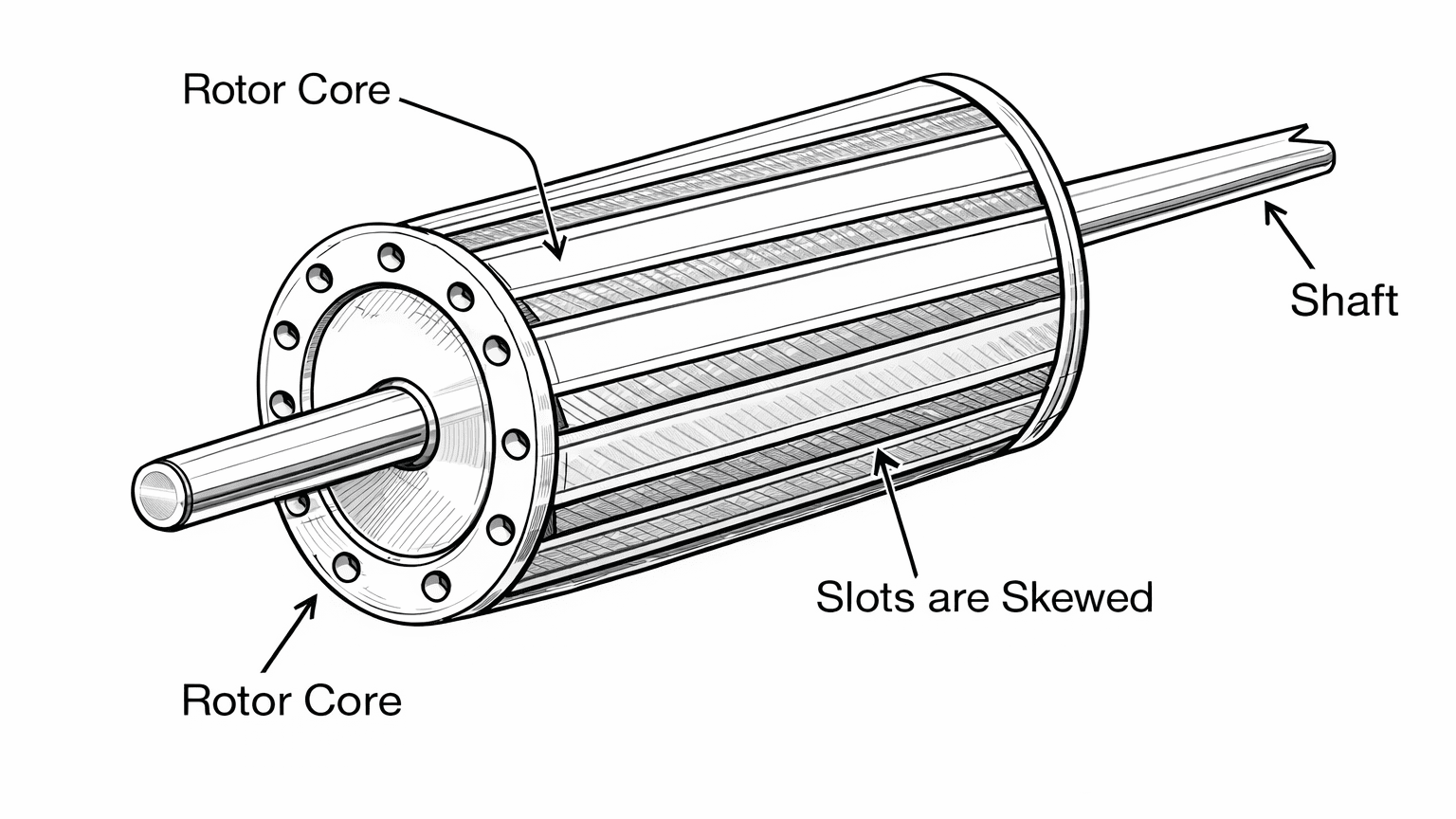
A cage rotor is made of many conducting bars placed in the slots of the rotor core.
These bars are short-circuited at both ends by end rings.
Because the bars and end rings look like a small rotating cage, this design is called a
squirrel-cage rotor (like the wheel used by a squirrel or hamster).
Important points:
- Rotor bars are shorted by end rings
- No external electrical connection to the rotor
- Construction is very simple and strong
Wound Rotor (Slip-Ring Rotor)
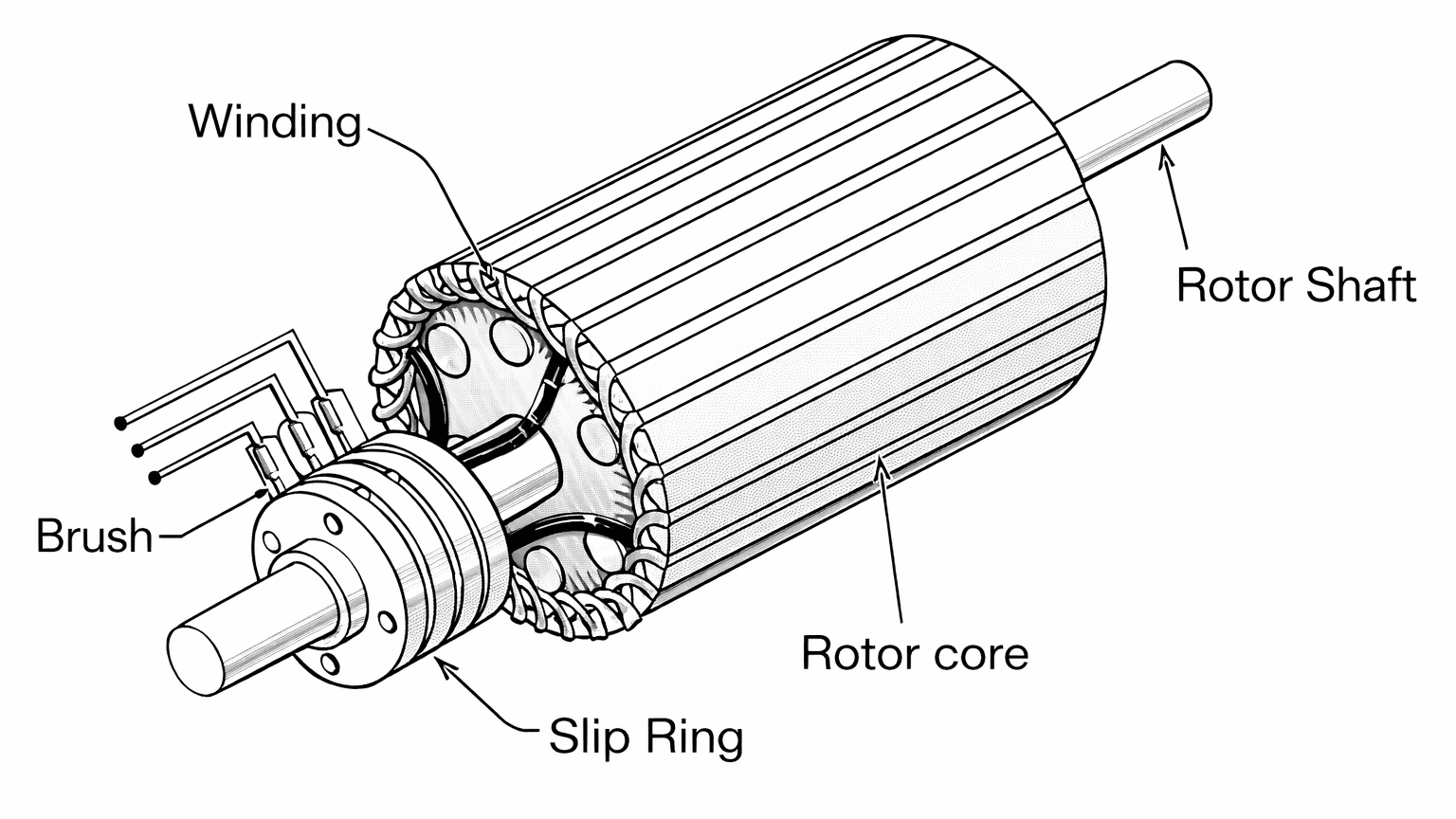
A wound rotor has a three-phase winding on the rotor, similar to the stator winding.
These rotor windings are usually star (Y) connected.
The three free ends of the rotor windings are connected to slip rings mounted on the shaft.
Brushes rest on these slip rings, and through the brushes:
- rotor current can be accessed
- external resistance can be connected in the rotor circuit
Because of this, the torque–speed characteristic of the motor can be changed, especially during starting.
Important points:
- Rotor has 3-phase winding
- Slip rings and brushes are used
- External resistance can be added to rotor circuit
Working of 3-Phase Induction Motor
When a three-phase supply is applied to the stator winding, a rotating magnetic field is produced at synchronous speed. This rotating magnetic field cuts the rotor conductors and, due to electromagnetic induction, an electromotive force is induced in the rotor. As the rotor circuit is closed, current flows in the rotor conductors.
The interaction between the stator magnetic field and the rotor current produces a force on the rotor conductors, which results in torque. Consequently, the rotor starts rotating in the same direction as the rotating magnetic field. However, the rotor never reaches synchronous speed because some relative speed is necessary to induce current in the rotor.
Comparison between Squirrel-Cage and Slip-Ring Induction Motor
| Feature | Squirrel-Cage Motor | Slip-Ring Motor |
|---|---|---|
| Rotor construction | Bars short-circuited by end rings | Three-phase rotor winding with slip rings |
| Starting torque | Low to medium | High |
| Starting current | High | Low (can be controlled) |
| External resistance | Not possible | Possible |
| Maintenance | Very low | High |
| Cost | Low | High |
| Applications | General purpose drives | Heavy starting load drives |
Comparison between Single-Phase and Three-Phase Induction Motor
| Feature | Single-Phase Induction Motor | Three-Phase Induction Motor |
|---|---|---|
| Supply | Single-phase AC | Three-phase AC |
| Starting torque | Low | High |
| Starting method | Requires auxiliary winding or capacitor | Self-starting |
| Efficiency | Lower | Higher |
| Power factor | Lower | Better |
| Size for same power | Larger | Smaller and compact |
| Applications | Domestic appliances | Industrial and commercial drives |
Advantages of 3-Phase Induction Motor
- Simple and rugged construction
- Low cost compared to other AC motors
- Requires very little maintenance
- High efficiency, especially at rated load
- Good power factor compared to single-phase motors
- Self-starting (no special starting device required)
- Long service life
- Suitable for continuous and heavy-duty operation
- Can operate in dusty and harsh industrial environments
Disadvantages of 3-Phase Induction Motor
- High starting current
- Starting torque is low in squirrel-cage motors
- Speed control is difficult without a VFD or power-electronic drive
- Power factor is poor at light load
- Slip-ring motors require more maintenance (brushes and slip rings)
- Speed is always slightly less than synchronous speed (cannot run at exact synchronous speed)
Application
- Pumps
- Fans and blowers
- Compressors
- Conveyors
- Elevators and lifts
- Cranes and hoists
- Machine tools
- Rolling mills
- HVAC and air-conditioning systems
- Textile, paper and cement industries