
Introduction
A Silicon Controlled Rectifier (SCR) is a three-terminal, four-layer semiconductor device that conducts current only after it is triggered ON. Once turned ON, it remains in the conducting state until the anode current falls below the holding current.
The process of making an SCR conduct is known as triggering or turn-ON of SCR.
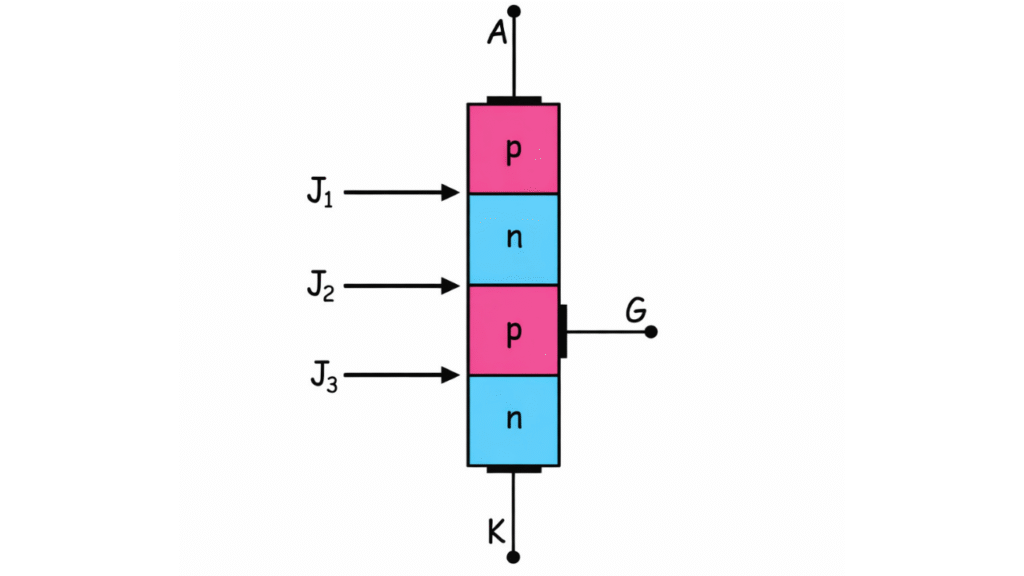
Methods of Turning ON an SCR
An SCR can be turned ON using the following methods:
- Forward Voltage Triggering
- Gate Triggering
- dv/dt Triggering
- Temperature Triggering
- Light Triggering (LASCR)
1. Forward Voltage Triggering
In forward voltage triggering, the SCR is turned ON by increasing the anode-to-cathode voltage while keeping the gate terminal open. When the applied forward voltage exceeds the forward breakover voltage VBO, the reverse-biased middle junction breaks down due to avalanche effect and the SCR starts conducting heavily. Although this method does not require any external gate signal, it is not preferred in practical circuits because it requires very high voltage and causes excessive power dissipation, which may damage the device.
2. Gate Triggering (Most Common Method)
Gate triggering is the most widely used and reliable method of turning ON an SCR. In this method, the SCR is forward biased and a small positive gate current is applied between the gate and cathode terminals. This gate current injects charge carriers into the inner layers of the SCR, initiating regenerative action and reducing the forward breakover voltage. As a result, the SCR turns ON at a much lower anode voltage. This method provides precise control over the firing angle and is extensively used in controlled rectifiers, AC voltage controllers, and inverter circuits.
3. dv/dt Triggering
dv/dt triggering occurs when the rate of rise of forward voltage across the SCR is very high. The reverse-biased junction of the SCR has inherent capacitance, and a rapidly changing voltage causes a displacement current to flow through this capacitance. If this current is sufficiently large, it can act like a gate current and turn ON the SCR even without any gate signal. This type of triggering is undesirable because it can cause false or accidental turn-ON of the SCR. To prevent dv/dt triggering, RC snubber circuits are commonly used.
4. Temperature Triggering
Temperature triggering takes place due to an increase in the junction temperature of the SCR. As temperature rises, the leakage current across the reverse-biased junction increases. When this leakage current becomes sufficiently high, it can initiate regenerative action and turn ON the SCR unintentionally. Since temperature variations are difficult to control and may lead to unstable operation, this method is not used for controlled triggering in practical power electronic circuits.
5. Light Triggering (LASCR)
In light triggering, a special type of SCR known as a Light Activated SCR (LASCR) is used. When light of sufficient intensity is allowed to fall on the junction region of the device, it generates electron-hole pairs, increasing the carrier concentration and triggering the SCR into conduction. This method provides complete electrical isolation between the control and power circuits and is mainly used in high-voltage and high-power applications where isolation and noise immunity are required.
Comparison of SCR Turn-ON Methods
| Method | External Control | Practical Use |
|---|---|---|
| Forward Voltage | No | Rare |
| Gate Triggering | Yes | Most common |
| dv/dt Triggering | No | Undesirable |
| Temperature | No | Avoided |
| Light Triggering | Yes (Optical) | Special use |
Conclusion
Among all SCR turn-ON methods, gate triggering is the most efficient, reliable, and widely used method in power electronics. Other methods either cause unwanted triggering or require special conditions.